

The delay of the world’s first global carbon pricing system for international shipping sparks criticism and concern over the maritime sector’s decarbonization goals.
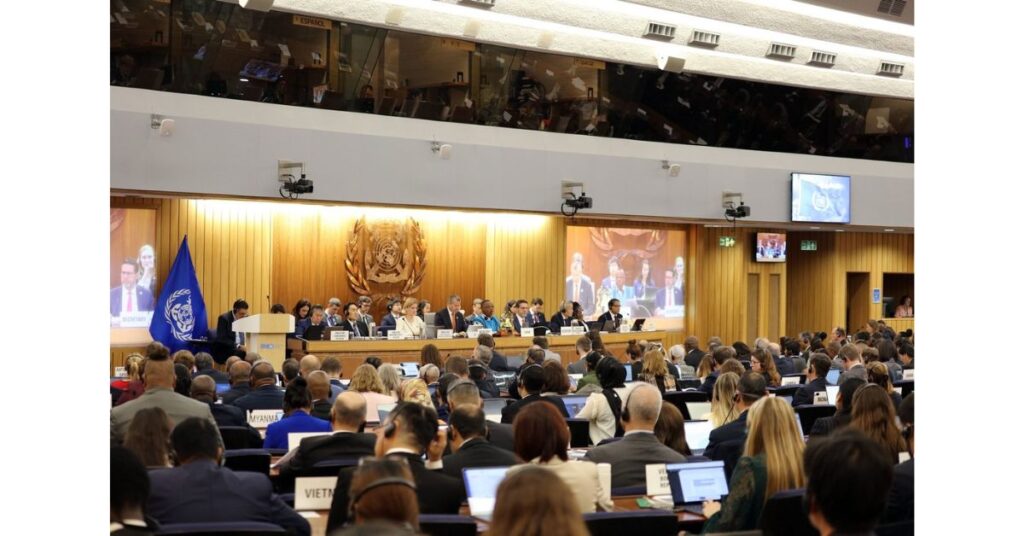
The International Maritime Organization (IMO) has postponed the adoption of its Net-Zero Framework (NZF)—a landmark initiative that would have introduced the world’s first global carbon pricing system on any international industry. The decision, taken during last week’s Marine Environment Protection Committee (MEPC ES.2) meeting in London, is being viewed as a major setback for efforts to decarbonize global shipping.
The postponement follows a procedural motion led by Singapore and called to a vote by Saudi Arabia, which effectively delayed the adoption of the framework until 2026.
Majority Support Blocked by Opposition and Procedural Challenges
A majority of IMO member states reportedly backed adopting the framework, which had been agreed in principle in April 2025 with support from 63 countries, including the EU27, Brazil, China, India, Canada, the UK, South Korea, and Japan. Only 16 oil-producing states opposed the move at the time.
However, negotiations in London were marked by what observers described as “delay tactics” and “procedural sabotage” from the United States, Saudi Arabia, Russia, and several other petroleum-producing countries. These nations sought to alter the IMO’s normal consensus-based adoption process to an “explicit” process that would add new procedural hurdles—potentially complicating participation for developing countries.
In the run-up to the meeting, the U.S. administration reportedly threatened retaliatory tariffs and sanctions against developing and climate-vulnerable nations that supported the framework. Delegates from several such countries described this as “bullying” and “undiplomatic.”
Divided Reactions Among Member States and Observers
Some delegates argued that the postponement could allow more time to build consensus. Others warned that further delays risk enabling greater political pressure from major emitters.
The Net-Zero Framework, if adopted, would require ships to pay fees for failing to meet carbon intensity targets, with revenues projected to reach up to $15 billion annually by 2030. The funds would support green fuel production, research, and assistance to developing nations.
Technical discussions will continue from October 20–24 under the IMO’s Intersessional Working Group on Greenhouse Gases (ISWG-GHG-20), focusing on the framework’s design, energy incentives, and revenue allocation. The framework’s original entry into force—scheduled for March 2027—will now be reviewed.
Climate-Vulnerable Nations Express Disappointment
Ralph Regenvanu, Minister for Climate Change for Vanuatu, said:
“We came to London in reluctant support of the IMO’s Net-Zero Framework. While it lacks the ambition that climate science demands, it does mark a significant step. We regret that IMO members followed Singapore’s initial proposal to delay the adoption of the framework by 12 months, which Saudi Arabia called to a vote. This is unacceptable given the urgency we face in light of accelerating climate change.”
He added that the IMO’s inaction represented “a failure of this United Nations agency to act decisively on climate change.”
Emma Fenton, Senior Diplomacy Director at Opportunity Green, described the outcome as “a devastating indictment of Member States’ lack of courage.”
“Too many governments chose political compromise over climate justice, abandoning the countries bearing the brunt of the climate crisis,” she said.
Alisa Kreynes, Director for Ports & Shipping at C40, called the outcome “a missed opportunity to accelerate a just and equitable transition in global shipping,” warning that “Small Island States and the Global South will continue to pay the biggest price for this inaction.”
Teresa Bui, Senior Climate Campaign Director at Pacific Environment, added:
“Delaying the vote on the IMO’s Net-Zero Framework is frustrating and a betrayal of the world’s most vulnerable nations. We urge IMO member states to adopt the Framework as soon as possible. The world is watching.”
Industry and NGO Voices: Setback, but Not the End
Natacha Stamatiou, IMO GHG Lead for Global Shipping at the Environmental Defense Fund, said:
“Today’s delay in adopting the Net-Zero Framework is a missed opportunity — and a setback that risks derailing the timeline countries agreed to under the IMO’s 2023 Strategy. Every delay means innovation will struggle to scale, inequities will deepen, and the transition to clean shipping will become harder and more costly.”
Anaïs Rios, Shipping Policy Officer at Seas At Risk, noted:
“Getting the Net-Zero Framework adopted in this MEPC ES.2, however imperfect, was fundamental for shipping to stay within reach of its own decarbonization targets. This isn’t the United States of Shipping — no single flag should dictate the world’s climate course.”
Industry groups also expressed disappointment.
Sotiris Raptis, Secretary General of the European Community Shipowners’ Associations (ECSA), said:
“We regret today’s postponement. The IMO Net-Zero Framework is essential to give the industry the certainty it needs and to send a strong signal to the market to produce the clean fuels necessary to get to net zero.”
Jesse Fahnestock, Director of Decarbonisation at the Global Maritime Forum, added:
“The adjournment creates serious challenges for meeting the timelines in the framework agreed in April. We encourage Member States to reaffirm their commitment and continue developing the guidelines necessary to deliver on the IMO’s Greenhouse Gas Strategy.”
What the Delay Means
The postponement of the NZF underscores persistent geopolitical divides over how—and how quickly—the global shipping industry should decarbonize. The framework’s delay also raises questions about the feasibility of meeting the IMO’s target to reach net-zero GHG emissions “by or around 2050.” Analysts note that without a carbon pricing mechanism, the sector risks losing momentum in scaling green fuels, low-emission technologies, and investment confidence across the maritime value chain.
Recent Posts
Ammonia
Reliance Industries Limited (RIL) has signed a binding long-term supply and purchase agreement (SPA) with Samsung C&T Corporation for the export of green ammonia over a 15-year period.
Bunkering
Ofiniti Raises $6.8 Million to Scale Digital Bunkering Platform for Global Shipping
Hydrogen
Hefring Marine and Ecomar Propulsion partner to deploy monitoring system on hydrogen-electric vessel