

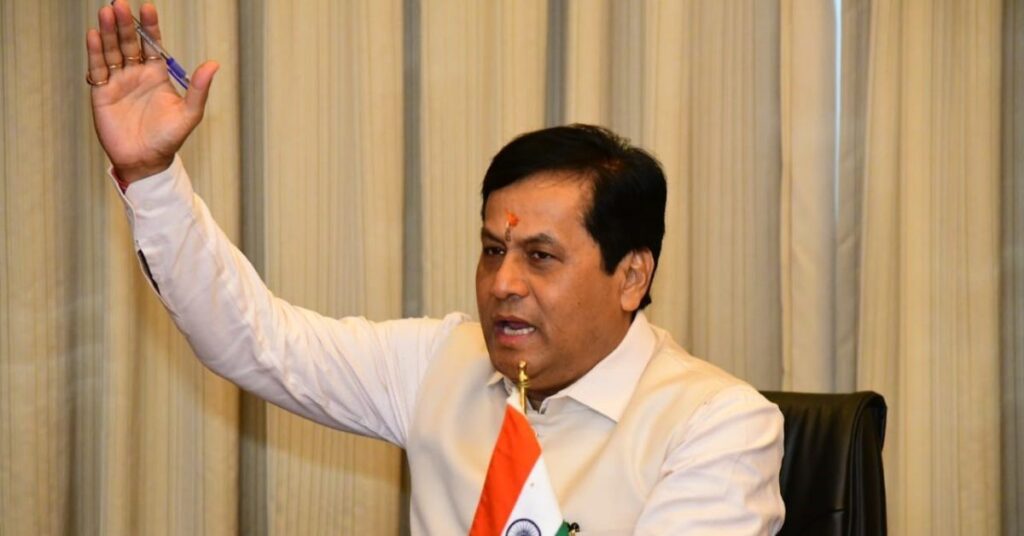
India’s maritime sector is expected to attract investments worth about ₹80 lakh crore, generate over 1.5 crore jobs, and advance the adoption of green shipping practices in the coming years, according to Union Minister for Ports, Shipping and Waterways Sarbananda Sonowal.
“India’s maritime growth story is about prosperity, sustainability, and pride in our heritage. Under the Maritime Amrit Kaal Vision, the blue economy aims to secure investments of ₹80 lakh crore and create 1.5 crore jobs,” Sonowal said in an official statement. He described the country as being on course to emerge as a global maritime power.
Green shipping has been identified as a core priority in the sector’s development. The government has emphasised decarbonisation measures, alongside efforts to strengthen supply chain resilience, improve cybersecurity, and modernise logistics.
The Sagarmala programme remains central to the government’s maritime strategy, with 840 projects worth ₹5.8 lakh crore targeted for completion by 2035. Of these, 272 projects valued at ₹1.41 lakh crore have already been delivered. Among upcoming projects, the planned ₹76,000-crore Vadhavan Port in Maharashtra is expected to become one of the world’s largest container hubs and create about 12 lakh jobs.
India’s port efficiency has also seen measurable improvement. Average turnaround time at major ports has reduced to 0.9 days, placing India ahead of several global benchmarks. Currently, nine Indian ports are ranked among the world’s top 100.
Sonowal pointed to Kerala’s role in India’s maritime development, highlighting expansion plans for Cochin Port and the Vallarpadam transhipment terminal. Under Sagarmala, 54 projects worth ₹24,000 crore are underway in the state, with 20 already completed. These include modernised fishing harbours in Kochi, Kannur, and Thrissur.
Looking ahead to India Maritime Week 2025, scheduled for October in Mumbai, the minister said the government expects stronger global partnerships and fresh inflows of capital. “We must focus on decarbonisation, supply chain resilience, cybersecurity, and sustainable shipping as key priorities for the sector’s growth,” he noted.
Recent Posts
Ammonia
Reliance Industries Limited (RIL) has signed a binding long-term supply and purchase agreement (SPA) with Samsung C&T Corporation for the export of green ammonia over a 15-year period.
Bunkering
Ofiniti Raises $6.8 Million to Scale Digital Bunkering Platform for Global Shipping
Hydrogen
Hefring Marine and Ecomar Propulsion partner to deploy monitoring system on hydrogen-electric vessel