

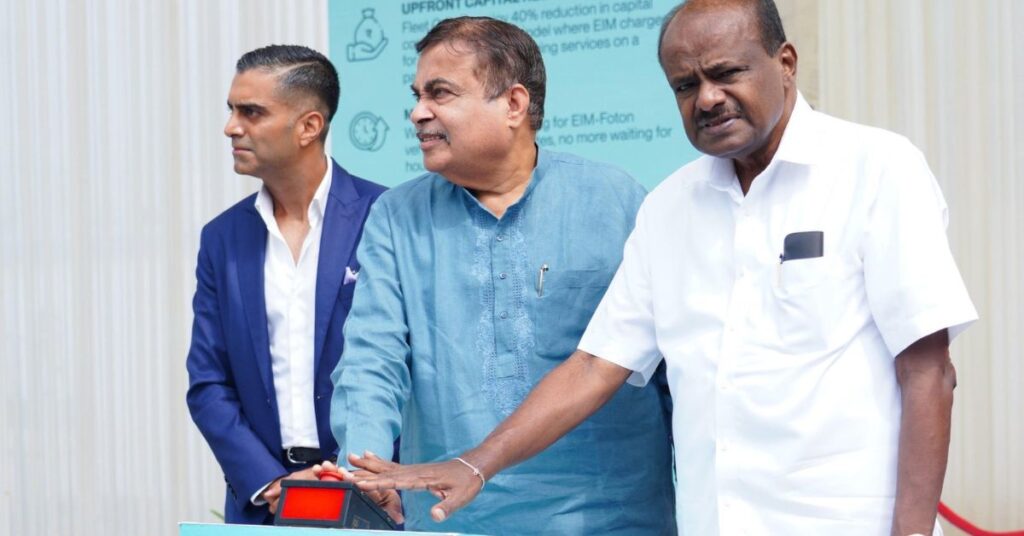
Union Minister for Road Transport and Highways Nitin Gadkari inaugurated India’s first commercial electric truck battery swapping and charging station at the Delhi International Cargo Terminal Private Limited (DICT) in Panchi Gujran village, located along the GT Road near Ganaur in Sonipat.
The new facility marks a significant step toward electrifying India’s freight transport network, offering logistics operators an alternative to diesel-powered trucks while supporting the government’s clean mobility goals.
Minister Highlights Role of Biofuels and Agricultural Waste in Energy Transition
Speaking at the event, Gadkari emphasized the potential of agricultural residues such as stubble to serve as a raw material for biofuel production. He urged farmers to adopt alternative uses for crop stubble instead of burning it, noting that such practices could enhance rural incomes and reduce air pollution.
“The day is not far when India will be number one in producing aviation fuel. Farmers will now be the fuel providers, as work is underway to make fuel from stubble,” said Gadkari.
He added that approximately 5 million tonnes of stubble are already being used to produce bio-bitumen, which is now being deployed in road construction projects in Nagpur and Jabalpur.
Ethanol and Flex-Fuel Engines Driving Change
Highlighting India’s ethanol initiatives, the minister said that ethanol production from corn has expanded agricultural markets and strengthened the rural economy.
“Companies are working on developing flexi-engines. Agricultural machinery will also be equipped with flex engines. With all these efforts, we have succeeded in curbing pollution due to stubble burning,” Gadkari said.
Lower Logistics Costs and Sustainable Infrastructure
Gadkari also underlined the importance of alternative fuels in reducing India’s logistics costs, which he noted are double that of China. He said that new highways and expressways have contributed to cutting logistics costs by around 6%, while also improving fuel efficiency.
“To reduce logistics costs and benefit farmers, we have to work on biofuels and other alternative fuels,” he said, adding that several high-value infrastructure projects worth “several lakh crore” rupees have been completed in Delhi alone.
He noted that innovative construction methods — such as using waste and garbage in road construction — are contributing to sustainable infrastructure development.
EV Adoption and the Future of Clean Transport
During the inauguration, Gadkari highlighted the rapid decline in battery prices and the economic potential of electric freight vehicles.
“EV vehicles will run without pollution and the trucks inaugurated today will travel at a lower rate than railways. The price of batteries has decreased by 50 to 60 percent. The day is not far when we will be free from diesel,” he stated.
The minister added that technological advancements in electric mobility and biofuels would soon enable India to produce its own marine fuels.
“Now the day is not far when our country will produce fuel for ships. Transporters should move away from diesel and petrol so that their expenses are less than other transporters,” Gadkari said.
Recent Posts
Ammonia
Reliance Industries Limited (RIL) has signed a binding long-term supply and purchase agreement (SPA) with Samsung C&T Corporation for the export of green ammonia over a 15-year period.
Bunkering
Ofiniti Raises $6.8 Million to Scale Digital Bunkering Platform for Global Shipping
Hydrogen
Hefring Marine and Ecomar Propulsion partner to deploy monitoring system on hydrogen-electric vessel