

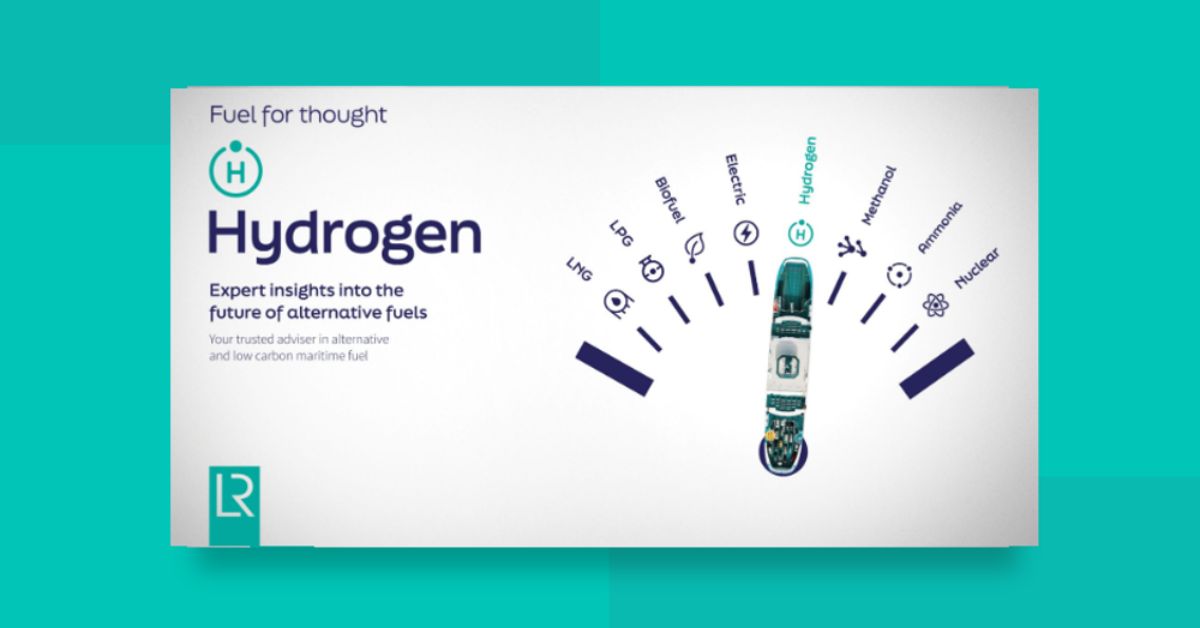
Lloyd’s Register (LR) has released the latest edition of its Fuel for thought series, offering a detailed assessment of hydrogen’s potential role in reducing greenhouse gas emissions in shipping, alongside the technical, safety and economic barriers that continue to limit large-scale adoption.
The report, Fuel for thought: Hydrogen, examines the fuel’s pathway from production and supply through to onboard use. It highlights hydrogen’s potential to deliver zero tank-to-wake emissions when used in fuel cells and its role as a feedstock for e-fuels such as ammonia and methanol. At the same time, it underscores challenges linked to hydrogen’s low volumetric energy density, the requirement for cryogenic storage at –253°C, and elevated safety risks.
Limited uptake despite growing interest
According to the report, hydrogen-capable vessels account for less than 0.5% of the global ship orderbook, despite rising interest as regulatory pressure increases. Shipowners are facing tighter emissions controls under the EU Emissions Trading System, FuelEU Maritime and the International Maritime Organization’s net-zero ambition for 2050.
Hydrogen could benefit from FuelEU Maritime’s two-times compliance multiplier for renewable fuels of non-biological origin until 2033, which may improve its competitiveness as production volumes increase.
Infrastructure and supply constraints
The assessment identifies infrastructure as a critical bottleneck. Despite pilot bunkering projects, low-emissions hydrogen—including green hydrogen, hydrogen derived from biomass, and hydrogen produced from fossil fuels with carbon capture and permanent storage—represented less than 1% of global hydrogen production in 2025, based on figures from the International Energy Agency.
Substantial investment will be required across production, transport and bunkering before hydrogen can support broader maritime demand. The report also notes that shipping will need to compete with other sectors for green hydrogen supply, reinforcing the importance of certification schemes and transparent lifecycle emissions accounting.
Safety and regulatory framework
Safety considerations are a central focus of the analysis. Hydrogen’s wide flammability range, low ignition energy and susceptibility to material embrittlement necessitate rigorous design standards and specialised crew training.
LR points to its hydrogen requirements, outlined in Appendix LR3 of the Rules for Ships Using Gases or Other Low-Flashpoint Fuels, as a framework to manage these risks. The rules are supported by guidance covering fuel cells, composite cylinders, liquid hydrogen systems and bunkering arrangements.
Near-term applications and design strategies
While large ocean-going vessels face significant hurdles, the report identifies near-term opportunities for hydrogen use in short-sea shipping, including ferries, tugs and coastal vessels. These segments benefit from regular bunkering cycles, reducing onboard storage constraints.
Fuel cell technologies are highlighted as particularly suited to these applications, supported by improving cost trends and advances in durability. Hydrogen-ready designs and hybrid fuel strategies are also identified as options for shipowners seeking to future-proof newbuildings.
Industry perspectives
Padmini Mellacheruvu, LR’s Lead Technical Specialist in Cryogenic and Compressed Fuel Systems, said:
“Hydrogen has an important role to play in the maritime energy transition, but the pathway to scale is complex. Progress will depend on early investment, careful planning and a clear focus on safety.
Our latest Fuel for Thought report brings clarity to both the potential of hydrogen and the substantial work still required to enable its safe, scalable and commercially viable use.”
The report includes a foreword by Dr Maximilian Kuhn, advisor and ISO TC 197 liaison to the IMO and advisor to Hydrogen Europe, who said:
“At Hydrogen Europe, we believe that hydrogen is more than just a fuel; it is one of the main drivers of systemic change.
Its versatility, scalability and compatibility with renewable energy sources put it in a unique position to address the complex challenges of maritime decarbonisation. Yet the path forward is not without obstacles: Infrastructure, regulation, safety and cost remain critical hurdles.
This report does not shy away from these realities. Instead, it provides a clear-eyed assessment of the current landscape while charting a course for innovation, investment and international collaboration.”
Recent Posts
Ammonia
Reliance Industries Limited (RIL) has signed a binding long-term supply and purchase agreement (SPA) with Samsung C&T Corporation for the export of green ammonia over a 15-year period.
Bunkering
Ofiniti Raises $6.8 Million to Scale Digital Bunkering Platform for Global Shipping
Hydrogen
Hefring Marine and Ecomar Propulsion partner to deploy monitoring system on hydrogen-electric vessel