

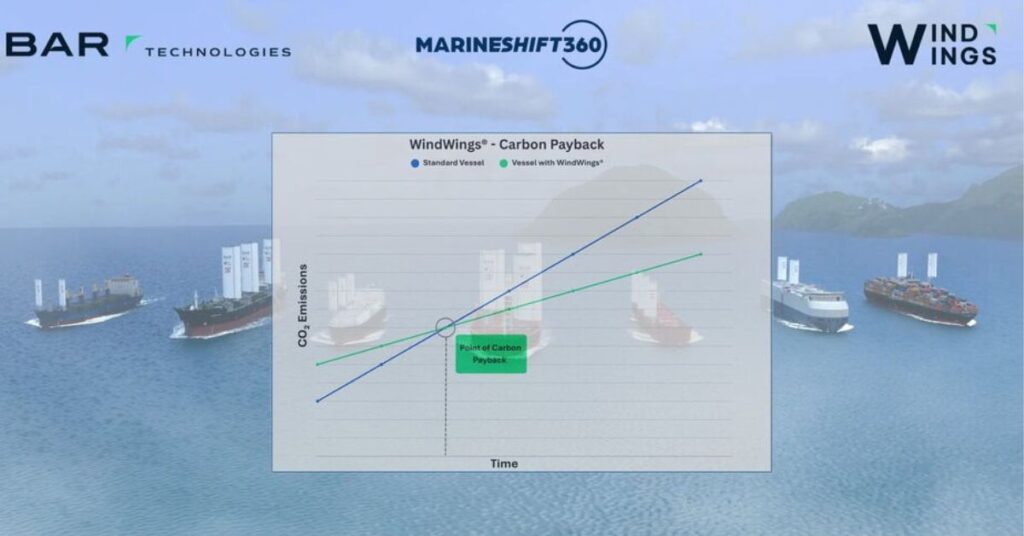
MarineShift360 has released findings from its Impact Accelerator programme, including a full lifecycle assessment (LCA) of BAR Technologies’ WindWings® wind-assisted propulsion system. The study reports that the technology achieves a carbon payback period of less than six months, providing new data on lifecycle impacts for maritime decarbonisation technologies.
Key points
- MarineShift360 Impact Accelerator programme delivers lifecycle results for WindWings®
- WindWings® achieves carbon payback in under six months
- Average fuel savings of 1.5 tonnes per wing per day and 4.7 tonnes of CO₂ reductions daily
- LCA performed in accordance with ISO 14044
- Findings influence material procurement, engineering design and supply-chain decisions
Lifecycle assessment highlights
The LCA was conducted as part of BAR Technologies’ participation in MarineShift360’s ten-month Impact Accelerator, which applies lifecycle methodologies to improve sustainability performance across marine products and supply chains.
According to MarineShift360, the analysis shows that fuel and emissions reductions delivered by WindWings® offset the embedded emissions generated during manufacturing in less than half a year of vessel operation. The organisation says the results provide a data-driven basis for evaluating the environmental return on investment of wind-assisted propulsion technologies.
“This is a landmark moment for commercial wind propulsion,” said John Cooper, CEO of BAR Technologies. “To demonstrate a sub-six-month carbon payback shows that WindWings® is not only delivering immediate environmental benefit but is a commercially ready solution that meets the industry’s urgent decarbonisation needs.”
“Seeing the payback come out in months has validated our design approach,” added Will Hopes, Simulation and Performance Engineer at BAR Technologies. “WindWings® are designed to decarbonise shipping as quickly as possible, and the study shows that this is what they are doing. LCA is a core part of every design review, not a separate consideration.”
Material impacts and supply-chain decisions
The LCA identified metalwork as the largest contributor to embedded emissions, accounting for 44% of the total. As a result, BAR Technologies has adjusted procurement strategies, shifting towards recycled-content DH32 steel manufactured through Electric Arc Furnace (EAF) processes. The findings have also informed updates to tooling utilisation and composite layup approaches.
“This wasn’t just a validation exercise,” Cooper said. “It enhanced engineering reviews, procurement decisions, and customer conversations. We have embedded carbon literacy across every function, because sustainable performance must be measurable, verifiable, and repeatable.”
According to MarineShift360, the assessment process helped reinforce the company’s design principles not only for WindWings® but also for future technologies, positioning carbon payback alongside operational and financial performance metrics.
“These results show what is possible when organisations commit to fully understanding their impact,” said Ollie Taylor, Director of Marine Futures. “LCA gives leaders the data to make better decisions and the confidence to scale those decisions across fleets, supply chains and product lines. As a first year, these results are incredibly encouraging and show what the Impact Accelerator was created to do, which is to catalyse change across our industry.”
Sector implications
MarineShift360 says the findings provide evidence that lifecycle-verified emissions reductions are achievable with current wind-assisted propulsion technologies. The organisation is encouraging maritime innovators and shipowners to participate in the next phase of the Impact Accelerator to support wider adoption of lifecycle analysis across the shipping sector.
Recent Posts
Ammonia
Reliance Industries Limited (RIL) has signed a binding long-term supply and purchase agreement (SPA) with Samsung C&T Corporation for the export of green ammonia over a 15-year period.
Bunkering
Ofiniti Raises $6.8 Million to Scale Digital Bunkering Platform for Global Shipping
Hydrogen
Hefring Marine and Ecomar Propulsion partner to deploy monitoring system on hydrogen-electric vessel