
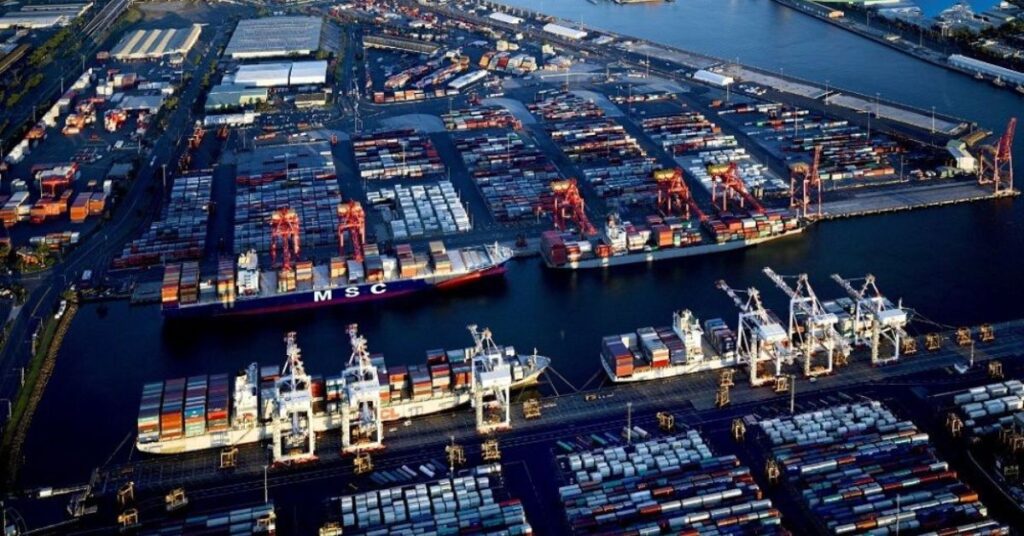
The Port of Melbourne and the Shanghai Municipal Transportation Commission (SMTC) have signed a memorandum of understanding (MoU) to advance maritime decarbonization and sustainable port operations. The agreement marks a new chapter in a partnership that began in 2006, formalizing nearly two decades of collaboration between the two ports.
The joint initiative, supported by the C40 Cities Climate Leadership Group (C40), aligns with the goals of the Clydebank Declaration and aims to accelerate the decarbonization of the maritime supply chain between Australia and China.
Under the MoU, the ports will work with a network of industry stakeholders — including Shanghai International Port Group (SIPG), COSCO SHIPPING Lines, HAMR Energy, and ABEL Energy — to explore strategies for reducing the environmental impact of maritime transport.
Key focus areas of the agreement include:
- Collaboration with industry partners to implement practical measures that lower the carbon footprint of shipping operations.
- Promotion of sustainable practices, such as adopting cleaner technologies, integrating renewable energy sources, and improving operational efficiency.
- Facilitation of clean-fuel adoption, by engaging with shipping lines operating between Shanghai and Melbourne to increase the use of low- and zero-emission vessels.
- Engagement with energy suppliers to enhance production technology, efficiency, and cost-effectiveness while developing integrated supply chain systems for low-carbon fuel production, storage, and distribution.
According to the Port of Melbourne, China remains its largest trading partner, accounting for half of total container imports and one-fifth of exports. Given the scale of trade between the two ports, the collaboration is expected to create meaningful opportunities to reduce emissions across shipping operations.
Saul Cannon, Chief Executive Officer of the Port of Melbourne, said:
“This MoU is a significant development in our work towards decarbonising the supply chain. Given Australia’s position as an island-nation that heavily relies on sea freight, we have a key role in global efforts to decarbonise shipping.
“As Australia’s largest container port working together with the world’s largest container port, we are well-placed to lead by example towards a greener future for our industry. We look forward to working with our industry partners to progress this initiative.”
The partnership is part of a broader international movement toward sustainable maritime operations, as ports worldwide seek to reduce emissions and align with global climate goals.
Recent Posts
Ammonia
Reliance Industries Limited (RIL) has signed a binding long-term supply and purchase agreement (SPA) with Samsung C&T Corporation for the export of green ammonia over a 15-year period.
Bunkering
Ofiniti Raises $6.8 Million to Scale Digital Bunkering Platform for Global Shipping
Hydrogen
Hefring Marine and Ecomar Propulsion partner to deploy monitoring system on hydrogen-electric vessel