

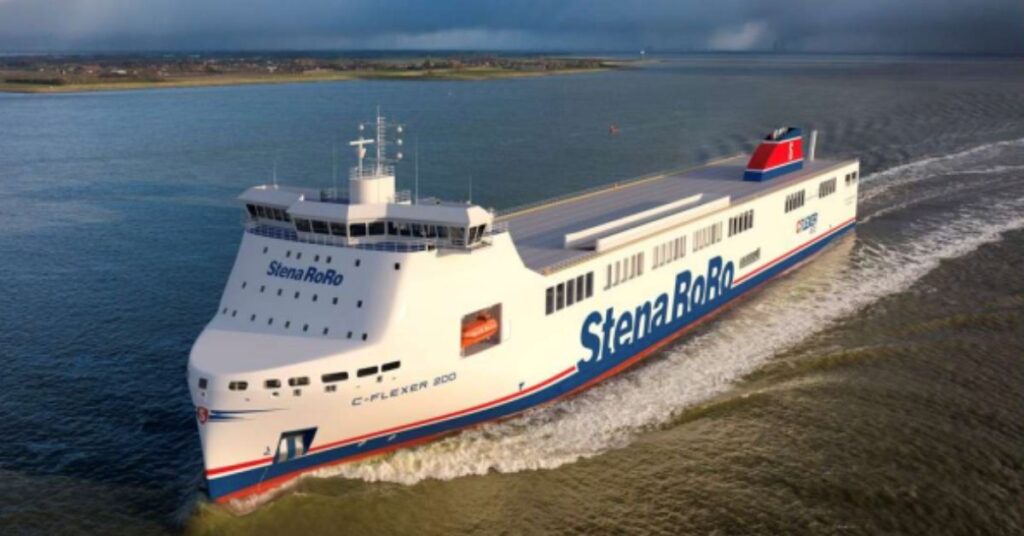
Swedish shipowner invests in future-ready design featuring hybrid propulsion and engines compatible with alternative fuels.
Swedish shipping company Stena RoRo has announced plans to expand its fleet with a new generation of battery-hybrid roll-on/roll-off (RoRo) vessels, designed to accommodate future fuel technologies and improve operational efficiency.
The company confirmed it has signed a Letter of Intent (LoI) with China Merchants Industry Weihai for the construction of up to six vessels — two firm orders with options for an additional four. The ships will have a capacity of 3,000 to 4,700 lane meters, making them suitable for high-capacity cargo transport across regional and intercontinental routes.
Strategic Expansion into a Growing Segment
“This LOI is a strategic investment for Stena RoRo in a segment which for a long time has been underinvested,” the company said in a statement.
The decision marks a continuation of Stena RoRo’s strategy to strengthen its position in sustainable ship design and RoRo transport solutions.
Introducing the C-Flexer Design
The new class, dubbed the C-Flexer, builds upon Stena RoRo’s previous E-Flexer and NewMax concepts. The vessels will feature a highly efficient hull form, engines prepared for future low- or zero-emission fuels, and an expandable battery-hybrid system designed to integrate larger energy storage as technology advances.
“These ships will be built for today and designed for tomorrow,” said Per Westling, CEO of Stena RoRo AB.
According to initial specifications, the C-Flexer vessels will measure 200 meters in length, with a beam of 28 or 31 meters, and reach speeds of up to 21 knots.
Future-Focused and Flexible
The C-Flexer concept aims to combine energy efficiency, operational flexibility, and fuel adaptability to meet evolving global regulatory and environmental standards. The design’s modular hybrid system allows for future upgrades as battery technology and alternative fuel infrastructure continue to mature.
By integrating hybrid propulsion and readiness for next-generation fuels such as methanol, ammonia, or hydrogen, Stena RoRo positions the new fleet as part of the maritime industry’s shift toward decarbonization and compliance with IMO 2030 and 2050 targets.
Recent Posts
Ammonia
Reliance Industries Limited (RIL) has signed a binding long-term supply and purchase agreement (SPA) with Samsung C&T Corporation for the export of green ammonia over a 15-year period.
Bunkering
Ofiniti Raises $6.8 Million to Scale Digital Bunkering Platform for Global Shipping
Hydrogen
Hefring Marine and Ecomar Propulsion partner to deploy monitoring system on hydrogen-electric vessel