

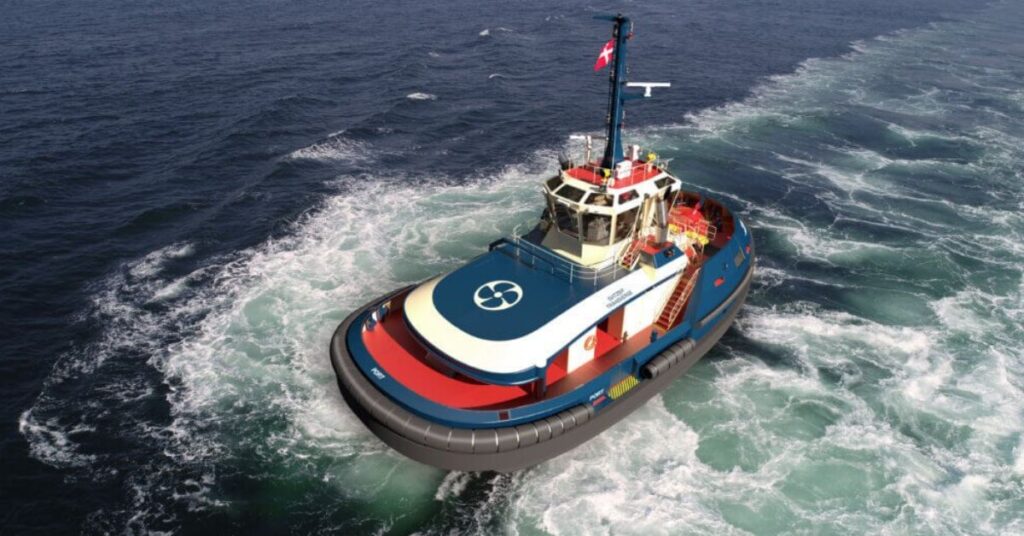
Svitzer, a global towage operator, has signed a shipbuilding agreement with Cochin Shipyard Limited (CSL) for the construction of four 26-metre electric TRAnsverse 2600e tugs in India. The contract formalises a Letter of Intent announced during India Maritime Week in October 2025.
Four Electric Tugs Confirmed, With Option for Additional Builds
Under the new agreement, CSL will construct at least four battery-electric TRAnsverse 2600e tugs for deployment in Svitzer’s international fleet. The contract includes an option for up to four additional vessels as part of the company’s wider fleet renewal programme. The tugs will be built at CSL’s facilities in Cochin to Svitzer’s specifications.
The TRAnsverse platform is Svitzer’s next-generation tug design and has been central to the company’s global newbuilding strategy. The deal is also expected to create pathways for the vessels to be deployed in Indian ports and terminals as demand for low-emission harbour assets grows.
Alignment With National Maritime Manufacturing Goals
The collaboration aims to support India’s ambitions to strengthen domestic shipbuilding under Maritime India Vision 2030, Maritime Amrit Kaal Vision 2047, and the Make in India initiative. The partnership combines Svitzer’s experience in sustainable towage technologies with CSL’s local shipbuilding capabilities and workforce.
Electric TRAnsverse Tug Design
The TRAnsverse 2600e is the battery-electric variant of the company’s next-generation tug class designed for complex manoeuvring scenarios and close-quarters harbour operations. The vessels are expected to deliver zero direct emissions during port operations when charged using renewable electricity.
The design features a patented staple arrangement, double-ended hull, and in-line propulsion system capable of delivering omni-directional thrust. According to Svitzer, this configuration expands the towage operating envelope by up to 50%.
Executive Statements
Kasper Karlsen, Chief Operating Officer at Svitzer, said:
“This contract with Cochin Shipyard for our next series of electric TRAnsverse tugs reflects our commitment to Make in India and to support port and terminal operations in their green transition and decarbonisation objectives.
“India has strong shipbuilding capabilities and a highly skilled workforce. Through this collaboration with CSL, we are not only investing in a series of advanced tugs for our own operations – we are also helping to build capacity for world-class, low- and zero-emission tug construction in India – signalling our trust in India’s existing capability and maritime vision.
“We welcome the opportunity to work closely with the CSL team to deliver these vessels and, in doing so, to support the goals of Maritime India Vision 2030 and Maritime Amrit Kaal Vision 2047 in a very practical way.”
Dr Harikrishnan S, Operations Director at Cochin Shipyard Limited, said:
“We look forward to delivering the next generation of tug, the TRAnsverse 2600e, drawing on CSL’s skilled workforce and our track record in complex, high-spec vessels. This agreement represents a natural expansion of our capabilities into advanced tug design and the industrialisation of battery-electric and future-fuel-ready technologies in India.
“The programme will deepen our expertise in electric propulsion, high-precision manoeuvring systems and integrated digital solutions for ports and terminals, while creating opportunities for our engineers, designers and local supply chain.
“As a Government of India company, we remain committed to Make in India and to the decarbonisation of maritime transport. Together with Svitzer, our goal is to deliver a world-class asset with significant decarbonisation credentials for ports in India and around the world.”
Construction Timeline
Construction of the first four vessels is expected to begin in the coming months. The initial delivery is targeted for late 2027 or early 2028, subject to detailed design work, regulatory approvals, and yard scheduling. Additional vessels may be ordered based on fleet strategy and customer requirements.
Recent Posts
Ammonia
Reliance Industries Limited (RIL) has signed a binding long-term supply and purchase agreement (SPA) with Samsung C&T Corporation for the export of green ammonia over a 15-year period.
Bunkering
Ofiniti Raises $6.8 Million to Scale Digital Bunkering Platform for Global Shipping
Hydrogen
Hefring Marine and Ecomar Propulsion partner to deploy monitoring system on hydrogen-electric vessel