

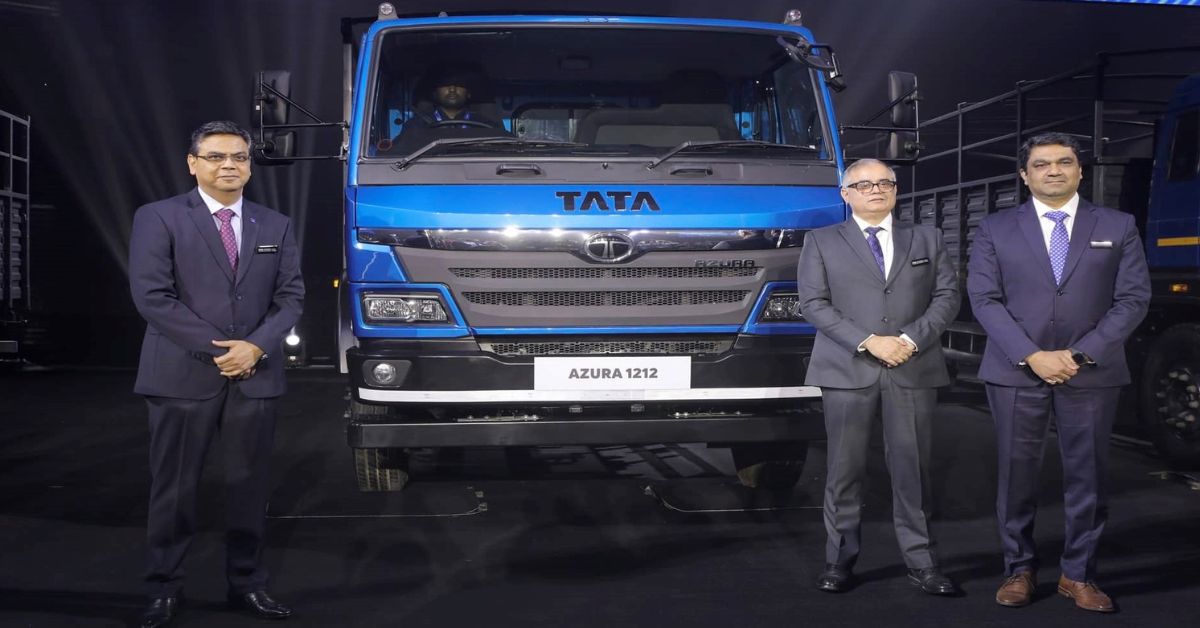
India’s commercial vehicle manufacturer Tata Motors has launched 17 new truck models across internal combustion engine (ICE) and electric platforms, marking one of its most extensive portfolio updates in recent years. The refreshed lineup spans gross vehicle weights from 7 to 55 tonnes and targets applications ranging from urban distribution to long-haul freight, mining and construction.
The rollout includes the all-new Azura series, upgrades to the Prima, Signa and Ultra platforms, and the introduction of the Tata Trucks.ev brand built on the company’s new I-MOEV electric vehicle architecture. The electric portfolio comprises Ultra EV light trucks, the Prima E.55S electric prime mover and the Prima E.28K electric tipper.
Safety, efficiency and platform upgrades
All newly launched trucks feature upgraded cabins designed to meet ECE R29-03 European crash safety norms, covering frontal, rollover and side-impact protection. Tata Motors said the vehicles also incorporate up to 23 India-specific active safety features, including adaptive cruise control and lane departure warning systems.
“India’s trucking landscape is undergoing a rapid transformation, driven by progressive national policies, modern infrastructure, and the rising demand for safer, cleaner, and more efficient logistics,” said Girish Wagh, Executive Director and head of Tata Motors’ commercial vehicle business.
He added:
“Designed to meet stringent global ECE R29-03 (Euro crash norms) safety norms, the new trucks are built to improve earnings, lower ownership costs and boost uptime, helping fleet operators achieve better operational efficiency and stronger returns from their vehicles.”
The Azura range is powered by a newly developed 3.6-litre diesel engine and is available in 7- to 19-tonne configurations. Tata Motors said the range is aimed at e-commerce, FMCG distribution, construction materials, agricultural transport and medium-haul logistics. The company claims the upgraded platforms enable payload increases of up to 1.8 tonnes and fuel efficiency improvements of up to 7%.
Electric trucks from 7 to 55 tonnes
With the launch of Tata Trucks.ev, the company’s electric truck portfolio now covers the full 7–55 tonne range. The Ultra EV series is positioned for urban and regional operations, while the Prima E.55S and Prima E.28K are intended for heavy-duty haulage, mining and construction applications.
According to Tata Motors, the electric trucks are designed primarily for use cases with predictable routes and charging access, such as ports, mines, city logistics hubs and industrial corridors.
Technology-agnostic decarbonisation pathway
Alongside the product launch, Tata Motors reiterated its technology-agnostic approach to decarbonisation, keeping multiple fuel pathways in play, including CNG, LNG, electric, hydrogen and biofuels.
“For decarbonization in Europe, they have decided that the future is going to be technology agnostic. They may also approve biofuels. So, I think that is what we are also getting geared up for,” Wagh said.
In the near term, the company sees compressed natural gas (CNG) as a key option for reducing emissions in high-utilisation and long-haul operations. Electric vehicles are viewed as suitable for closed-loop operations, while LNG is positioned for long-haul trucking, subject to improvements in infrastructure and fuel availability.
“We continue to run LNG trucks, but there are two key challenges. One is infrastructure reach, and the other is fuel pressure at filling stations, which affects the amount of LNG that can be loaded and, in turn, reduces real-world driving range,” Wagh said.
Hydrogen, meanwhile, is being assessed as a long-term zero-emission solution. Tata Motors is conducting trials of hydrogen-powered trucks in partnership with Indian Oil, focusing on fuel cost thresholds, supply reliability and technical challenges such as hydrogen embrittlement.
Global expansion context
The product expansion comes as Tata Motors prepares to scale its global commercial vehicle operations following its agreement to acquire full control of Italy-based Iveco’s commercial vehicle business. The deal, announced in July 2025 for around Rs 38,000 crore, is expected to close in April–May 2026, subject to regulatory approvals.
“With Iveco, once we get in, we will be number four globally in volumes,” Wagh said, noting that the gap with the third-ranked global truck maker is relatively narrow. Tata Motors expects the combined geographic footprint to help manage demand cycles across regions and strengthen its position in the global truck market.
Recent Posts
Ammonia
Reliance Industries Limited (RIL) has signed a binding long-term supply and purchase agreement (SPA) with Samsung C&T Corporation for the export of green ammonia over a 15-year period.
Bunkering
Ofiniti Raises $6.8 Million to Scale Digital Bunkering Platform for Global Shipping
Hydrogen
Hefring Marine and Ecomar Propulsion partner to deploy monitoring system on hydrogen-electric vessel