
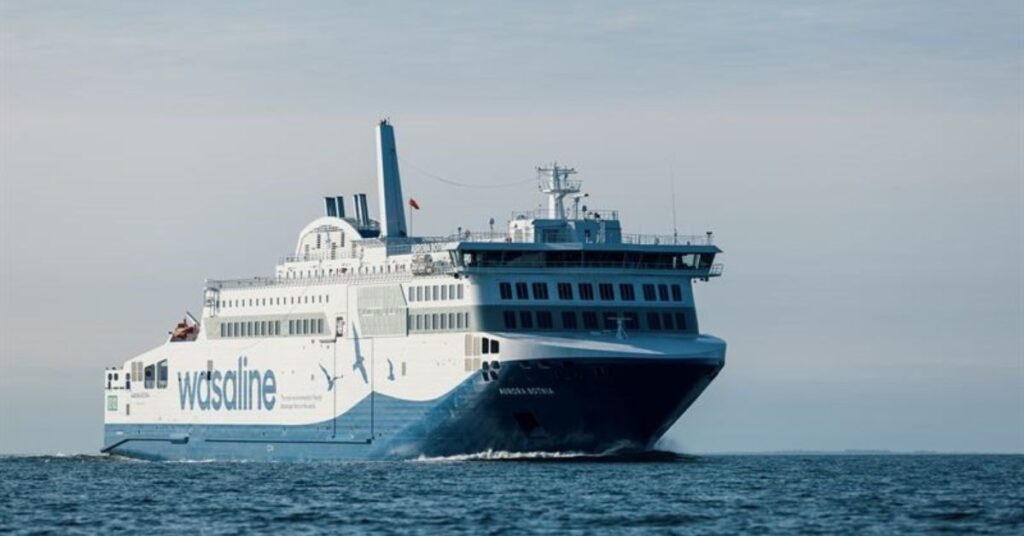
Technology group Wärtsilä has been contracted as the electrical integrator for a major battery capacity expansion on the Wasaline ROPAX ferry Aurora Botnia. The project will increase the vessel’s battery storage from 2.2 MWh to 12.6 MWh, creating what is expected to be the largest marine battery hybrid system currently in operation. The order was confirmed in Q3 2025, with commissioning scheduled for early 2026.
The Aurora Botnia, which entered service in 2021, operates with dual-fuel engines and batteries and uses biogas alongside stored power for propulsion. According to Wärtsilä, the new scope includes delivery of an Energy Management System, upgrades to power drives, and control system integration.
“Wasaline’s commitment to decarbonised shipping operations is central to everything we do,” said Peter Ståhlberg, Managing Director of Wasaline. “In this, our close cooperation with Wärtsilä is an essential element that benefits not only both our companies, and we can see that our cooperation sets standards for the whole marine sector. Through our continued collaboration, the Aurora Botnia has become a working example of what is possible when it comes to delivering environmentally friendly transportation within shipping.”
The expanded battery system is intended to enhance hybrid propulsion, which combines stored energy with conventional engines to reduce fuel consumption and emissions. The Aurora Botnia will also serve as a test platform connected to Wärtsilä’s Sustainable Technology Hub in Vaasa, supporting further development of hybrid solutions.
“Wasaline once again demonstrates its strong commitment to decarbonisation by extending the electrification capacity of this ferry. Our latest contribution will optimise the ship’s operations even further, creating fuel savings and a significant reduction in emissions,” said Roger Holm, President of Wärtsilä Marine and Executive Vice President at Wärtsilä Corporation.
The ferry currently operates with four Wärtsilä 31DF dual-fuel engines, which are designed to limit methane slip and enable operation on biogas. The vessel connects Vaasa in Finland with Umeå in Sweden.
Recent Posts
Ammonia
Reliance Industries Limited (RIL) has signed a binding long-term supply and purchase agreement (SPA) with Samsung C&T Corporation for the export of green ammonia over a 15-year period.
Bunkering
Ofiniti Raises $6.8 Million to Scale Digital Bunkering Platform for Global Shipping
Hydrogen
Hefring Marine and Ecomar Propulsion partner to deploy monitoring system on hydrogen-electric vessel