

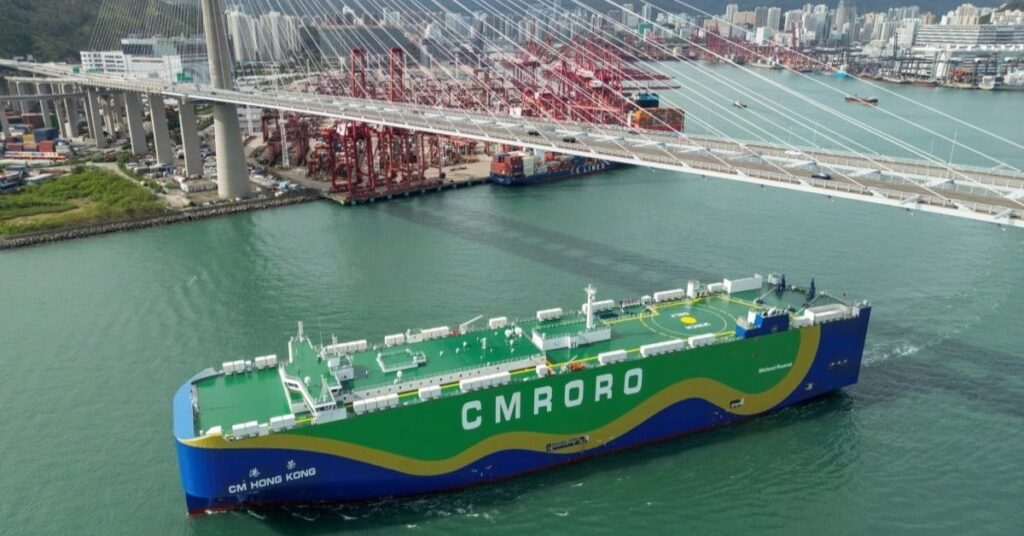
The world’s first methanol dual-fuel car carrier has made a maiden call at Hong Kong on its voyage to Europe, underscoring the city’s efforts to position itself as a hub for green maritime fuels.
The vessel, named CM Hong Kong, was commissioned by a subsidiary of China Merchants Group and constructed in Jiangsu province. Flying the Hong Kong flag, the ship berthed at Tsing Yi on Sunday.
At a ceremony marking the event, Chief Secretary for Administration Eric Chan Kwok-ki said the government was committed to supporting the shipping sector’s transition to low-carbon operations. He highlighted plans to offer tax concessions on methanol used as fuel by outbound ships and noted that authorities had invited expressions of interest for developing storage facilities for green marine fuels at a Tsing Yi South site.
“In the future, Hong Kong will increase the quality of our green marine fuel bunkering services, strengthen cooperation with ports worldwide and facilitate the trading of green marine fuels in the city by providing a platform for cooperation,” Chan said.
Between February and mid-September this year, Hong Kong supplied more than 130,000 tonnes of green marine fuels to oceangoing vessels, according to official data.
The CM Hong Kong measures 220 metres in length and 38 metres in width, with 13 cargo decks capable of carrying up to 9,300 vehicles. Its 78,000 square metres of deck space is equivalent to about 11 football pitches. The ship’s dual-fuel system is designed to cut greenhouse gas emissions by over 70 per cent.
Secretary for Transport and Logistics Mable Chan noted that the vessel is transporting electric vehicles manufactured in mainland China for export to Europe.
In his recent policy address, Chief Executive John Lee Ka-chiu said Hong Kong would prioritise the development of infrastructure for alternative maritime fuels, including methanol, ammonia and hydrogen. All vessels conducting methanol bunkering in the city’s waters will be required to use mass flow meters within the next year to enhance operational efficiency.
The International Maritime Organization has set a global target of net-zero emissions for international shipping by 2050.
Recent Posts
Ammonia
Reliance Industries Limited (RIL) has signed a binding long-term supply and purchase agreement (SPA) with Samsung C&T Corporation for the export of green ammonia over a 15-year period.
Bunkering
Ofiniti Raises $6.8 Million to Scale Digital Bunkering Platform for Global Shipping
Hydrogen
Hefring Marine and Ecomar Propulsion partner to deploy monitoring system on hydrogen-electric vessel