
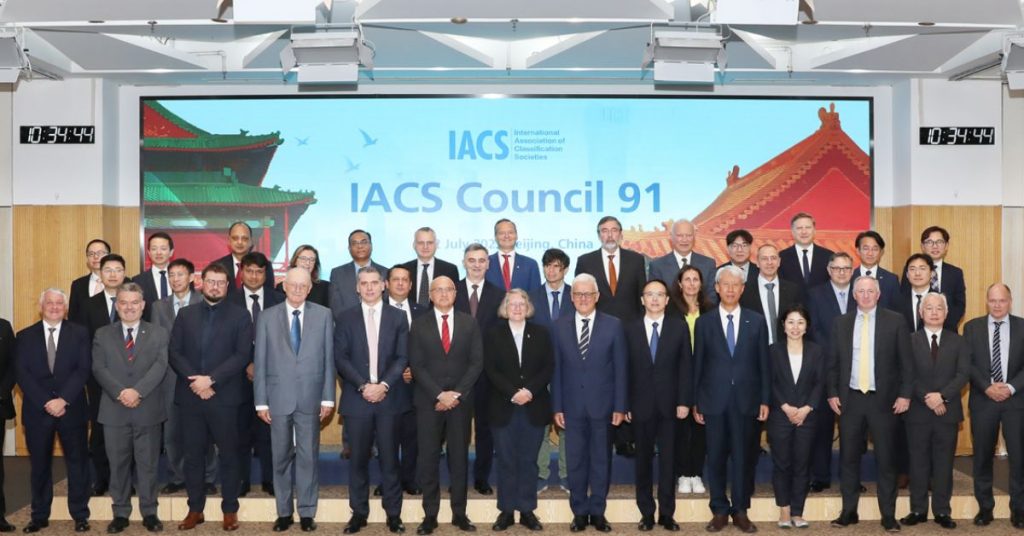
The International Association of Classification Societies (IACS) Council convened in Beijing last week for its 91st session (C91), focusing on the association’s ongoing work in decarbonisation, digital transformation, governance and technical rulemaking.
A major focus of C91 was assessing progress on safe decarbonisation and the digital transition. The Council acknowledged the rapid development of technical guidance supporting the deployment of alternative fuels and propulsion technologies on both newbuilds and the existing fleet. IACS instruments now provide guidance on the use of ammonia, methanol, hydrogen, battery systems and carbon capture. The association is also engaging with flag states on gas dispersion analysis and risk assessments under the IGF Code. Preliminary evaluations are underway on IACS’ potential future role in nuclear propulsion technologies.
In the digital domain, the Council reviewed the work of the Safe Digital Transformation Panel, launched in January 2024. Delegates welcomed efforts to define IACS’ role in digitalisation, cyber systems and Maritime Autonomous Surface Ships (MASS). These efforts were shared earlier this year with the International Maritime Organization (IMO) during the FAL49 meeting in support of its broader digitalisation strategy.
IACS is also developing resolutions across a broad spectrum of digital topics. These include cybersecurity measures for existing ships, asset inventory protocols for computer-based systems, classification criteria for complex systems, data exchange formats for 3D models, risk frameworks for MASS, and guidelines on remote connectivity.
C91 highlighted IACS’ active collaboration with industry stakeholders such as CIMAC, in the context of IMO digital discussions, and BIMCO on automated fuel consumption data gathering. The Council also noted IACS’ participation in multiple Joint Industry Working Groups, addressing areas such as anchoring equipment and underwater radiated noise.
On the technical rulemaking front, the Council discussed the continuing revision of the Common Structural Rules (CSR). A comprehensive industry consultation is ongoing, and IACS has responded with detailed technical clarifications. The Council reaffirmed that any updates to the CSR must ensure an equal or improved level of safety. A consequence assessment, covering a representative sample of oil tankers and bulk carriers, is currently underway to validate the impact of the proposed changes.
Given the need for sufficient industry feedback on the assessment results, the Council acknowledged that the initial timeline for CSR adoption may require adjustment. The updated schedule will remain under review pending further industry input.
C91 also marked the first steps in integrating Environmental, Social and Governance (ESG) principles into IACS’ operations. While many IACS member societies already maintain individual ESG policies, the Council agreed to develop an association-wide framework that aligns ESG goals with IACS’ safety and environmental protection mandate.
The Council further formalised IACS’ relationship with the International Quality Assessment Review Body (IQARB), recognising its growing influence and independence. A new engagement framework was adopted to support ongoing collaboration and technical input from IACS. Commenting on the session, IACS Council Chair Roberto Cazzulo said the meeting reflected IACS’ commitment to technical leadership and its proactive role across key maritime challenges. He emphasised the Association’s responsiveness in working with industry partners, both in shaping regulatory frameworks and in evolving structural standards.
Recent Posts
Events
Singapore International Bunkering Conference and Exhibition (SIBCON) 2026
Methanol
Deendayal Port to Begin Construction of 150 TPD e-Methanol Plant
Marine
NTNU to Acquire Kongsberg HUGIN 6000 for Ocean Technology Research