
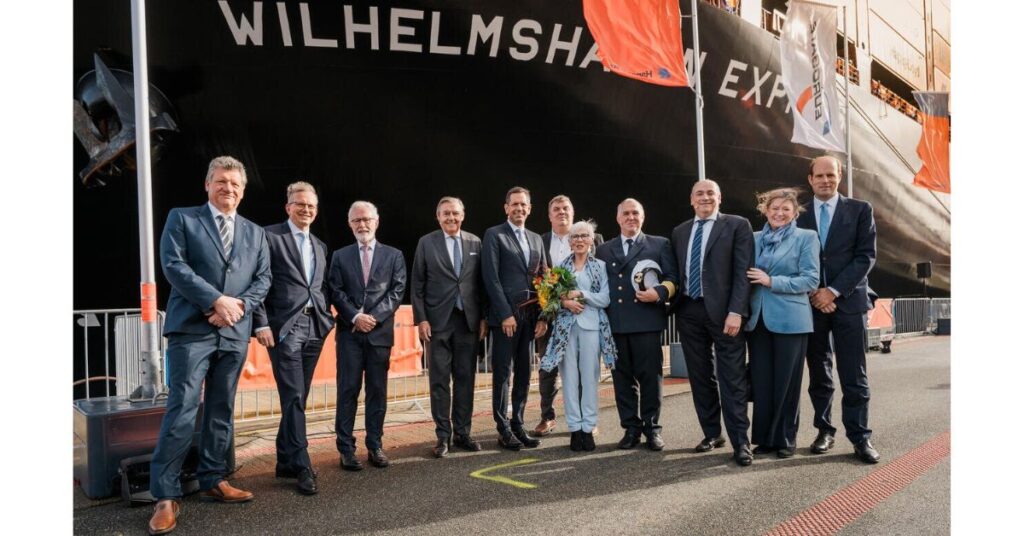
Hapag-Lloyd has marked the completion of its major three-year newbuild program with the naming ceremony of the “Wilhelmshaven Express” at Jade Weser Port in Wilhelmshaven, Germany. The event celebrated the addition of the 12th and final vessel in the company’s Hamburg Express class of ultra-large container ships.
The naming ceremony was performed by Wibke Friedrichs, wife of former Hapag-Lloyd board member and COO Anthony Firmin, who served as the ship’s naming patron. The event was attended by Olaf Lies, Minister-President of Lower Saxony, alongside customers, business partners, and members of the press.
The Final Vessel in a Landmark Fleet Series
The “Wilhelmshaven Express” represents the culmination of a significant investment in Hapag-Lloyd’s fleet modernization strategy. Built at Hanwha Ocean shipyard in South Korea, the Hamburg Express class comprises 12 vessels, each with a capacity of 23,660 TEU. The ships feature dual-fuel propulsion systems capable of operating on liquefied natural gas (LNG) and biomethane, reducing CO₂ emissions by up to 25% compared to conventional designs.
The “Wilhelmshaven Express” is deployed on the Gemini Cooperation’s NE1 service, connecting Asia and Northern Europe. The series marks one of Hapag-Lloyd’s largest fleet investments, with an estimated total cost of USD 2 billion.
Rolf Habben Jansen, CEO of Hapag-Lloyd, said:
“The Wilhelmshaven Express and its eleven sister vessels all successfully deployed are not just the largest in our fleet – they are a symbol of our unwavering commitment to continuously lower emissions, to quality leadership, and to long-term strategic growth.”
Strategic Role of Wilhelmshaven Port
The ceremony also highlighted the importance of Container Terminal Wilhelmshaven as a deep-water hub for Hapag-Lloyd and the Gemini Cooperation.
Rolf Habben Jansen added:
“The deep-water port has firmly established itself as a reliable and productive hub for Hapag-Lloyd and the Gemini Cooperation. With its consistent processes, efficient cargo handling, and direct connections to key trade lanes such as the Far East and the Atlantic, it plays a vital role in strengthening both our network and the resilience of our customers’ supply chains across Northern Europe.”
Next Phase of Fleet Expansion
Following the completion of the Hamburg Express class, Hapag-Lloyd is preparing for its next fleet renewal program involving 24 new vessels. Twelve of these ships will have a capacity of 16,800 TEU each, while the remaining twelve will have a capacity of 9,200 TEU.
All vessels will be equipped with advanced low-emission, high-pressure dual-fuel engines capable of operating on LNG and biomethane. The new ships are expected to cut CO₂ emissions by up to 95% compared to traditional propulsion systems. Deliveries are scheduled between 2027 and 2029.
Key Highlights
- Event: Naming ceremony of “Wilhelmshaven Express” at Jade Weser Port.
- Vessel Class: Final ship in the 12-vessel Hamburg Express class.
- Capacity: 23,660 TEU per vessel.
- Propulsion: Dual-fuel (LNG and biomethane) with up to 25% lower CO₂ emissions.
- Investment: USD 2 billion fleet renewal.
- Next Phase: 24 new dual-fuel vessels (9,200–16,800 TEU) to be delivered between 2027–2029.
Recent Posts
Ammonia
AM Green wins H2Global auction for €585 million renewable ammonia supply to Germany
Ports & Harbours
JNPA secures ₹671 crore IFC financing for shore power expansion
HYBRID
IMO study finds hybrid and electric ferries could cut Sea of Marmara emissions by 63%