
Leaders from across the global shipping and logistics sectors have gathered in Hong Kong for Hong Kong Maritime Week (HKMW) 2025, the ninth edition of the annual industry event held from November 16–22 under the theme “Navigating to a Greener Future.”
The week features more than 50 events organised by over 70 local and international partners, attracting a record 18,000+ participants. Discussions centre on decarbonisation, port cooperation, technological innovation, and Hong Kong’s evolving role as a maritime hub.
CE John Lee Calls for Stronger International Maritime Collaboration
At the opening ceremony on November 17, Hong Kong Chief Executive John Lee highlighted the need for coordinated global action on shared challenges.
“In a world being reshaped by geopolitical discord, technological disruption and climate change, these themes are more than aspirational. They sound an alarm, a wake-up call to collective action,” Mr Lee said. “Hong Kong’s role as a stable, reliable and dynamic maritime hub has never been more vital.”
He emphasised that the “one country, two systems” framework remains central to Hong Kong’s position as an international maritime centre.
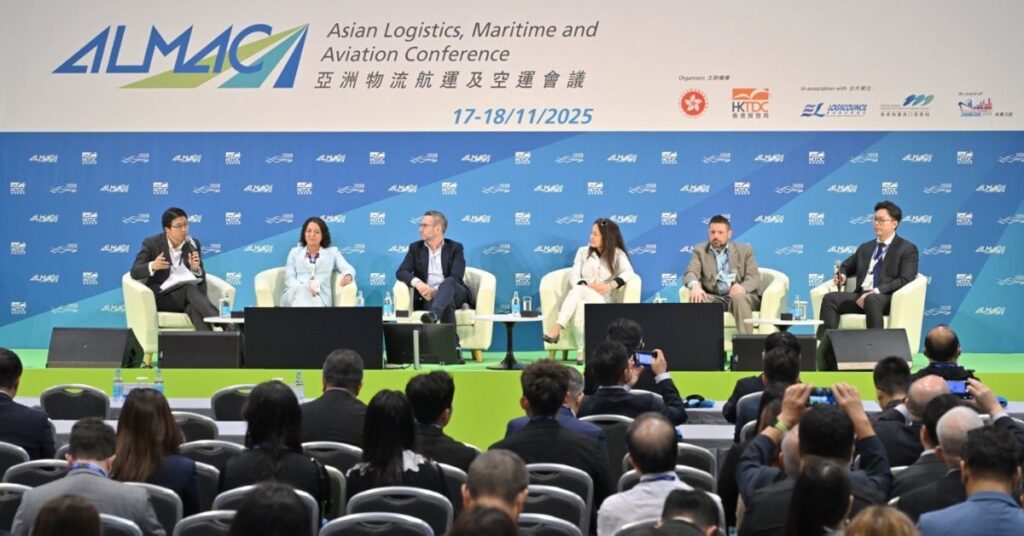
Mr Lee also attended the opening of the Asian Logistics, Maritime and Aviation Conference (ALMAC), which welcomed around 2,300 logistics leaders from more than 40 countries and regions. During the event, he announced the first group of ports to join Hong Kong’s new Partner Port network.
“I am particularly pleased to announce that Hong Kong has established Partner Port relationships with Guangxi port and Dalian port in the Chinese Mainland, and Port San Antonio in Chile,” Mr Lee said. “These ports are of strategic importance… we seek partners who support an open, international trade order.”
Hong Kong Expands Green Bunkering and Zero-Emission Initiatives
Hong Kong’s Secretary for Transport and Logistics, Mable Chan, said the city is aligning with the IMO’s 2050 net-zero objective by accelerating efforts around green fuels and maritime decarbonisation.
She outlined measures including:
- Publication of the Code of Practice on LNG Bunkering and Code of Practice on Methanol Bunkering
- Launch of the Green Maritime Fuel Bunkering Incentive Scheme
- Support for early-stage commercial bunkering operations
“The government facilitated the conduct of the first liquefied natural gas (LNG) ship-to-ship bunkering demonstration… in February 2025. Since then, 13 commercial LNG bunkering operations have been successfully conducted,” Ms Chan said. “These demonstrate Hong Kong’s great potential in developing green maritime fuel bunkering.”
Financial Secretary Paul Chan, speaking at the Hong Kong Global Maritime Trade Summit, described maritime decarbonisation as a significant global investment opportunity.
“The transition to zero-emission marine fuels could create up to 4 million jobs globally across the energy supply chain,” he said.
Hong Kong’s Action Plan on Green Maritime Fuel Bunkering aims to provide green fuel bunkering services to ocean-going vessels more than 60 times annually by 2030, covering over 200,000 tonnes of green fuels.
Strengthening High-Value Maritime Services
Hong Kong has ranked fourth globally for six consecutive years in the International Shipping Centre Development Index, with over 1,200 port and maritime-related companies operating in the city.
Mr Lee said Hong Kong will continue leveraging its structural advantages—including a simple tax regime, free port status, common law system, and free flow of capital and information—to reinforce its competitiveness.
Ms Chan added that the government is working with international marine insurance organisations to expand talent development and will extend the Maritime and Aviation Training Fund to include more green energy courses.
Digitisation and Trade Facilitation
Hong Kong is also advancing digital capabilities through a Port Community System scheduled for launch in January 2026. Once operational, the platform will enable real-time cargo tracking and streamline data exchange across logistics and transport modes, supporting more efficient trade flows and opening opportunities in areas such as customs processing and trade finance.
Recent Posts
Biofuels
WinGD Ethanol-Fuelled Engine Completes First In-Service Voyage on Maersk Vessel
Power & Propulsion
Norsepower Rotor Sails Installed on Airbus Cargo Ship Spirit of Toulouse
EV
Estonia Electric Ferry to Combine Steerprop Propulsion with Battery Power