
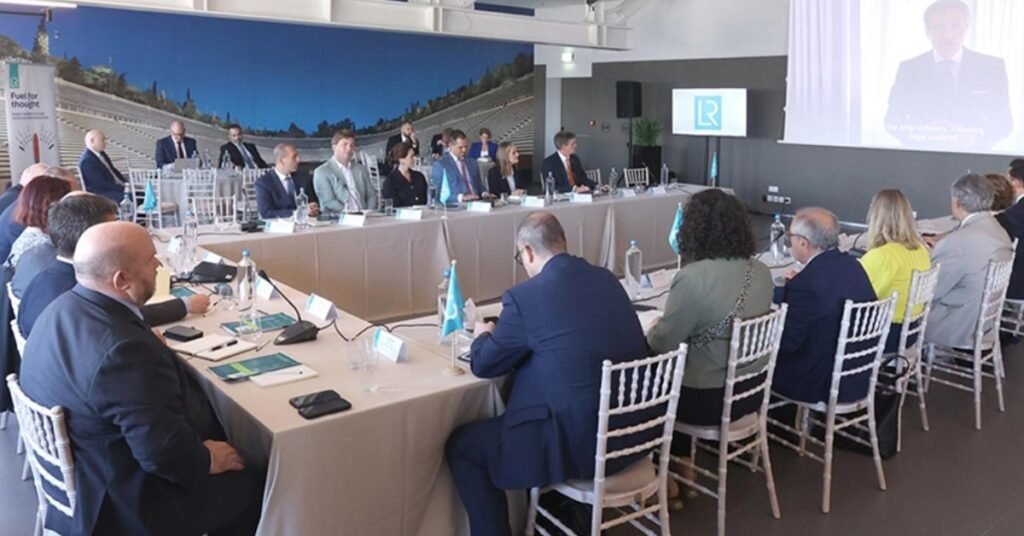
Industry leaders discuss regulation, economics and deployment pathways for nuclear-powered vessels
Growing interest in nuclear propulsion for commercial shipping was highlighted during a high-level industry roundtable hosted by Lloyd’s Register at Posidonia 2026 in Athens, as governments, regulators and maritime stakeholders examined the role of nuclear energy in the sector’s long-term decarbonisation strategy.
The event brought together representatives from the maritime, nuclear and regulatory sectors to discuss the opportunities and challenges associated with deploying nuclear technologies at sea, particularly advanced Small Modular Reactors (SMRs).
The roundtable was opened by Panos Mitrou, Senior Vice President Shipping Strategy at Lloyd’s Register, and featured remarks from International Atomic Energy Agency Deputy Director General Karine Herviou, alongside a video address from IAEA Director General Rafael Mariano Grossi.
Regulatory Framework Seen as Critical to Deployment
A key focus of the discussion was the lack of an established international regulatory framework specifically designed for civil nuclear applications in maritime operations.
Participants noted that while technological development is advancing, regulatory frameworks will need to evolve in parallel to provide certainty for investors, shipowners and governments considering nuclear-powered vessels.
Deputy Director General Karine Herviou said:
“This is a very important conversation. One of the main issues is the need to have an international framework to provide regulatory predictability.
The ATLAS initiative has as its objective the need to identify this international framework, and reach consensus needed to create harmonisation of the requirements of different countries.”
Economic and Commercial Challenges Remain
The roundtable also examined the commercial viability of nuclear propulsion, including financing models, infrastructure requirements and potential cost drivers.
While participants acknowledged significant barriers to entry, discussions highlighted the possibility that early adopters could gain strategic advantages if nuclear technologies become commercially viable at scale.
Delegates compared nuclear propulsion with other alternative fuel pathways, assessing relative efficiencies, operational constraints and long-term scalability as the maritime industry seeks solutions to achieve net-zero emissions targets.
ATLAS Initiative Advances Nuclear Shipping Framework
Discussions also highlighted progress under the Atomic Technologies Licensed for Applications at Sea (ATLAS) initiative, which aims to establish a framework for the safe and secure deployment of civil nuclear technologies in maritime applications.
The project is focused on addressing regulatory, safety and assurance requirements that could support future commercial deployment of nuclear-powered vessels.
Nick Brown, Chief Executive Officer of Lloyd’s Register, said:
“LR is delighted to hold this important conversation bringing together the highest level of international maritime influencers to the table.
We brought together the nuclear industry, the maritime industry, and regulation. We heard of the very clear and compelling speed that the regulation needs to be here because we have small modular reactors starting to go critical within the next month.
Today’s conversation was a very clear indication that the work of ATLAS, the work of the UK Maritime Nuclear Consortium, the work of NEMO, is going to be demanded by industry to ensure that there is a path to application and scale.”
SMR-Powered Vehicle Carrier Project Progresses
Alongside the roundtable, Lloyd’s Register announced progress on a joint development project involving HD Hyundai Heavy Industries, Korea Shipbuilding & Offshore Engineering (KSOE), Hyundai Glovis, G-Marine Service and the Korea Atomic Energy Research Institute (KAERI).
The project is focused on integrating an advanced Small Modular Reactor into a Pure Car and Truck Carrier (PCTC), reflecting increasing industry interest in nuclear-powered commercial vessels.
Industry Sees Growing Interest in Nuclear Maritime Applications
Reflecting on the discussions, Lloyd’s Register’s Power to X Director Mark Tipping said:
“Today’s roundtable convened a unique blend of maritime nuclear, maritime, government and regulatory leaders. It presented an opportunity that participants were eager to engage in – understanding each other’s requirements but also projecting what each aspect of the value chain requires from each other to build a unified approach to delivering nuclear in maritime.”
Recent Posts
Events
Singapore International Bunkering Conference and Exhibition (SIBCON) 2026
Methanol
Deendayal Port to Begin Construction of 150 TPD e-Methanol Plant
Marine
NTNU to Acquire Kongsberg HUGIN 6000 for Ocean Technology Research