
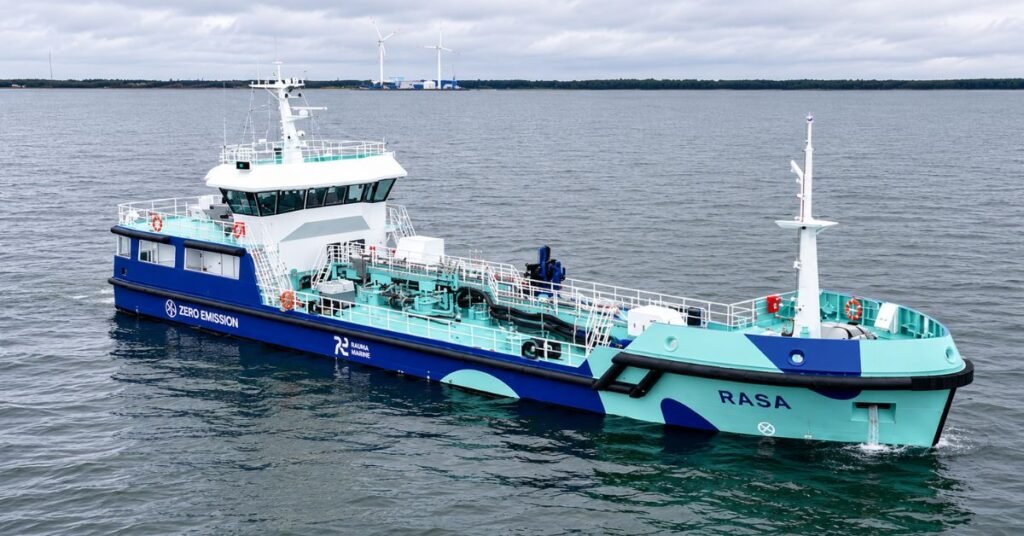
The Port of Klaipėda has commissioned Rasa, the world’s first waste collection vessel powered by a combination of green hydrogen and battery-electric propulsion, marking a new milestone in the adoption of zero-emission technologies for port operations.
The vessel was officially launched on 18 June and is designed to collect ship-generated waste, bilge water and sludge from vessels calling at Lithuania’s largest seaport. Powered by green hydrogen produced locally in Klaipėda, Rasa emits only water vapour during operation.
Zero-Emission Vessel Supports Sustainable Port Operations
The vessel is equipped with storage tanks and onboard treatment systems that allow collected waste to be processed before the treated water is transferred to municipal wastewater facilities.
The project integrates the vessel with Klaipėda’s recently established hydrogen production and refuelling infrastructure, supporting Lithuania’s broader strategy to develop a hydrogen-based energy ecosystem.
“We are launching one of the world’s first hydrogen-powered vessels, and just a few weeks ago we opened Lithuania’s first hydrogen production and refuelling station here in Klaipėda. Together, these developments turn a new page in Lithuania’s story as a maritime nation,” said Lithuanian Minister of Transport and Communications Juras Taminskas.
Lithuanian and Estonian Companies Collaborate on Vessel Construction
The €12 million project was developed through collaboration between Lithuanian and Estonian maritime companies.
The vessel’s hull and part of its equipment were constructed in Klaipėda, while final outfitting, systems integration and testing were completed in Estonia. The project also involved technology providers responsible for hydrogen fuel cells, electric propulsion systems and onboard electrical integration.
“Rasa represents a significant shift in shipping, an investment in a cleaner future and a new approach to port operations, where cutting-edge technologies and environmental responsibility become part of everyday activities,” said Algis Latakas, Director General of the Klaipėda Port Authority.
Arnoldas Šileika, CEO of Western Shipyard Group, added: “Rasa is much more than an addition to Klaipėda Port’s fleet. It is an innovative project that demonstrates the ability of our countries, the port, and the maritime engineering industries of Lithuania and Estonia to work together towards a common goal – creating an advanced, competitive and sustainable maritime future.”
Hydrogen Technology Demonstrates Practical Port Applications
Baltic Workboats, which participated in the vessel’s construction, said the project demonstrated the technical feasibility of integrating hydrogen propulsion into specialised port service vessels.
“As is often the case with new and innovative designs, the project brought its share of challenges, but the excellent cooperation with the customer, partners, equipment suppliers, and the classification society once again proved that Baltic Workboats is capable of executing demanding and technically challenging projects to the highest standards,” said Margus Vanaselja, CEO of Baltic Workboats.
Rebecca Sharp, CEO and Co-Founder of Genevos, said: “Rasa sets a powerful example for ports and vessel operators worldwide, showing how clean technologies can be deployed today to reduce emissions while maintaining the reliability and performance required at sea.”
Supporting the Regional Hydrogen Economy
Beyond its operational role, the project is intended to support the development of the Baltic region’s hydrogen economy while demonstrating how zero-emission technologies can be applied to essential port services.
During the naming ceremony, attended by the First Ladies of Lithuania and Estonia, Diana Nausėdienė, First Lady of Lithuania, said the vessel symbolises purity and harmony while reflecting its environmentally focused mission of cleaning the Port of Klaipėda using a propulsion system that produces only water vapour.
Sirje Karis, First Lady of Estonia, described the vessel as a symbol of Lithuanian-Estonian cooperation, sustainability and a shared commitment to innovation and environmental stewardship.
The Port of Klaipėda said the project could serve as a model for future hydrogen-powered port service vessels as ports worldwide explore low-emission solutions to support maritime decarbonisation.
Recent Posts
HYBRID
GRSE Signs ₹1,032-Crore ONGC Contract for Four Hybrid Offshore Supply Vessels
EV
Energy In Motion Opens ₹500-Crore Electric Truck Plant in Pune
Fuels
Aegis Logistics Commissions 35,000-Tonne LPG Bottling Plant at JNPA