
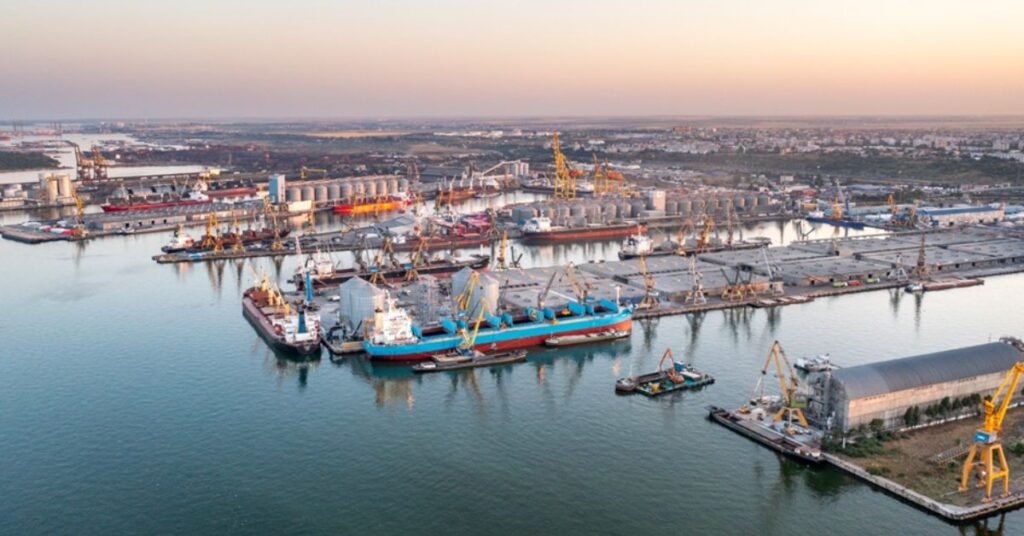
The European Bank for Reconstruction and Development (EBRD) and the European Union (EU) are supporting a €100 million investment programme to electrify operations at Romania’s Port of Constanța, accelerating the port’s transition towards low-emission infrastructure.
The investment will modernise the Constanța South Container Terminal (CSCT)—a wholly owned subsidiary of DP World—through the deployment of electric cargo-handling equipment, expanded electrical infrastructure and shore power facilities.
Financing to Drive Port Electrification
The project is being financed through a combination of:
- Up to €25 million senior loan from the EBRD
- €19.8 million grant from the European Union under the Alternative Fuels Infrastructure Facility (AFIF)
- €55.2 million investment from CSCT
The funding will support the electrification of terminal operations while reducing emissions from one of the Black Sea region’s largest container ports.
Investment in Shore Power and Electric Equipment
The €100 million programme includes the installation of new electrical infrastructure across the terminal, including:
- Power distribution networks
- Cold ironing (onshore power supply)
- Transformer stations
- Grid connections
- Associated electrical installations
The project also includes the procurement of:
- Electric container cranes
- Electric terminal tractors
The upgrades are expected to improve operational efficiency while reducing emissions from both port equipment and vessels calling at the terminal through the use of shore power.
Supporting Sustainable Port Operations
CSCT operates the South Container Terminal at the Port of Constanța under a concession agreement extending to 2049.
As part of the DP World global port and logistics network, the terminal plays a key role in regional trade and logistics across the Black Sea.
The investment is expected to strengthen the port’s environmental performance while supporting the wider decarbonisation of transport and logistics infrastructure.
Part of EBRD’s Green Cities Programme
The project forms part of the EBRD Green Cities programme, enabling the City of Constanța to develop its own Green City Action Plan.
In addition to reducing emissions from port operations, the initiative incorporates digitalisation, inclusion and gender considerations while contributing to local environmental objectives.
The EBRD has classified the investment as a 100% Green Economy Transition (GET) project and confirmed that it aligns with the goals of the Paris Agreement.
Strengthening Romania’s Green Infrastructure
The Port of Constanța is Romania’s largest seaport and one of the most important transport hubs on the Black Sea.
According to the EBRD, the investment supports the long-term decarbonisation of transport infrastructure while reinforcing Romania’s energy transition and sustainable economic development.
To date, the EBRD has invested more than €12.6 billion across 597 projects in Romania, with infrastructure development and energy transition remaining among its strategic priorities.
Recent Posts
Events
Singapore International Bunkering Conference and Exhibition (SIBCON) 2026
Methanol
Deendayal Port to Begin Construction of 150 TPD e-Methanol Plant
Marine
NTNU to Acquire Kongsberg HUGIN 6000 for Ocean Technology Research