
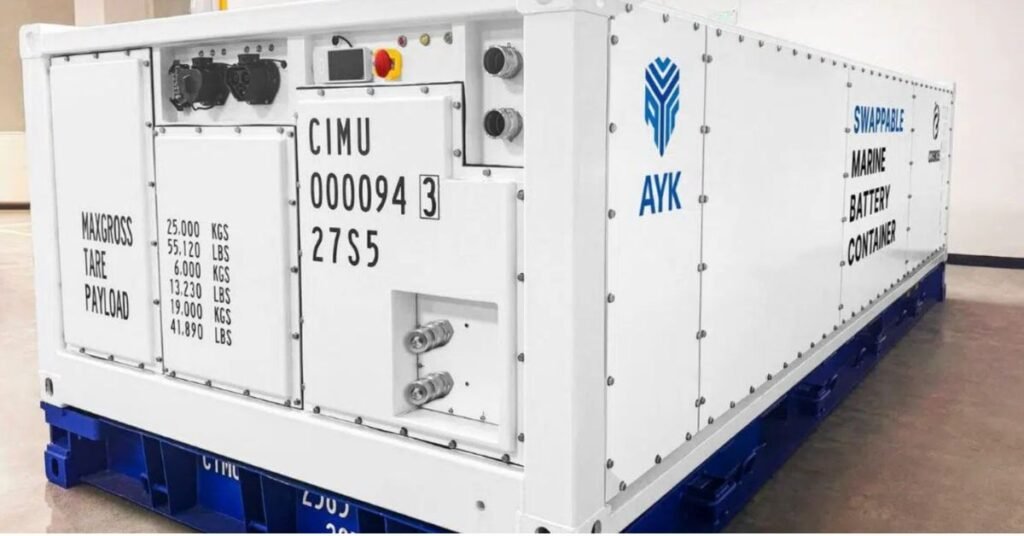
Marine battery manufacturer AYK Energy is preparing to introduce what it describes as the world’s first swappable containerised marine battery system at the SMM trade fair in Hamburg, as the company targets wider adoption of battery-electric and hybrid propulsion in commercial shipping.
The company said it is already receiving orders for the system while it advances through the marine class approval process. The battery has completed the New Technology Qualification (TQ) stage, a structured assessment used to establish whether a new technology is sufficiently mature to proceed towards full class approval.
Containerised System Designed to Simplify Battery Installation
AYK Energy founder Chris Kruger said the new system is intended to change how marine batteries are integrated into vessels by reducing the engineering work associated with conventional battery installations.
Kruger said a significant amount of engineering and development work had been invested in the technology. He said the AYK Cosmos Marine Battery Container is designed to simplify installation, reduce engineering complexity, lower project costs and shorten deployment times.
The system also eliminates the need for a dedicated battery room, which can require additional vessel engineering and construction work.

Batteries Can Be Swapped or Permanently Installed
The containerised design allows the batteries to either be permanently installed or exchanged according to operational requirements. This provides vessel operators with greater flexibility in managing energy capacity and battery deployment.
According to Kruger, battery containers can be charged at an onshore facility before being transported to a port and loaded onto a vessel. Multiple containers can be deployed depending on the energy requirements of a particular voyage.
The system could be used for short-sea fully electric operations in Europe, where shipping companies face increasing pressure to reduce emissions and comply with regulations such as the EU Emissions Trading System (ETS).
The technology can also provide temporary hotel-load electricity while vessels are berthed, potentially allowing ships to reduce emissions from onboard generators. In other applications, battery containers can be exchanged between voyages or permanently installed as part of hybrid and fully electric propulsion systems.
Eight-Level Safety System
AYK said the marine battery container incorporates eight independent levels of safety. The system has an IP67 protection rating and an A60 fire rating.
The company is initially focusing on ferries, RoPax vessels and passenger ships. It also identifies tugboats, feeder vessels, hybrid commercial vessels, fully electric ships and other workboats as potential applications.
Targeting Wider Marine Electrification
Kruger said the flexibility of the containerised system is intended to address some of the engineering, cost and deployment challenges associated with marine battery installations.
The company has previously worked with lithium iron phosphate (LFP) battery chemistry for marine applications and said it was the first company to obtain marine certification for LFP batteries from DNV.
Recent Posts
Marine
Singapore Unveils Ammonia Bunkering Standard, First Ethanol Bunkering and LNG Storage Plans
Ammonia
Singapore Launches TR 148 Ammonia Bunkering Standard and Model Contract to Prepare for Ammonia-Fuelled Ships
Policy
China Targets Doubling New Energy Inland Vessels by 2028 Under 2026-2030 Action Plan