Namibia has commissioned a fully integrated green hydrogen facility at Walvis Bay that combines solar generation, hydrogen production and battery storage, with the project initially supplying hydrogen to local transport and industrial applications.
Developed by CMB.TECH Namibia, the facility is designed to demonstrate an integrated model for producing and using renewable hydrogen. Its planned applications include hydrogen-powered vehicles, generators and freight transport, while future expansion could connect the facility with port infrastructure and support maritime fuel production.
Sabine Dall’Omo, CEO of Siemens Sub-Saharan Africa, said the facility demonstrates the potential for large-scale clean energy projects in Africa.
“Africa’s first fully integrated green hydrogen facility demonstrates that large-scale clean energy production is not a future ambition, but a present-day reality. Operating successfully in one of the world’s most demanding environments, it showcases the viability of green hydrogen as a cornerstone of the continent’s energy transition,” Sabine Dall’Omo, CEO, Siemens Sub-Saharan Africa, tells ESI Africa, part of VUKA Group.

5 MWp Solar Plant Powers Green Hydrogen Production
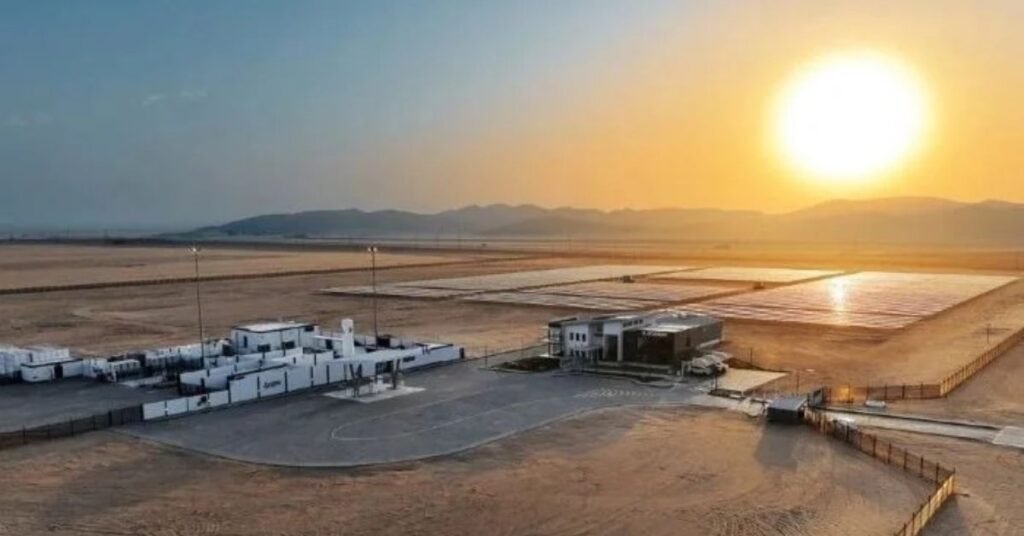
The Walvis Bay facility uses a 5 MWp solar park spread across 6.5 hectares. Electricity generated by the solar installation powers a 5 MW Proton Exchange Membrane (PEM) electrolyser, while a 5.9 MWh battery energy storage system provides additional electricity storage.
The electrolyser uses renewable electricity to split water into hydrogen and oxygen. Because the system operates off-grid, hydrogen production is supplied by the facility’s solar generation and stored electricity.
Namibia’s high solar resource provides the basis for the project. The country receives around 300 days of sunshine annually, supporting the development of solar-powered hydrogen production.
Siemens has supplied electrical, automation and safety infrastructure for the facility, integrating the systems required to operate the site.
“In a region where reliable energy is essential for economic growth and social development, what matters most is a system that simply works,” says Dall’Omo. “The CMB.TECH plant can only deliver on its promise if all technologies operate seamlessly as one. That is where Siemens makes the decisive difference. Working as a ONE tech company and serving as the unified interface for automation, control, and power distribution, we ensure the facility runs reliably from day one.
“Our long presence in the region, deep understanding of local conditions, and close collaboration across our businesses help reduce complexity, solve issues quickly, and keep operations stable. In short, we bring the entire system to life, enabling the plant to become a dependable, future-shaping asset for the customer and the wider community.”
Hydrogen to Support Transport and Industrial Applications
CMB.TECH is using the hydrogen produced at the facility for its own industrial applications, making the company the initial offtaker for the project.
The hydrogen is intended to supply dual-fuel trucks, generators and Namibia’s first hydrogen-powered freight locomotive. The facility also includes a hydrogen refuelling station for vehicles and industrial uses.
Roy Campe, Chief Technology Officer at CMB.TECH, described the site as a testbed for an integrated hydrogen economy.
“The facility includes a solar-powered off-grid electrolyzer for renewable hydrogen production, a refueling station for hydrogen-powered vehicles and industrial applications, and an on-site Hydrogen Academy for local talent development,” says Campe.
Sabine Dall’Omo said securing demand for hydrogen remains an important factor for project development.
“Many green hydrogen projects are stalling because, while they invest heavily in solar energy and green hydrogen production, there is often no commercial offtake agreement in place to secure demand for the hydrogen produced,” says Dall’Omo.
Potential Link to Maritime Fuel Production
The project could eventually expand towards maritime applications through the production of green ammonia.
Hydrogen can be combined with nitrogen separated from air to produce ammonia. Once liquefied, green ammonia can be used as a potential marine fuel, creating a pathway for the Walvis Bay facility to support lower-carbon shipping.
Wiebke Polomka, Senior Manager: Southern Africa at Afrika-Verein der deutschen Wirtschaft, said the project could connect hydrogen production with transport and logistics applications.
“Beyond its role as an energy production facility, the project illustrates how green hydrogen can accelerate the decarbonization of transport and logistics value chains. From supporting local mobility solutions to enabling future maritime refueling infrastructure, it provides a tangible pathway toward lower-carbon industrial and shipping ecosystems,” says Polomka.
Hydrogen Academy Develops Local Workforce
The facility also incorporates a Hydrogen Academy focused on training drivers, technicians and scientists. According to the project, 24 of its 25 employees are Namibian and received training through the academy.
The project is also working with local universities and technical institutions to develop skills for hydrogen-related operations and maintenance.
Johannes Shimbilinga, Municipal Mayor of Walvis Bay, said the training component could support the development of a local hydrogen workforce.
“By partnering with local universities and institutions like the Namibia Institute for Mining Technology, the project is training a new generation of engineers and technicians. This creates a sustainable pipeline of local expertise, positioning Namibia as an exporter of not just green molecules, but also the technical knowledge required to operate and maintain a hydrogen economy,” says Shimbilinga.
Expansion Plans Target Up to 500 MW of Solar Capacity
The existing 5 MWp solar park occupies only part of the available site. CMB.TECH has outlined plans to significantly expand renewable generation capacity.
“The next step is to increase capacity to 250MW, then to 500,” says Campe. “We want to turn Namibia into a global energy hub and export energy to Europe and the rest of the world. Today we have 7,000 solar panels. In the future, there could be millions.”
Dall’Omo said the project illustrates the role of collaboration between developers, technology providers and industrial stakeholders in developing integrated energy infrastructure.
“The project underscores the importance of ecosystem-led execution in delivering complex energy transitions,” Dall’Omo concludes. “By bringing together developers, systems integrators, technology partners, and cross-border industry stakeholders, it demonstrates how strategic collaboration can unlock sustainable industrial growth and long-term economic resilience.”
Recent Posts
Ammonia
Singapore Launches TR 148 Ammonia Bunkering Standard and Model Contract to Prepare for Ammonia-Fuelled Ships
Policy
China Targets Doubling New Energy Inland Vessels by 2028 Under 2026-2030 Action Plan
EV
Singapore Offers Up to S$250,000 per Vessel to Spur Electric Harbour Craft Adoption