
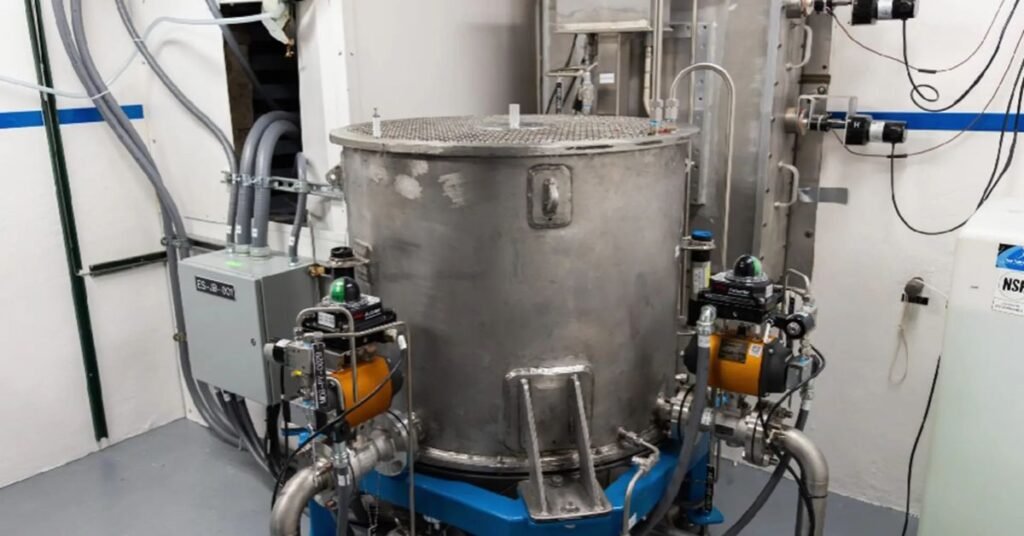
The US state of Utah is examining the potential deployment of compact nuclear reactors capable of generating 1 MW of electricity and designed to fit inside standard 20-foot shipping containers.
The Utah Office of Energy Development has signed a non-binding memorandum of understanding (MOU) with Houston-based clean energy company Deployable Energy Limited to assess the feasibility of deploying the company’s Unity Nuclear Battery technology in the state.
The agreement, signed on August 18, provides a framework for the two sides to exchange information and examine potential opportunities involving research, testing, demonstration and eventual commercial deployment.
The MOU does not authorise construction of the reactors in Utah. Instead, it establishes a basis for evaluating the technology and determining whether it could be deployed in the state.

1 MW Microreactor Designed for Containerised Deployment
The Unity Nuclear Battery is a factory-built microreactor designed to be transported to its destination and installed where electricity is required.
According to Deployable Energy, each unit can produce 1 MW of electrical power while occupying the footprint of a standard 20-foot shipping container. The company says the reactor uses uranium dioxide fuel enriched to approximately 4.95% and helium as a coolant, alongside established materials and manufacturing processes.
The modular design allows individual reactors to be deployed independently or combined into larger arrays. According to the company, installations could eventually scale from megawatt-level projects to systems with hundreds of units.
The reactors are designed around five-year refuelling cycles, while their thermal output can also potentially be used to provide process heat in addition to electricity.
Microreactors Target Remote and Industrial Applications
Deployable Energy says the Unity Nuclear Battery can be transported using conventional equipment and configured with either liquid or air cooling depending on the application.
The system is intended for both conventional electricity projects and remote locations where building conventional power infrastructure could be difficult or costly.
The company is targeting factory-based mass production and has indicated a goal of achieving a six-month lead time for units from 2030. Gallagher said the reactors are intended to arrive as plug-and-play systems, reducing installation requirements and deployment times.
Bobby Gallagher, co-founder and CEO of Deployable Energy, said the agreement reflects Utah’s growing interest in advanced nuclear technologies.
“Utah is demonstrating the kind of leadership that can make it a national hub for advanced nuclear energy,” Gallagher said.
Utah Evaluates Advanced Nuclear Technology
The agreement forms part of Utah’s broader efforts to examine advanced nuclear power as a potential source of additional electricity generation.
Emy Lesofski, energy advisor to the Governor and director of the Utah Office of Energy Development, said the state is evaluating technologies that could contribute to its future energy supply.
“Utah is leading the nation in energy innovation, and that the partnership with Deployable Energy is another step towards an abundant energy future that is reliable, secure and clean,” Lesofski said.
However, the MOU does not represent regulatory approval for the Unity Nuclear Battery. Any future commercial deployment would be subject to applicable federal, state and local regulatory and licensing requirements.
Unity Nuclear Battery Reaches Criticality
Deployable Energy said its microreactor technology has reached criticality, meaning the nuclear chain reaction has become self-sustaining.
The company has also received an Approval in Principle from a maritime classification society, according to the company.
The technology’s modular configuration and containerised form factor are intended to allow nuclear power systems to be deployed across different scales and applications, depending on electricity and heat requirements.
Recent Posts
Marine
Singapore Unveils Ammonia Bunkering Standard, First Ethanol Bunkering and LNG Storage Plans
Ammonia
Singapore Launches TR 148 Ammonia Bunkering Standard and Model Contract to Prepare for Ammonia-Fuelled Ships
Policy
China Targets Doubling New Energy Inland Vessels by 2028 Under 2026-2030 Action Plan