
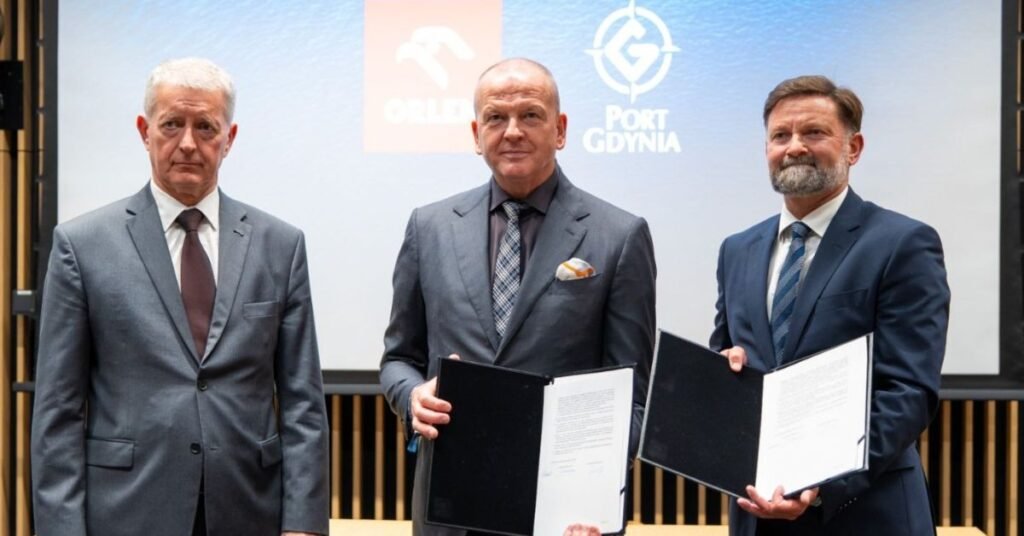
ORLEN and the Port of Gdynia Authority have signed an agreement to explore the use of LNG and bioLNG as marine vessel fuels. The partnership will assess potential market demand for LNG and bioLNG bunkering services, and infrastructure solutions that would increase the availability of alternative marine fuels along the Polish coast.
ORLEN’s cooperation with the Port of Gdynia will cover an assessment of market demand, the potential for LNG and bioLNG bunkering, as well as the necessary infrastructure, operational conditions and regulatory requirements needed to develop such services. One of the key areas under review will be the feasibility of waterside bunkering, including ship-to-ship operations, where fuel is transferred directly from a bunker vessel to a ship in port.
Robert Soszyński, Vice President of the ORLEN Management Board, Operations, said the expanded cooperation with the Port of Gdynia marks an important step in developing the LNG and bioLNG market in the Tricity area and forms part of a wider transformation of ORLEN’s fuel portfolio through 2035. He said that under the ORLEN Group’s strategy, gas, including LNG, will play a strategic role as a transitional fuel supporting energy security and the decarbonisation of transport, with the company aiming to build competitive strength across the entire value chain, from supply and logistics through to end use. He added that ORLEN is also developing capabilities in renewable fuels, including bioLNG, which could become one of the key pathways to lower emissions in heavy-duty road and maritime transport in the coming years, and that the company wants to be more than a fuel supplier to ports, positioning itself as a partner in their transition.
Piotr Gorzeński, CEO of the Port of Gdynia Authority, said the energy transition in the shipping industry is already under way, with shipowners looking for solutions that could reduce emissions while ports need to be ready to accommodate vessels using a range of fuels and technologies. He said the port wants to be prepared for what the future may bring, since no one can say with certainty which solutions will matter most 10 or 20 years from now, and that the cooperation with ORLEN on LNG and bioLNG bunkering is one step in that direction.
The scope of the partnership includes knowledge sharing, assessment of the needs of shipowners and port users, particularly the operators of scheduled ferry, container and ro-ro services, evaluation of potential bunkering models, and a review of solutions used at other European ports. The parties will examine the potential for ship-to-ship bunkering, its suitability for larger vessels, and the feasibility of bunkering while a vessel is alongside, including in parallel with cargo handling operations. The objective is to develop solutions tailored to market needs while ensuring compliance with safety requirements, minimising disruption to vessel traffic, ensuring berth availability, maintaining operational efficiency and safeguarding the continuity of terminal operations.
The initiative comes against the backdrop of a changing regulatory environment for shipping. The FuelEU Maritime framework has been in force since 2025, progressively tightening requirements for the greenhouse gas intensity of energy used on board ships. As a result, shipowners and ports are preparing for a market in which a range of fuels and technologies will develop in parallel, from LNG and bioLNG to methanol, ammonia and hydrogen.
The initiatives pursued jointly with the Port of Gdynia are of a long-term nature and are intended to help lay the foundations for an alternative marine fuels ecosystem in Poland.
Recent Posts
Biofuels
WinGD Ethanol-Fuelled Engine Completes First In-Service Voyage on Maersk Vessel
Power & Propulsion
Norsepower Rotor Sails Installed on Airbus Cargo Ship Spirit of Toulouse
EV
Estonia Electric Ferry to Combine Steerprop Propulsion with Battery Power