
Summary
LD Armateurs has completed the installation of six Norsepower rotor sails on Spirit of Toulouse, the first of three new cargo ships chartered to Airbus. The vessel combines wind-assisted propulsion with methanol-capable engines as part of a programme to reduce emissions from transatlantic aircraft-component transport.
Installation completed ahead of sea trials
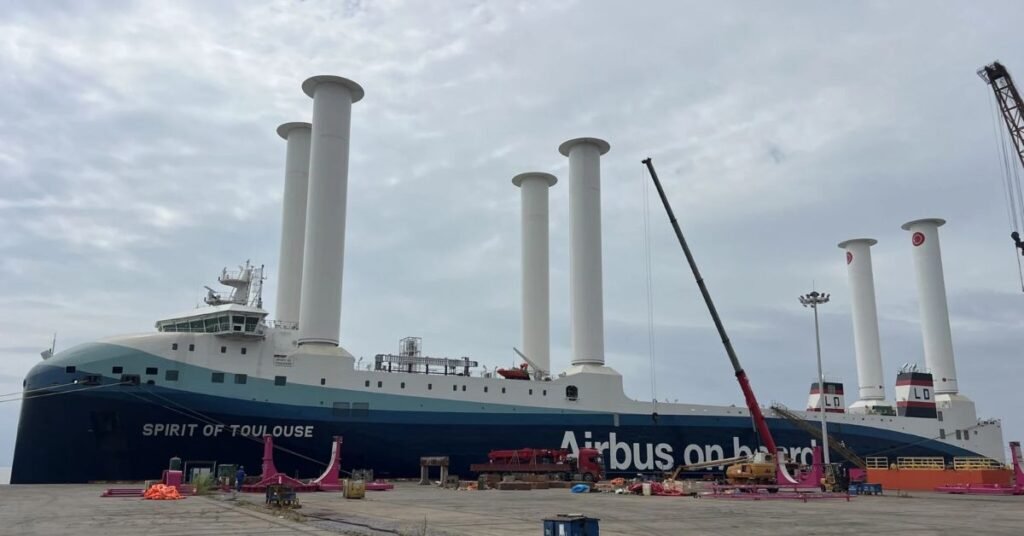
Six Norsepower rotor sails have been fitted to Spirit of Toulouse at Wuchang Shipbuilding Industry Group’s coastal outfitting site in Shanghai, LD Armateurs announced on 15 October 2026.
Each rotor measures 35 metres high and five metres in diameter. LD Armateurs describes the ship as the world’s largest roll-on/roll-off vessel equipped with wind propulsion.
The installation precedes sea trials, during which the equipment’s performance and integration with onboard systems will be tested. Further adjustments are planned during the maiden voyage from China to France.
The vessel carries two dual-fuel main engines and two dual-fuel generator sets capable of using e-methanol, bio-methanol or marine diesel oil. Sister vessels Spirit of Mobile and Spirit of Mirabel complete the three-ship programme.
How the rotating sails provide thrust
Rotor sails use the Magnus effect to convert wind into additional propulsive force. Although they harness wind energy, the cylinders are rotated by electric motors rather than being spun directly by the wind.
As air flows around a rotating cylinder, differences in airflow speed create a pressure difference. The resulting force can help propel the ship, allowing the main engine’s output to be reduced when conditions are favourable.
This makes wind an additional energy source within the vessel’s propulsion system. The engines continue to provide power, while the rotors reduce the amount of fuel required to maintain the intended operating speed.
The contribution varies with the vessel’s operating profile, wind conditions and equipment configuration. Consequently, an installation’s effectiveness must be assessed over actual voyages rather than inferred solely from the number or dimensions of its sails.
Airbus fleet renewal provides the commercial foundation
The project forms part of a fleet replacement programme Airbus announced in October 2023. The aircraft manufacturer commissioned LD Armateurs to build, own and operate three vessels for transporting large aircraft subassemblies across the Atlantic.
The logistics network connects European production facilities with Airbus’ single-aisle aircraft assembly operations in Mobile, Alabama. Cargo includes wings, fuselage sections, engine pylons and tail assemblies.
Each new vessel was designed to carry approximately seventy 40-foot containers and six single-aisle aircraft subassembly sets. The previous ships accommodated three to four sets, making increased carrying capacity another feature of the renewal.
Airbus originally projected that the new fleet would reduce average annual transatlantic carbon-dioxide emissions from approximately 68,000 tonnes to 33,000 tonnes by 2030.
That forecast applies to the fleet renewal programme as a whole. It should not be interpreted as an emissions reduction delivered by the rotor sails alone, or as a saving already demonstrated by Spirit of Toulouse.
Routing and fuel choices complement wind assistance
Airbus’ earlier project outline also identified voyage-routing software as part of the efficiency package. Routing is intended to improve the use of favourable winds while avoiding adverse ocean conditions that increase resistance.
The manufacturer envisaged increasing the proportion of e-methanol used over time, allowing the fuel strategy to develop alongside the vessels’ operation.
Together, these measures show why the programme combines several technologies. Wind assistance can reduce fuel demand, while engine capability provides flexibility over the fuels used for the remaining energy requirement.
For a regular industrial transport service, these decisions also need to work within the requirements of moving aircraft components between production locations. The project therefore brings propulsion efficiency into the design of an established supply chain.
From supply agreement to operational assessment
LD Armateurs and Norsepower announced their cooperation on the Airbus fleet in February 2024, specifying six 35-metre rotors for each ship.
The completed installation on the lead vessel moves that agreement into the testing stage. For the two remaining ships, the first installation also provides practical experience in fitting multiple large rotors within a newbuilding programme.
For cargo owners and ship operators, the commercial interest lies in how wind assistance performs alongside alternative-fuel propulsion on a scheduled service. Sea trials and subsequent voyages will provide the operating evidence needed to assess that combination.
FAQs
Which vessel has received the rotor sails?
Spirit of Toulouse, owned and operated by LD Armateurs and chartered to Airbus.
How many rotor sails are installed?
Six, each measuring 35 metres high and five metres in diameter.
Do the sails replace the engines?
They provide additional thrust that can reduce engine power requirements when wind conditions are favourable.
What will the ship transport?
Large aircraft subassemblies between Airbus production facilities in Europe and North America.
Has the projected emissions reduction been achieved?
The approximately 50% reduction is a fleet-level target for 2030. The latest announcement concerns installation ahead of sea trials.
Recent Posts
Biofuels
WinGD Ethanol-Fuelled Engine Completes First In-Service Voyage on Maersk Vessel
Power & Propulsion
Norsepower Rotor Sails Installed on Airbus Cargo Ship Spirit of Toulouse
EV
Estonia Electric Ferry to Combine Steerprop Propulsion with Battery Power