
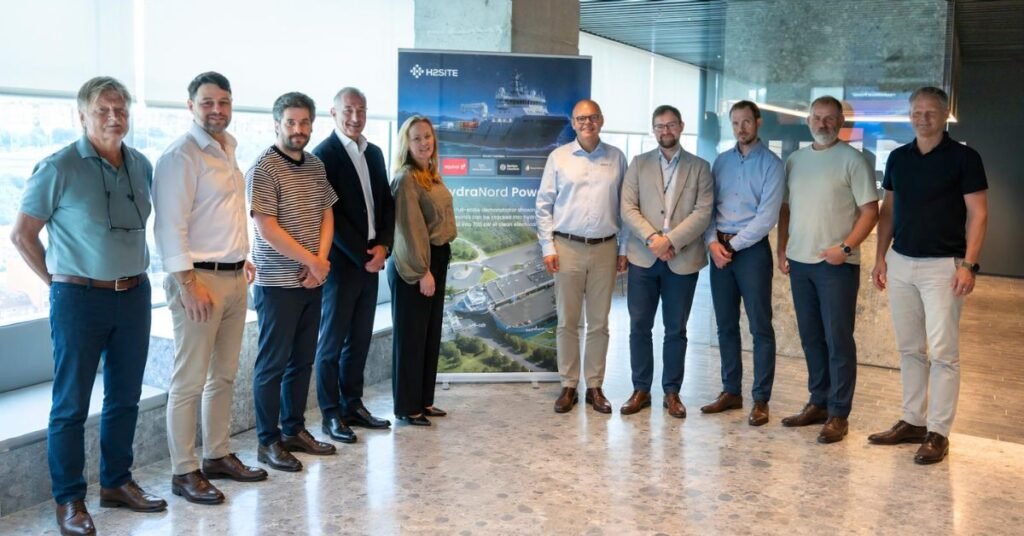
H2SITE has secured €3.4 million (NOK 39.1 million) in funding from Norway’s Enova for HydraNord Power, a project aimed at developing and validating a commercial-scale onboard system that converts ammonia into hydrogen for maritime power generation.
The Bilbao- and Bergen-based company said the project will develop a modular system capable of producing up to one tonne of hydrogen per day and supplying fuel cells with 700 kW of net electrical power. The system is intended for auxiliary and hybrid power applications on commercial vessels.
Enova, a Norwegian government agency supporting the country’s climate and energy transition, is providing the funding through the Climate and Energy Fund.
HydraNord Power Targets Commercial Maritime Deployment
Led by H2SITE, HydraNord Power will use ammonia as a hydrogen carrier, converting it into high-purity hydrogen directly onboard vessels. The project builds on the company’s previous maritime ammonia-to-hydrogen demonstrations, including smaller systems already in operation.
With a 700-kW electrical output, the new system is designed to address auxiliary power requirements on larger commercial vessels and move the technology towards repeatable commercial deployment.
H2SITE’s technology uses a membrane reactor that combines ammonia cracking and hydrogen separation in a single process. The system is designed to produce fuel-cell-grade hydrogen while limiting ammonia contamination of the fuel cells.
The compact architecture can be configured for both newbuild and retrofit applications and can be integrated into fuel-cell-only or hybrid power systems. Multiple modules can also be installed in parallel to support higher power requirements and future multi-megawatt applications.
Project Partners Cover Vessel and System Integration
HydraNord Power brings together H2SITE, Equinor, Höegh Autoliners, Breeze Ship Design, Sustainable Energy Catapult Centre, Alltec and Maritime CleanTech.
The consortium covers areas including vessel requirements, system design, fuel-cell integration, site integration, testing and project coordination. The partners are developing the system around maritime operating requirements rather than as a standalone technology demonstration.
Andrés Galnares, CEO of H2SITE, said HydraNord Power takes ammonia-to-power from successful smaller deployments into a commercially relevant power range. He said at 700 kW net, the company is addressing a real onboard power requirement with a standardised system that can be replicated across vessels and scaled into larger installations, adding that Enova’s support allows the company to demonstrate this under representative operating conditions and opens a significant market opportunity in maritime segments where direct electrification is not viable.
Testing Planned in Norway
The complete HydraNord Power system will be installed and tested at Energy House in Stord, Norway, under conditions designed to represent commercial maritime operations.
Development and system integration are scheduled to take place during 2027, with commissioning planned for early 2028.
The initial applications will focus on auxiliary and hybrid power for deep-sea shipping, offshore operations and other energy-intensive maritime segments.
The modular design is intended to allow the same core technology to be adapted for different vessel types and power requirements, providing a common platform for deployments ranging from the initial commercial installations to larger power systems.
Recent Posts
Dual-Fuel
EPS Adds 93,000-cbm LPG Dual-Fuel VLAC Lilac Cove to Fleet
Ammonia
ABS and lomarlabs Launch Collaboration to Test Emerging Maritime Technologies
LNG
LR Study Finds 200,000m³ LNG Carriers Could Expand Fleet Efficiency Without Major Terminal Changes