
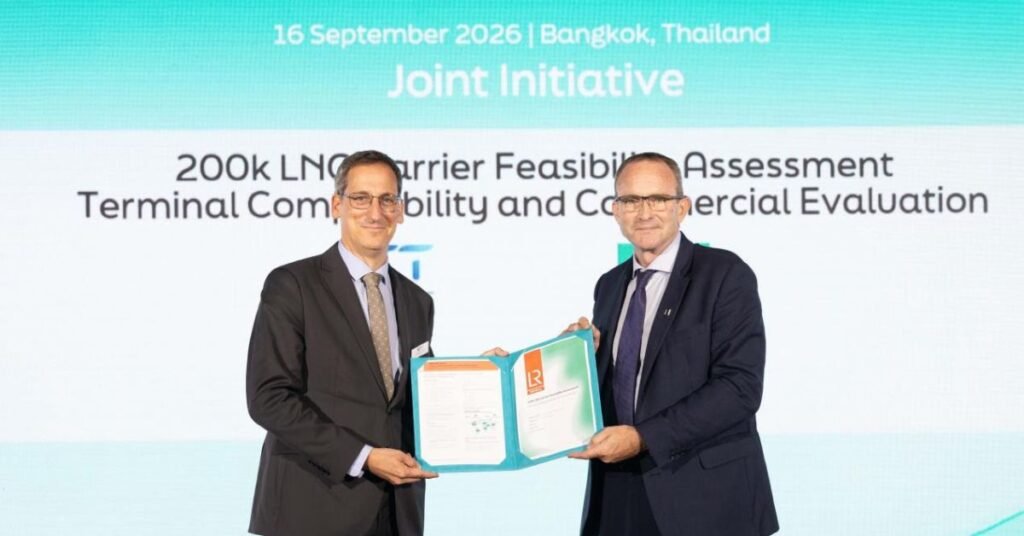
Lloyd’s Register (LR) has identified 200,000m³ LNG carriers as a potential option for the next phase of global LNG fleet renewal, with a new study indicating that larger vessels could increase cargo capacity and improve transport efficiency while retaining access to most major LNG terminals.
The findings come from an LR Advisory terminal compatibility and commercial evaluation report prepared for GTT and presented at Gastech 2026. The analysis assessed representative 200,000m³ LNG carrier designs against existing LNG infrastructure and modelled their commercial performance across Atlantic and Pacific trading routes.
200,000m³ LNG Carriers Retain Access to Major LNG Hubs
The study found that 88 LNG terminals globally are compatible with 200,000m³ LNG carrier concepts, compared with 97 terminals for a conventional 174,000m³ vessel.
Despite the reduction in the number of accessible terminals, the larger vessels would retain access to many major LNG trading hubs. LR’s assessment found that LNG infrastructure across Asia Pacific, Europe, North America and the Middle East is generally positioned to accommodate 200,000m³ vessels.
The analysis also found that cargo tank configuration has limited influence on terminal compatibility. No material difference was identified between three-tank and four-tank designs.
Instead, vessel beam was identified as the most significant factor affecting terminal compatibility, followed by draft and displacement.
Larger LNG Carriers Could Reduce Transport Costs
The commercial analysis examined the potential impact of increasing LNG carrier capacity on shipping economics.
According to LR’s modelling, the larger vessel concept could generate an estimated owner benefit of approximately US$85.5 million over a 30-year period. The study also identified transport savings on representative Atlantic and Pacific routes.
Higher cargo capacity could allow more LNG to be transported per voyage, potentially reducing the number of voyages required to move a given volume of cargo.
The findings come as LNG shipping companies assess fleet renewal requirements alongside changing operating profiles, including lower average vessel speeds and evolving trade patterns.
Study co-author Sujith Tooneri, Global Head – Newbuild Advisory Services, LR, said: “The industry is entering a period where fleet renewal decisions will shape LNG transportation for decades to come. Our analysis shows that 200,000m³ LNG carriers can retain access to most major LNG terminals while increasing cargo carrying capacity, making them a practical option for owners looking to improve transportation efficiency and support future trade growth.”
Terminal Compatibility Remains a Key Design Consideration
The report indicates that moving to larger LNG carriers would not necessarily require major changes to global terminal infrastructure. However, the reduction in the number of compatible terminals means vessel dimensions will remain an important consideration for owners and charterers evaluating newbuild designs.
Constantinos Chaelis, Global Gas Segment Director, LR, said: “The significance of these findings is that larger LNG carriers do not appear to require a wholesale rethink of terminal infrastructure. Many key LNG hubs are already capable of supporting these vessel concepts, which gives the market a realistic pathway to improve transport efficiency while maintaining broad trading optionality.”
The study suggests that the commercial case for larger LNG carriers will depend on the balance between increased cargo capacity, voyage economics and access to loading and discharge infrastructure.
Recent Posts
Ammonia
Aegis Tristar acquisition to expand Indian group’s global energy logistics reach
Power & Propulsion
Everllence and MITSUI E&S Mark 100 Years of Two-Stroke Engine Partnership
Ammonia
NTPC Targets Japan, South Korea and Germany for Green Ammonia Exports from Andhra Pradesh Hub