
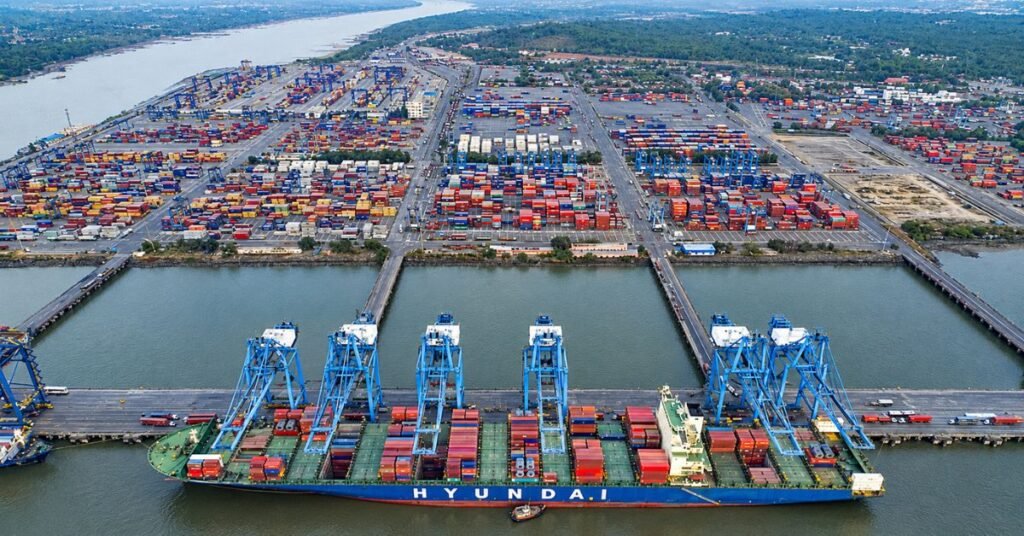
Jawaharlal Nehru Port Authority (JNPA) is set to receive $70 million (approximately ₹671 crore) in long-term financing from the International Finance Corporation (IFC) to expand shore-to-ship power supply facilities across its terminals.
The financing makes JNPA the first Indian maritime facility to receive blue financing from the World Bank Group institution for the deployment of shore power infrastructure, according to the announcement.
Shore power, also known as cold ironing, enables vessels at berth to connect to electricity supplied from the port and switch off their auxiliary engines while cargo and other operations are carried out. The technology can reduce emissions from vessels while they are alongside.
JNPA to scale up shore-to-ship power
The IFC financing is intended to support the deployment of shore power infrastructure across JNPA’s terminals. The investment is also expected to help the port build operational experience with the technology and address the commercial and infrastructure requirements associated with wider adoption.
JNPA Chairperson Gaurav Dayal said: “Funding from international development institutions like IFC will enable JNPA to manage early-stage commercial risks, build operational experience and bring international best practices prior to scale-up.”
The financing comes as Indian ports examine measures to reduce emissions from ships and port operations. While shore power has been adopted at ports in several international markets, deployment across India’s major ports remains limited.
How shore power works
Under a shore power system, a berthed vessel connects to the port’s electrical grid through dedicated shore-side equipment. The ship can then use electricity for onboard systems instead of operating its auxiliary engines.
This can reduce fuel consumption and associated emissions during port stays, although the overall emissions benefit depends partly on the carbon intensity of the electricity supplied to the vessel.
For ports, implementing shore power at scale requires investment in electrical connections, substations, cables, connection equipment and related grid infrastructure. Compatibility between port facilities and vessels is also required for effective utilisation.
Shore power deployment across Indian ports
India has 12 operational major ports, but shore-to-ship power has not yet been deployed at scale across the major-port network.
JNPA’s financing is therefore expected to provide an opportunity to develop operational experience with larger-scale shore power infrastructure. The experience could also inform future projects at other Indian ports as the country expands its maritime decarbonisation efforts.
The IFC financing is structured as a long-term investment, with the project expected to address both the infrastructure requirements and early-stage commercial risks associated with scaling up shore power.
Recent Posts
Ammonia
AM Green wins H2Global auction for €585 million renewable ammonia supply to Germany
Ports & Harbours
JNPA secures ₹671 crore IFC financing for shore power expansion
HYBRID
IMO study finds hybrid and electric ferries could cut Sea of Marmara emissions by 63%