
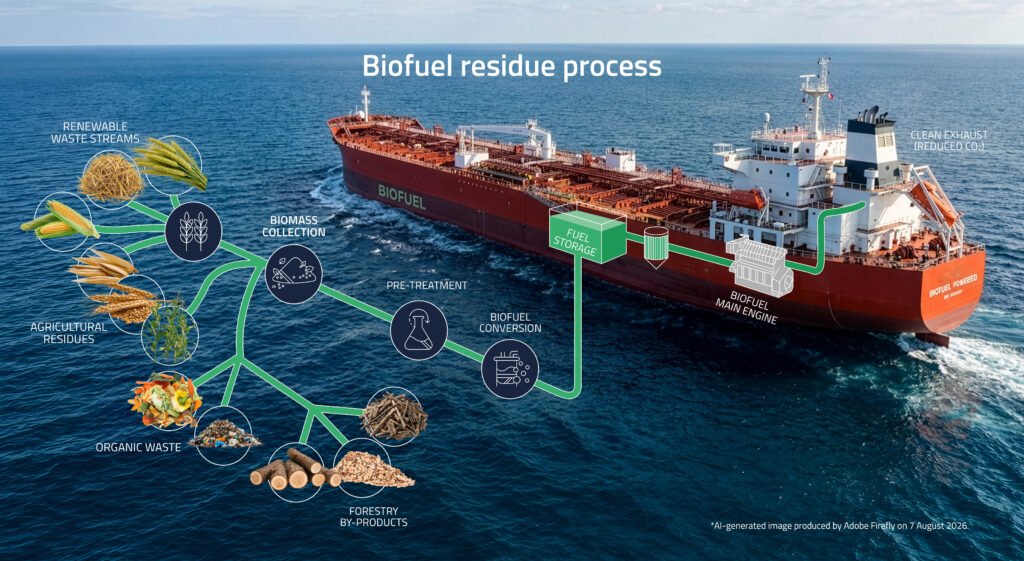
The maritime industry is increasingly turning to biofuels derived from waste and biological residues as shipping companies seek lower-carbon alternatives to conventional marine fuels. However, the growing use of bio-residues is also introducing new challenges around fuel quality, traceability, storage, compatibility and engine performance, according to NorthStandard.
Biofuels can be produced from feedstocks including used cooking oil (UCO), certain animal fats, palm oil mill effluent, tall oil, lignocellulosic residues, and agricultural, forestry and industrial waste streams. Unlike food crops such as corn, sugarcane, wheat and vegetable oils, these residue-based feedstocks can reduce direct competition with food production.
Policy measures are also strengthening the economic case for bio-residue fuels. The FuelEU Maritime regulation provides financial incentives for lower-emission fuels, while proposed changes to the EU Emissions Trading System (EU ETS) could establish a technology-neutral Sustainable Maritime Alternative Propulsion (SMAP) framework aimed at narrowing the cost gap between fossil and low-carbon fuels.
The Renewable Energy Directive (RED III) also supports the production of renewable fuels from qualifying waste and residue feedstocks. At the international level, the IMO Net-Zero Framework initially included a greenhouse-gas pricing mechanism intended to encourage lower-emission fuels, although member states remain divided over its implementation.
Why demand for marine biofuels is increasing
The continued reliance of much of the existing fleet on conventional oil-based fuels is expected to support demand for drop-in biofuels such as fatty acid methyl ester (FAME) and hydrotreated vegetable oil (HVO).
In its latest Maritime Forecast to 2050, DNV estimates that 89.8% of in-service tonnage can operate only on oil fuels.
“This implies reliance on drop-in fuels such as fatty acid methyl ester (FAME) or hydrotreated vegetable oil (HVO) for decarbonization, unless these vessels are converted to use alternative fuels or equipped with onboard carbon capture and storage,” says DNV. “For vessels currently on order, 60.6% of the tonnage and 79.5% of the ships by number face similar limitations.”
With a large proportion of the fleet unable to readily switch to alternative fuel systems, marine biofuels can provide a pathway to emissions reduction without requiring fundamental changes to vessel propulsion systems.
As demand rises, however, fuel suppliers are expected to increasingly explore less conventional and more complex bio-residue feedstocks.

Competition for bio-residues could increase supply-chain risks
Bio-residues are also being sought by sectors including aviation and heavy road transport. Competition for suitable feedstocks could push maritime fuel buyers towards more variable residue streams and blended products.
According to NorthStandard Director of Decarbonisation Mark Smith, this could expose ship operators to chemically variable feedstocks, blends sourced from multiple residue streams and greater uncertainty over fuel quality.
The risks extend beyond fuel specifications. Increased pressure on traceability systems could raise the potential for fraud or misclassification of sustainability values in proof-of-compliance documentation, while disputes relating to chain of custody could become more frequent.
For ship operators, inconsistent biofuel quality can affect both machinery and vessel performance. Potential issues include oxidation instability, changes in acidity and cold-flow characteristics, degradation during storage, injector fouling and fuel-pump wear.
Higher sediment levels can also contribute to blockages in purifiers and filters. Residual contaminants or water may increase the risk of microbial growth, while incompatibility between biofuels and conventional marine fuels can create problems involving seals, gaskets, coatings and certain alloy metals.
Variations in fuel composition between batches could further affect engine performance and machinery condition over time, potentially increasing maintenance requirements.
Fuel management becomes critical
NorthStandard is advising ship operators to strengthen fuel-management procedures as bio-residue fuels become more widely adopted.
Tank cleaning before loading biofuels is one area requiring particular attention. Standard fuel testing may also need to be supplemented with additional analysis covering microbial growth, chemical contamination and other parameters relevant to biofuel quality.
Operators are advised to source fuels from reliable suppliers and obtain detailed fuel specifications and quality declarations. Biofuels should not be blended with other fuels unless compatibility testing has established that the products can be safely mixed.
NorthStandard also recommends monitoring fuel storage conditions, including temperature and water drainage, while paying close attention to purification, filtration, sludge formation and fuel-transfer systems.
Additional monitoring of fuel pumps, injectors and cylinder condition may also help identify emerging machinery issues.
Documentation and certification are increasingly important
The use of bio-residue fuels also creates additional requirements around documentation and sustainability certification.
Ship operators should retain information on fuel composition and blending, particularly because different fuel properties may influence the behaviour and environmental impact of spills. Such information can also support pollution-response and clean-up operations.
Certification systems such as International Sustainability & Carbon Certification (ISCC EU) can help establish whether a fuel has been produced from qualifying waste or residue feedstocks rather than crops. Documentation is also important for demonstrating lifecycle greenhouse-gas performance and supporting third-party compliance audits.
As marine biofuel use expands, the industry’s challenge will therefore extend beyond securing sufficient volumes. Maintaining consistent fuel quality, reliable certification, robust traceability and effective onboard fuel-management practices will be critical to ensuring that bio-residue fuels deliver their intended emissions-reduction benefits without creating additional operational and pollution risks.
Read more about Biofuels in NorthStandard’s whitepaper here.
Recent Posts
Biofuels
Marine Biofuels Gain Ground as Bio-Residues Create New Fuel-Quality Risks
Marine
MOL Ocean Bulk secures 25-year Vale contract for world’s first tri-fuel 210,000 dwt ore carriers
LNG
LNG leads as alternative-fuel newbuild orders hit two-year monthly high in September: DNV