
Summary
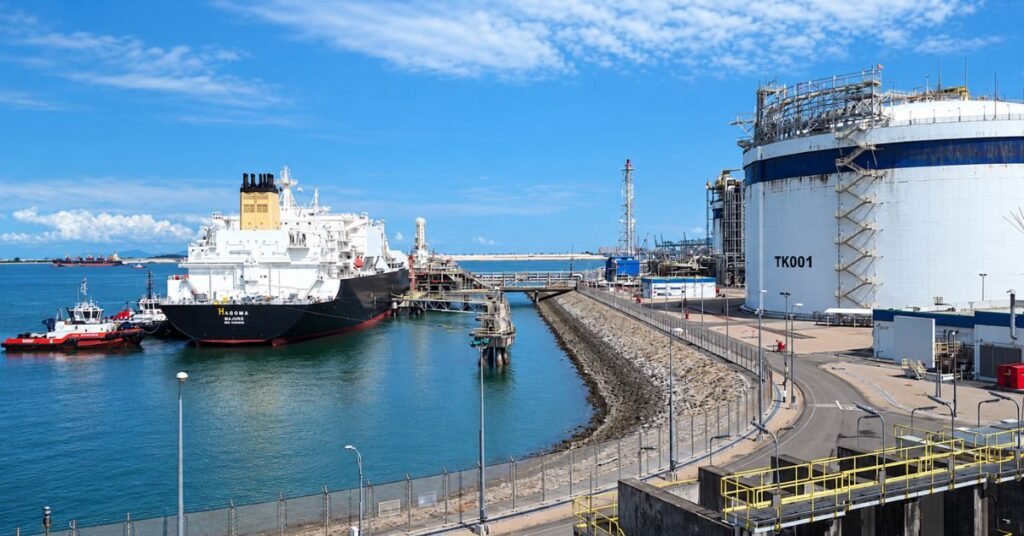
Shell and Singapore LNG Corporation have imported the SLNG terminal’s first ISCC EU-certified bio-LNG cargo, delivered aboard Macoma. The shipment used US-sourced biomethane accounted for through a mass-balance system within conventional LNG infrastructure, demonstrating a certified supply pathway for potential use in power generation, shipping and trucked LNG markets.
Certified import connects overseas supply with Singapore
The SLNG bio-LNG cargo announced on 9 October 2026 marks a step in establishing renewable gas supply chains through Singapore’s existing LNG terminal.
Shell supplied the shipment following the arrival of the LNG tanker Macoma. The certified biomethane originated in the United States and was mass-balanced through a pipeline system to a liquefaction plant, where its sustainability characteristics were allocated within a conventional LNG cargo.
The arrangement links certified sourcing with liquefaction, transportation, discharge and storage. It demonstrates the use of established infrastructure while maintaining an accounting trail for renewable gas.
The companies did not disclose the certified biomethane quantity, total cargo size, price or a named end-user. The announcement confirms an import milestone rather than a completed marine bunkering delivery.
Mass balance preserves documented sustainability attributes
Mass balance allows certified and conventional material to move through shared infrastructure while retaining records of eligible quantities and sustainability characteristics.
It does not require renewable gas molecules to remain physically segregated throughout every stage. Consequently, describing the shipment as certified bio-LNG should not be interpreted as meaning that the entire vessel cargo consisted of physically separated biomethane.
ISCC’s biomethane guidance requires documentation covering the relevant quantities and verification of physical connections between gas-grid input and output points. Delivery invoices or contracts and gas-grid information support that reporting.
The system also restricts the transfer of sustainability credits where the matching quantity of sustainable material is absent at the end of a mass-balancing period.
These requirements make traceability central to the commercial proposition. They provide a framework for accounting that accompanies the fuel movement, rather than relying solely on a renewable label attached to the shipment.
Terminal certification supports downstream handling
SLNG has separately obtained ISCC EU certification covering bio-LNG storage, regasification and send-out, bunkering and trucking.
That certification extends the terminal’s readiness across several distribution services. It supports documentation as fuel moves from import infrastructure towards potential customers in different sectors.
The terminal is also working with partners on certification and accounting practices across the upstream-to-terminal chain.
This combination of cargo certification and certified handling capability addresses different parts of the supply route. The import establishes a practical delivery example, while terminal certification supports the subsequent management of eligible fuel quantities.
Jetty expansion adds a physical infrastructure component
The cargo announcement coincided with SLNG’s groundbreaking for a third jetty at its Jurong Island terminal on 9 October.
Jetty 3 will accommodate LNG carriers ranging from 5,800 to 80,000 cubic metres and will be the terminal’s first berth dedicated to small and mid-scale vessels.
Completion is scheduled for the second half of 2028. The facility is expected to support approximately two million tonnes of annual LNG bunker reload demand, alongside break-bulk and other small-scale activities.
Together with existing infrastructure, SLNG could potentially support up to three million tonnes of bunker reloads annually, depending on demand. The new jetty will also have bio-LNG handling capability.
These are future infrastructure capabilities, distinct from the certified cargo already imported. They nevertheless provide context for the terminal’s efforts to develop renewable gas handling alongside its broader LNG services.
Earlier supply agreement targeted customers from 2027
Shell’s Singapore bio-LNG activity predates the latest shipment. In September 2025, it signed a supply agreement with Knowledge Integration Services.
That arrangement was intended to enable Shell to supply biomethane, regasified from bio-LNG, to Singapore customers starting in 2027.
Shell described bio-LNG as a renewable fuel derived from organic waste that can be used through existing gas infrastructure. Its compatibility offers a potential route for customers seeking lower lifecycle emissions without major equipment changes.
The 2025 agreement and October 2026 import are separate developments. The latest announcement does not identify Knowledge Integration Services as the source of this US-origin cargo or confirm that the earlier agreement’s customer deliveries have begun.
Existing terminal services provide the operational backdrop
SLNG’s development history shows an established platform for distributing smaller LNG quantities. The terminal completed its first small-scale reload in June 2017 and modified its secondary jetty in February 2019 to accommodate reloads onto vessels between 2,000 and 10,000 cubic metres.
It also joined the Rotterdam–Singapore Green and Digital Shipping Corridor in September 2024, supporting work on biomethane and bio-LNG adoption.
The latest certified import builds on that operational foundation, adding documented renewable gas sourcing to existing terminal capabilities and planned capacity expansion.
FAQs
Who delivered the certified cargo?
Shell supplied the cargo aboard the LNG tanker Macoma to the SLNG terminal.
Where did the biomethane originate?
It was sourced from the United States.
Was the entire cargo physically segregated bio-LNG?
The announcement describes certified biomethane allocated through mass balance within a conventional LNG cargo.
Has the fuel been supplied to a ship as bunkers?
The announcement confirms an import and terminal handling milestone, without identifying a completed bunkering delivery.
What services does SLNG’s certification cover?
Storage, regasification and send-out, bunkering and trucking.
Recent Posts
Marine
ABS and US Department of Energy Sign MOU on Maritime Nuclear Technology
Fuels
Repsol Supplies B30 Co-Processed Marine Fuel to NCLH in Barcelona
Ammonia
Viking Energy Set for Ammonia Bunkering Test After Norwegian Safety Approval