
Summary
Swiss energy company Axpo has completed its first LNG bunkering operation at the Port of Valencia, Spain, with its 12,500 m³ bunker vessel Alisios refuelling a container ship for a global logistics company. More than half of the fuel delivered was bio-LNG, extending Axpo’s growing LNG and bio-LNG bunkering network across Spanish, Portuguese and Italian ports.
Article
Valencia: Axpo completed its first liquefied natural gas (LNG) bunkering operation at the Port of Valencia, Spain, on Tuesday, October 13, 2026.
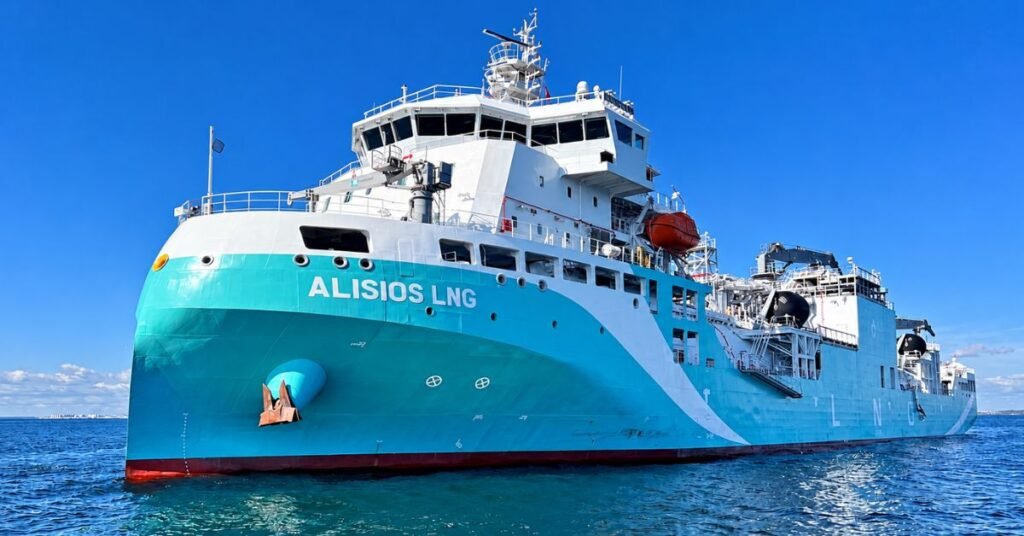
Axpo’s bunker vessel Alisios refuelled a container ship operated for a global transport and logistics company. More than half of the LNG supplied was bio-LNG. The receiving vessel and its operator were not named.
Why is Valencia important?
Daniele Corti, Head of Small-Scale LNG at Axpo, said Valencia is Spain’s largest container port and the fifth-busiest container port in Europe, making it “a strategically important location.” He said the operation strengthens Axpo’s presence in the LNG market, serving customers across a growing number of key European ports.
What is the Alisios?
Alisios is a 12,500 m³ LNG bunkering vessel operated by Axpo. It was launched in March 2026 at the Port of Huelva in south-west Spain and operates along the southern coast of the Iberian Peninsula, supplying LNG and bio-LNG as transition fuels for shipping.
How has Axpo’s network grown?
Axpo has expanded rapidly in the Spanish bunkering market over the past 18 months. It completed its first LNG delivery in Málaga in April 2025, followed by operations at Algeciras, Sines in Portugal and Barcelona.
In Italy, Axpo carried out the country’s first ship-to-ship bio-LNG bunkering in Genoa in December 2025, followed by operations in Naples in May 2026 and Civitavecchia in August 2026.
How competitive is the Valencia LNG market?
The Valencia region is becoming a competitive LNG bunkering market. Peninsula recently completed its first LNG bunkering at the nearby Port of Sagunto using the 12,500 m³ vessel Levante LNG, supplying K Line’s car carrier Thor Highway. Peninsula holds bunkering licences covering Valencia, Sagunto and Gandía.
Elsewhere in Spain, Repsol has supplied co-processed B30 biofuel to a cruise ship in Barcelona using its hybrid bunker vessel Bahía Candela, underlining the variety of lower-carbon fuels now on offer at Spanish ports.
Why does the bio-LNG share matter?
Supplying a majority bio-LNG blend allows the shipowner to reduce greenhouse gas intensity under the EU’s FuelEU Maritime regulation without changing engines or fuel systems. However, the economics are shifting. Weekly market data from ENGINE show that falling FuelEU pooling prices have recently reduced bio-LNG’s compliance advantage, with Rotterdam bio-LNG moving from a discount to a premium over fossil LNG.
Why does it matter?
Axpo’s expansion into Valencia gives container lines calling at one of Europe’s busiest Mediterranean hubs another source of LNG and bio-LNG. With LNG dual-fuel container ships accounting for a growing share of new tonnage, the availability of bio-LNG at major ports offers a practical pathway to reduce emissions from existing LNG-fuelled fleets, while competition between suppliers in the western Mediterranean should improve supply options and pricing for shipowners.
FAQs
What did Axpo achieve in Valencia?
It completed its first LNG bunkering operation at the Port of Valencia on October 13, 2026.
How much of the fuel was bio-LNG?
More than half of the LNG supplied was bio-LNG.
What vessel did Axpo use?
The Alisios, a 12,500 m³ LNG bunkering vessel launched in March 2026 at Huelva.
Where else does Axpo supply LNG?
In Spain at Málaga, Algeciras and Barcelona, in Portugal at Sines, and in Italy at Genoa, Naples and Civitavecchia.
Why is Valencia significant for LNG bunkering?
It is Spain’s largest container port and the fifth-busiest container port in Europe.
Recent Posts
Marine
Singapore Unveils Ammonia Bunkering Standard, First Ethanol Bunkering and LNG Storage Plans
Ammonia
Singapore Launches TR 148 Ammonia Bunkering Standard and Model Contract to Prepare for Ammonia-Fuelled Ships
Policy
China Targets Doubling New Energy Inland Vessels by 2028 Under 2026-2030 Action Plan