
Summary
The Maritime and Port Authority of Singapore, CMA CGM and Singapore LNG Corporation have signed an MoU at SIBCON 2026 to explore the supply and use of liquefied bio-methane as a marine fuel. The partners will study how existing gas infrastructure can deliver bio-methane, how its emissions savings are accounted for when blended with natural gas, and run pilots under real operating conditions.
Article
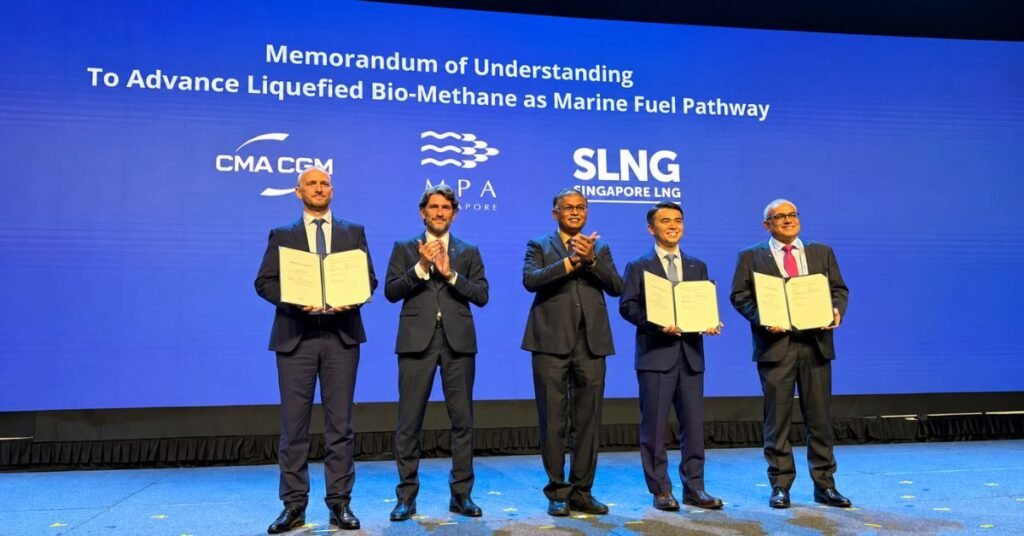
The Maritime and Port Authority of Singapore (MPA), the CMA CGM Group and Singapore LNG Corporation (SLNG) signed a Memorandum of Understanding on October 14, 2026, to develop liquefied bio-methane as a marine fuel in Singapore.
The MoU was signed at SIBCON 2026 by Ang Wee Keong, Chief Executive of MPA; Bo Wegener, CEO of CMA CGM Asia Pacific; and Leong Wei Hung, CEO of SLNG.
What does the MoU cover?
The partnership combines MPA’s regulatory and industry development role, CMA CGM’s shipping and logistics expertise and SLNG’s LNG infrastructure and technical capabilities. The parties will share knowledge and best practices to develop bio-methane supply pathways in Singapore, covering certification, supply and use as a marine fuel.
Specifically, they will explore:
- How existing gas infrastructure in Singapore could support the supply of liquefied bio-methane for shipping
- How bio-methane’s sustainability attributes and greenhouse gas savings can be properly accounted for when it is mixed with natural gas in shared infrastructure
- Pilots and trials to validate these approaches under real operating conditions
The findings will build industry knowledge to support bio-methane bunkering capabilities in Singapore.
What did the partners say?
“LNG is an established marine fuel in Singapore,” said Ang, adding that MPA is now looking at how lower-emission variants can build on existing infrastructure and capabilities as part of Singapore’s multi-fuel bunkering strategy.
Wegener said decarbonising shipping requires collective action and credible energy pathways that can be deployed at scale, describing bio-methane supply solutions as a key enabler for the sector.
Leong said bio-methane supports both maritime decarbonisation and Singapore’s wider energy transition. He noted SLNG is one of the region’s first LNG terminals certified under the ISCC EU framework to handle liquefied bio-methane, placing it well to support the fuel’s development.
Why is bio-methane significant?
Liquefied bio-methane, also known as bio-LNG, is chemically similar to fossil LNG, so it can be used in existing LNG-fuelled engines and handled through current LNG supply infrastructure. This makes it a potential drop-in route to cut emissions from the growing fleet of LNG dual-fuel ships, particularly container vessels.
CMA CGM has been among the most active adopters of LNG propulsion for large container ships, giving it a direct interest in lower-carbon LNG pathways.
A key challenge is accounting. When bio-methane is mixed with fossil LNG in shared tanks and pipelines, a robust mass-balance and certification system is needed so that buyers can credibly claim emissions reductions under regulations such as FuelEU Maritime. The MoU’s focus on accounting addresses this directly.
What is the wider context?
The MoU is one of several measures announced at SIBCON 2026, alongside licence applications for LNG floating storage units and the award of eight new LNG bunker supplier licences in July 2026.
Market economics remain a hurdle. In Rotterdam, bio-LNG recently swung from a discount to a premium over fossil LNG as FuelEU pooling values fell, reducing its compliance advantage, according to ENGINE data.
Why does it matter?
By testing how bio-methane can move through existing LNG infrastructure and be credibly certified, Singapore aims to give LNG-fuelled ships a practical pathway to lower emissions without new bunkering assets. If the pilots succeed, the model could be replicated at other LNG bunkering hubs, including ports in India developing LNG and alternative fuel bunkering.
FAQs
Who signed the bio-methane MoU?
MPA, the CMA CGM Group and Singapore LNG Corporation (SLNG).
What is liquefied bio-methane?
A renewable form of LNG produced from organic sources that can be used in existing LNG-fuelled ships and infrastructure.
What will the partners study?
Supply via existing gas infrastructure, accounting for emissions savings when blended with natural gas, and pilots under real operating conditions.
Is SLNG certified to handle bio-methane?
Yes. SLNG says it is one of the region’s first LNG terminals certified under ISCC EU to handle liquefied bio-methane.
Why does accounting matter for bio-methane?
When blended with fossil LNG in shared infrastructure, credible certification is needed for shipowners to claim emissions reductions under rules like FuelEU Maritime.
Recent Posts
Marine
Singapore Unveils Ammonia Bunkering Standard, First Ethanol Bunkering and LNG Storage Plans
Ammonia
Singapore Launches TR 148 Ammonia Bunkering Standard and Model Contract to Prepare for Ammonia-Fuelled Ships
Policy
China Targets Doubling New Energy Inland Vessels by 2028 Under 2026-2030 Action Plan