
Summary
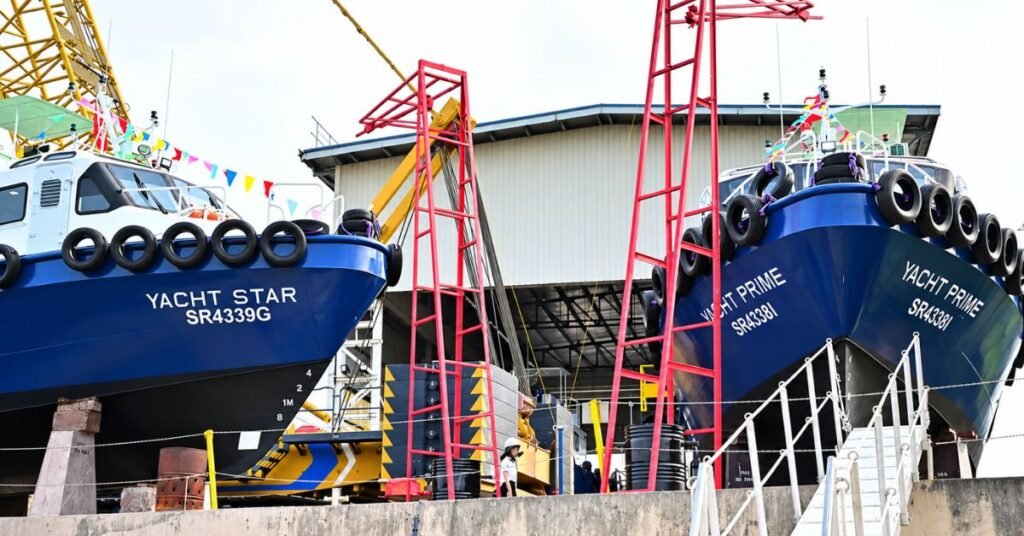
Pinnacle Marine has launched two aluminium utility boats for Excelessel Offshore, taking its B100-compatible vessel launches to five. Named Yacht Prime and Yacht Star, the boats form part of a six-vessel programme as Singapore’s harbour craft sector prepares for new fuel-capability requirements from 2030.
Twin launch advances vessel programme
Singapore-based Pinnacle Marine launched two B100-compatible utility boats, Yacht Prime and Yacht Star, on 19 October 2026 for Excelessel Offshore Pte Ltd.
The vessels are designed to accommodate pure biodiesel, giving their owner an alternative-fuel option as Singapore advances the decarbonisation of marine services within its port waters.
The launch represents a construction milestone. The announcement did not specify delivery dates, the start of commercial operations or confirmed B100 consumption by either vessel.
Pinnacle Marine described Excelessel Offshore’s participation with two vessels as a step towards fleet renewal and alternative marine-fuel adoption. The development also brings the shipbuilder closer to completing its current B100-compatible programme.
Sixth vessel targeted for November
Yacht Prime and Yacht Star follow three earlier launches: President 100 in July 2025, Sea Horizon on 2 October 2026 and Baraka-9 on 5 October.
A sixth and final vessel is targeted for launch around mid-November 2026. That remains a planned milestone rather than a completed launch.
Earlier construction updates provide additional background to the programme. In August, Pinnacle Marine reported that all five vessels in its planned series of 20-metre B100-compatible utility boats had entered construction.
That series builds on experience gained from President 100, which the company identifies as a 16-metre B100-compatible utility vessel. Together, the earlier craft and subsequent newbuilds show how the yard has progressed from an initial vessel towards a broader construction programme.
Pinnacle Marine also received the Harbour Craft Decarbonisation Excellence Award at Singapore’s Harbour Craft Forum 2026, recognising its work on B100 adoption and compatible vessel development.
Singapore’s 2030 requirements shape investment
The launches come against an established policy timetable for Singapore’s domestic maritime sector.
From 2030, all new harbour craft operating in the Port of Singapore must be fully electric, capable of using B100 biofuel, or compatible with net-zero fuels such as hydrogen.
The Maritime and Port Authority of Singapore has also asked operators planning new harbour craft to inform it of their proposals from January 2027, allowing vessel designs to be adjusted where necessary.
These requirements support Singapore’s wider objective of achieving net-zero emissions by 2050. They give owners and builders a framework for evaluating propulsion and fuel choices before commissioning replacement vessels.
For Excelessel Offshore, the vessels provide a technical route towards biodiesel adoption. Their eventual operating performance and environmental benefits will depend on how that capability is used, including the fuel supplied and actual consumption.
B100 availability supports the transition
B100 denotes pure biodiesel, rather than a blend containing conventional petroleum diesel. Compatibility establishes a vessel’s ability to use the fuel; it does not, by itself, demonstrate that the vessel operates exclusively on biodiesel.
Singapore’s bunkering framework already accommodates biofuels ranging from lower blends to B100. MPA’s published requirements address matters including fuel specifications, delivery arrangements and measurement.
For biofuel deliveries using mass flow meters, suppliers must ensure that the equipment is suitable for the fuel being measured and supported by the meter manufacturer. These arrangements form part of the supporting infrastructure needed as more vessels become capable of using higher biofuel blends.
Incentives focus on qualifying fuel use
Singapore has also introduced financial incentives to encourage cleaner harbour craft.
Under its Green Craft Programme, qualifying newbuild harbour craft registered between 1 January 2025 and 31 December 2027 can receive port-dues concessions of up to 100%, subject to the applicable criteria.
The programme covers low-carbon fuels, zero-carbon fuels and zero-emission fuels or technologies. Eligibility therefore depends on meeting the programme’s conditions, rather than simply describing a vessel as alternative-fuel compatible.
There has been no confirmation that Yacht Prime or Yacht Star has received these concessions. Nevertheless, the combination of regulatory requirements, fuel-supply arrangements and incentives provides a wider commercial setting for investment in B100-capable harbour craft.
FAQs
What are the two vessels called?
They are named Yacht Prime and Yacht Star.
Who were the boats built for?
They were built for Excelessel Offshore Pte Ltd.
Are the vessels already operating on B100?
The launch announcement confirms compatibility but does not establish commercial operation or actual B100 use.
When is the next launch planned?
Pinnacle Marine is targeting mid-November 2026 for the sixth and final vessel.
What will Singapore require from new harbour craft in 2030?
They must be fully electric, capable of using B100, or compatible with net-zero fuels such as hydrogen.
Recent Posts
Ammonia
Maersk Tankers Ammonia Retrofit Project Advances Towards EU Support
Policy
EU Maritime Innovation Projects Advance in €3.4-Billion Funding Selection
Policy
Shanghai–Melbourne Green Shipping Corridor Sets 2035 Vessel Deployment Goal