
Summary
The Shanghai–Melbourne Green Shipping Corridor has entered its implementation phase, with partners targeting low-carbon-fuelled container vessels on the route by 2035. The programme combines fuel-supply development, bunkering assessments, shore-power planning and digital cooperation, building on the agreement established between the ports in October 2025.
Implementation plan advances the partnership
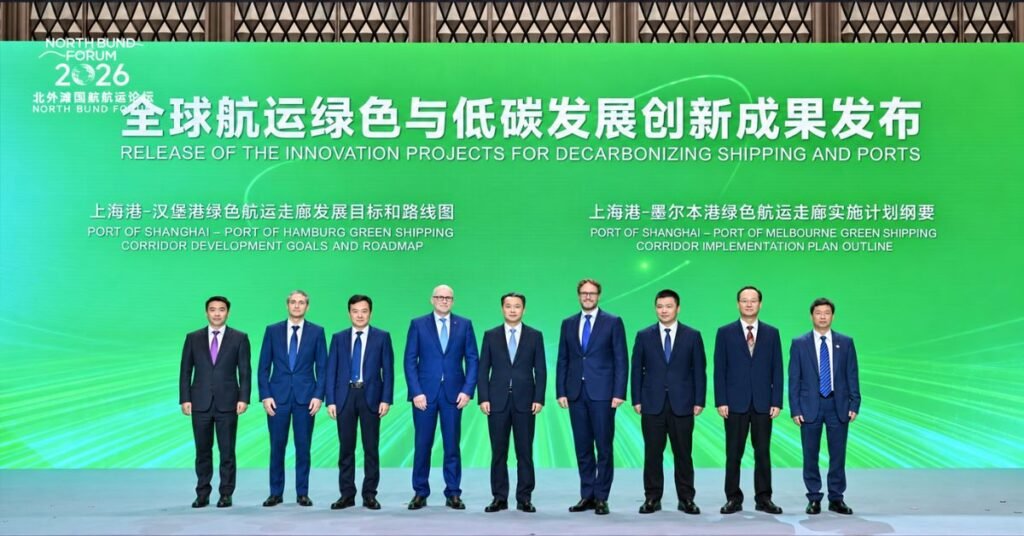
The Shanghai–Melbourne Green Shipping Corridor has moved into a delivery phase following the launch of an implementation plan by the ports and C40 Cities.
Announced on 21 October 2026, the plan sets out work intended to reduce emissions across the maritime supply chain connecting China and Australia.
A central objective is to complete baseline assessments and feasibility studies and deploy one or more container vessels using non-fossil-based low-carbon fuels by 2035.
That timetable establishes a development goal. The announcement does not identify a confirmed vessel, deployment date or dedicated operating schedule.
Fuel supply and bunkering receive attention
Green methanol, biofuels and other non-fossil-based low-carbon fuels form part of the proposed transition.
Shanghai aims to develop annual bunkering capacity of one million tonnes for green methanol and biofuels. Melbourne will assess the feasibility of alternative-fuel bunkering infrastructure.
The partners intend to work with shipping lines and energy suppliers to connect production, transport and marine fuel delivery. Industry participants include Shanghai International Port Group, COSCO Shipping Lines, HAMR Energy, ABEL Energy and Shenergy.
For fuel producers, a defined route offers a setting in which to examine potential customers and delivery requirements. For shipowners, dependable fuel availability must align with vessel capability, voyage schedules and operating costs.
The capacity ambition should therefore be distinguished from actual fuel sales or contractual purchases. Commercial uptake will require agreements between suppliers and customers as the programme develops.
Shore power and data systems broaden the scope
The implementation plan extends beyond propulsion fuels.
At Melbourne, the work includes assessing shore-power feasibility and the infrastructure needed to support it. The partners will also explore connections between port and ship data systems, voyage optimisation and interoperable digital tools.
These activities are intended to improve operational efficiency, transparency and emissions performance. They also reflect the corridor’s wider supply-chain focus, encompassing how vessels and ports coordinate their operations.
The practical value will depend on participation across the route. Shared information must be useful to the organisations making decisions about sailing, arrival, berthing and cargo handling.
Similarly, infrastructure development will need to match the requirements of the ships expected to use it. Assessments will help establish where investment is justified and how implementation should be sequenced.
Earlier agreement established the framework
The corridor was formalised at the North Bund Forum in Shanghai on 19 October 2025.
That agreement brought together the Port of Melbourne and Shanghai Municipal Transportation Commission, supported by C40 Cities. It envisaged cooperation with shipping companies and energy suppliers to increase the use of cleaner vessels and strengthen low-carbon fuel supply chains.
The partnership also sought improvements in production efficiency, cost control, transportation and storage. These earlier objectives provide the foundation for the implementation work now announced.
The relationship predates the corridor itself. Melbourne and Shanghai’s transport authorities began their sister-port partnership in 2006, making 2026 its twentieth anniversary.
In its 2025 announcement, Melbourne identified China as its largest trading partner, accounting for approximately half of container imports and one-fifth of container exports. Those figures concern China-related trade overall, rather than only cargo moving through Shanghai.
Delivery depends on coordinated investment
The programme creates a framework for aligning vessels, fuels and supporting infrastructure along an established trade relationship.
Commercially, its significance lies in bringing the parties responsible for those investments into a common planning process. Fuel producers need demand visibility, while shipping lines need confidence in supply, infrastructure and costs.
Melbourne’s separate commitment to net-zero emissions from its own operations by 2030 sits alongside the corridor’s broader supply-chain objectives. The operational target does not encompass every vessel or cargo movement using the port.
The next milestones will be completed studies, defined infrastructure proposals and commercial commitments. These will show how the implementation plan translates into fuel availability and lower-emission shipping services.
FAQs
What has been announced?
An implementation plan covering cleaner fuels, port infrastructure and operational cooperation.
What is the vessel deployment target?
One or more low-carbon-fuelled container vessels on the route by 2035.
Which fuels are being considered?
Green methanol, biofuels and other non-fossil-based low-carbon fuels.
Has Melbourne confirmed a new bunkering facility?
The plan provides for feasibility assessment rather than a confirmed operating facility.
When was the corridor established?
The founding agreement was formalised on 19 October 2025.
Recent Posts
Ammonia
Maersk Tankers Ammonia Retrofit Project Advances Towards EU Support
Policy
EU Maritime Innovation Projects Advance in €3.4-Billion Funding Selection
Policy
Shanghai–Melbourne Green Shipping Corridor Sets 2035 Vessel Deployment Goal