
Summary
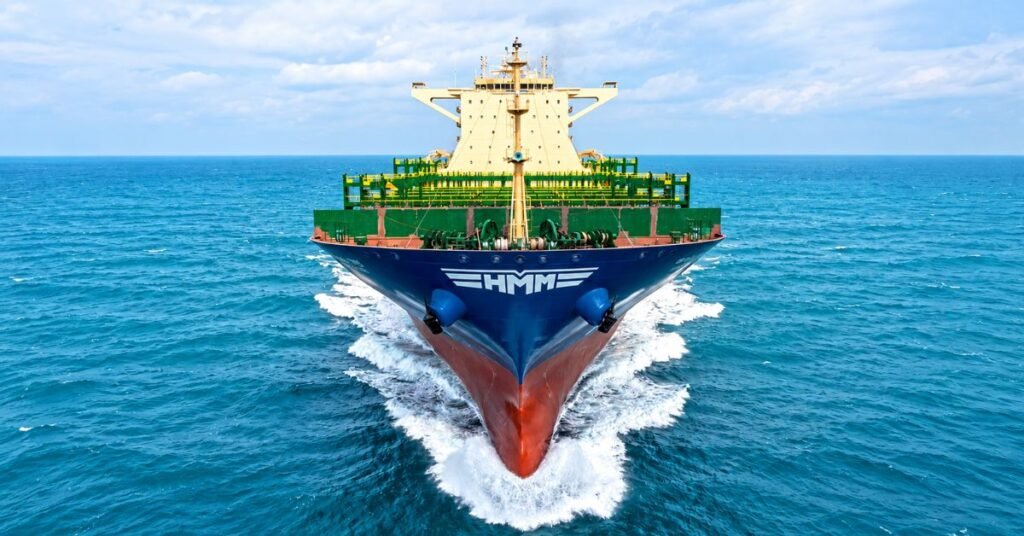
HMM has ordered eight 13,000-TEU LNG dual-fuel container ships from HD Korea Shipbuilding & Offshore Engineering in a contract worth approximately KRW1.92 trillion. Construction will be divided between two South Korean yards, with deliveries scheduled through 2029 as the carrier advances its longer-term fleet expansion programme.
Eight ships contracted across two yards
The HMM LNG dual-fuel ships order covers vessels capable of operating on either liquefied natural gas or conventional marine fuel.
Announced on 20 October 2026, the contract assigns two ships to HD Hyundai Heavy Industries in Ulsan and six to HD Hyundai Samho in Yeongam, South Jeolla Province.
Each vessel will measure approximately 337 metres in length. The ships will incorporate independent LNG fuel tanks manufactured by HD Hyundai Ecovina, the group’s specialised tank-production facility.
The eight vessels represent a combined nominal capacity of 104,000 TEUs. That is contracted carrying capacity entering the delivery pipeline, rather than an immediate increase in HMM’s operating fleet.
Delivery programme supports fleet planning
The vessels are scheduled for delivery through 2029, providing HMM with additional tonnage towards the end of the decade.
The announcement does not identify the services on which they will operate. Deployment decisions will determine whether the ships provide growth on existing routes, replace other vessels or support changes to the carrier’s network.
For cargo owners, the commercial effect will depend on those decisions. An order establishes future vessel availability, while sailing frequency, port coverage and freight capacity emerge from the operating plans subsequently assigned to the ships.
For the shipbuilding group, the contract adds a substantial series to its orderbook, with construction distributed across two established yards.
Latest investment follows revised strategy
The order sits within HMM’s investment programme extending to 2030.
The carrier’s revised strategy envisages approximately KRW29 trillion in investment and a container fleet of 166 ships with aggregate capacity of 1.47 million TEUs. It also targets 110 bulk carriers totalling 13.52 million deadweight tonnes.
The revised container target differs from the strategy announced in September 2024. At that time, HMM planned a 130-vessel fleet with capacity of 1.55 million TEUs and total investment of KRW23.5 trillion.
The earlier programme allocated spending across container shipping, bulk shipping, integrated logistics and competitiveness improvements. It also linked fleet development with changes in global shipping alliances.
The comparison illustrates how fleet planning can evolve. Vessel numbers and total carrying capacity measure different aspects of a network, and neither figure alone establishes the eventual size mix or deployment pattern.
Dual-fuel capability provides operating flexibility
The selected propulsion arrangement allows the new ships to use LNG while retaining the ability to run on conventional marine fuel.
Commercially, that flexibility gives the operator options when considering fuel availability and voyage requirements. Its value will depend on bunker prices, supply arrangements and the ships’ actual operating profiles.
The announcement does not provide a quantified emissions-reduction guarantee for the vessels. Describing them as LNG-capable therefore identifies their propulsion technology without establishing their complete greenhouse-gas performance.
That distinction is relevant when assessing the environmental contribution of new ships over their operating lives.
Lifecycle assessment remains important
IMO’s framework for evaluating marine fuels considers emissions across the fuel lifecycle, encompassing production and supply as well as onboard use.
Its 2024 lifecycle guidelines provide a methodology for assessing greenhouse-gas intensity across different fuels and energy carriers. The framework covers carbon dioxide, methane and nitrous oxide.
For LNG-powered vessels, this makes the fuel pathway and engine performance important to the overall assessment. Propulsion capability is one element; the emissions associated with producing, transporting and consuming the fuel also matter.
The appropriate commercial and environmental comparison will consequently depend on the specific fuel supplied and verified operating performance.
Construction milestones will clarify deployment
The next steps will involve detailed engineering, construction and the delivery sequence across the two yards.
As the ships approach completion, HMM’s deployment announcements will provide a clearer picture of their contribution to its route network and capacity strategy.
For ports, suppliers and logistics partners, those decisions will be more immediately relevant than the order’s aggregate TEU figure. They will determine where the vessels call, what supporting services they require and how customers can use the additional shipping capacity.
FAQs
How many ships has HMM ordered?
Eight LNG dual-fuel container ships of 13,000 TEUs each.
What is the contract value?
Approximately KRW1.92 trillion.
Which yards will build them?
HD Hyundai Heavy Industries will build two, and HD Hyundai Samho will build six.
When are deliveries expected?
Deliveries are scheduled through 2029.
Have their operating routes been announced?
The available announcement does not specify service deployments.
Recent Posts
Ammonia
Maersk Tankers Ammonia Retrofit Project Advances Towards EU Support
Policy
EU Maritime Innovation Projects Advance in €3.4-Billion Funding Selection
Policy
Shanghai–Melbourne Green Shipping Corridor Sets 2035 Vessel Deployment Goal