
Summary
Singapore-based VC Power is applying artificial intelligence to marine battery sizing and performance management, aiming to reduce unnecessary capacity and improve operating efficiency. The company has outlined potential fuel and engine-hour savings for offshore vessels, while its approach places vessel operating data at the centre of battery investment decisions.
Article
Digital analysis guides battery selection
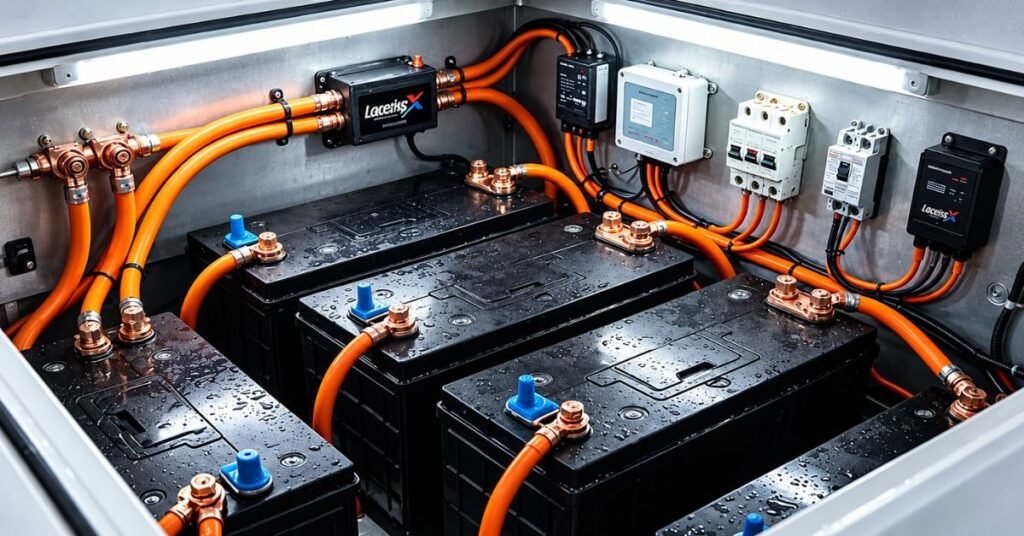
VC Power marine batteries are being offered alongside digital tools intended to help owners determine suitable storage capacity and manage performance after installation.
Chief executive Shengwei Wu outlined the approach at the 2026 Offshore Support Vessel Asia Conference. The company supplies integrated and containerised battery systems and charging equipment for vessel categories including offshore support vessels, tugs and crewboats.
Wu cited an example in which analysis reduced a proposed installation from 2,000 kWh to 1,700 kWh—a 15% reduction in specified capacity.
The commercial objective is to avoid paying for storage that the vessel’s operating profile does not require, while reducing associated space and weight demands.
Performance figures remain application-specific
Wu said the company’s newbuilding solutions could reduce engine running hours by 38% and fuel consumption by around 20%, with a payback period of three to four years.
He also described active load balancing across battery racks and modules as a means of limiting uneven degradation, with potential battery-life improvements of up to 10%.
These are company-reported performance claims. The published account does not provide named vessels, detailed operating baselines or independent verification for each figure.
They should therefore be treated as examples of potential outcomes rather than guaranteed results across offshore fleets.
Joint venture combines marine and battery expertise
The business follows a joint venture announced by Vallianz Holdings in November 2025 to pursue marine electrification opportunities.
Under that agreement, Vallianz Investment Capital was to hold 51% of Singapore-incorporated VC Power, with Chengrui Technology Singapore holding 49%.
Chengrui Technology Singapore is a subsidiary of Chengrui Power Technology in Shanghai, whose capabilities include vessel battery-electric systems and smart charging infrastructure.
The partnership was designed to combine Vallianz’s marine engineering and operational experience with its partner’s electrical technologies.
That earlier announcement provides the corporate background to VC Power’s market entry. It also establishes that the partnership agreement predates the company’s latest conference presentation.
Offshore operating profiles create opportunities
The rationale for hybrid batteries extends beyond replacing an engine with stored electricity.
IMO’s GreenVoyage2050 technology guidance identifies offshore vessels and tugs as relevant applications because their power requirements can fluctuate considerably.
Batteries can supply short-duration peaks while engines operate more consistently at efficient loads. During periods of low demand, stored power may also allow engines to stop, reducing running hours.
Dynamic-positioning vessels are a particular example: maintaining position can involve changing power demands while engines spend time operating below their most efficient load.
These characteristics explain why analysing real operating demand matters. A battery installation must support the vessel’s work, including transient loads and operating reserves, rather than be selected solely by nominal capacity.
Integration determines the wider business case
Earlier DNV research into hybrid auxiliary power systems examined batteries for peak shaving, load levelling and reserve power.
That work used trading patterns, operating modes and recorded power loads from conventional vessels to assess alternative configurations.
The approach illustrates the importance of evaluating batteries as part of the complete electrical system. Storage capacity, generator operation and the timing of power demand interact.
For owners considering an installation, the comparison consequently needs to include the equipment and its integration with the vessel, alongside the expected reduction in fuel consumption and machinery use.
Data quality will shape commercial value
VC Power’s proposition places greater emphasis on the information used before and after battery installation.
For a prospective customer, a useful assessment would establish the operating baseline, required reserve, charging opportunities and expected service pattern. These inputs influence whether a smaller installation remains appropriate throughout the vessel’s working cycle.
In-service monitoring can then help compare actual performance with the investment case.
The wider commercial opportunity is to improve the fit between battery systems and vessel operations. Demonstrating repeatable results across documented projects will be important as owners assess the technology’s contribution to fuel savings, maintenance and battery replacement costs.
FAQs
What is VC Power’s approach?
It combines battery systems with digital analysis to assess vessel-specific capacity and monitor performance.
What capacity reduction was cited?
One example reduced a proposed installation from 2,000 kWh to 1,700 kWh.
Are the reported savings guaranteed?
No. Outcomes depend on vessel configuration and operating conditions.
Who are the joint venture partners?
Vallianz Investment Capital and Chengrui Technology Singapore.
Why can batteries benefit offshore vessels?
They can support fluctuating power demand and help engines operate more efficiently.
Recent Posts
Ports & Harbours
VOC Port’s Tuticorin International Container Terminal Declared Green Terminal After Full Equipment Electrification
Hydrogen
India Could Become Leading Green Hydrogen Producer and Exporter, Says Gadkari
Fuels
Offshore Vessel Fuel Efficiency Offers Immediate Savings, Says Opsealog