
Summary
Hanwha Power has secured Approval in Principle from ABS for a 1,700-TEU battery-powered container ship concept featuring approximately 151 MWh of energy storage. Intended for short-sea and regional services, the design combines electric propulsion with containerised batteries, marking a development milestone ahead of any announced construction programme.
Article
Battery-powered design targets regional shipping
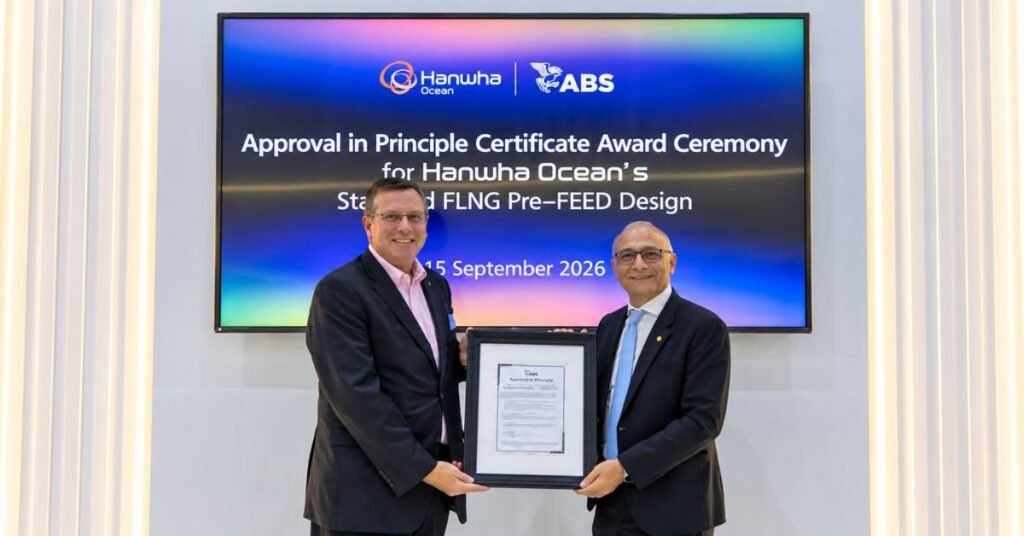
The Hanwha electric container ship design has received Approval in Principle from the American Bureau of Shipping, advancing the company’s development of battery-powered cargo vessels.
Hanwha Power announced the milestone on 23 October 2026. The certificate was presented the previous day during the Maritime Hybrid, Electric & Hydrogen Fuel Cells Conference in Bergen, Norway.
The proposed 1,700-TEU vessel would use approximately 151 MWh of stored electrical energy for propulsion, replenished through port charging infrastructure. Hanwha has also completed the basic design for a smaller, 1,000-TEU battery-powered container vessel.
Together, the designs indicate an effort to develop electric vessels for different customer requirements and operating conditions.
Containerised batteries shape the concept
The larger design places batteries in containerised units that can be handled and stowed in a similar manner to standard freight containers.
Hanwha says this arrangement supports battery replacement and allows the energy-storage configuration to be adapted. The company also identifies space utilisation and cargo capacity as design objectives.
For commercial operators, the practical assessment would involve balancing energy requirements with revenue-earning cargo space. A modular arrangement offers flexibility, but the suitability of a particular configuration would depend on the service being considered.
The announcement does not specify a customer, construction contract, delivery date, operating range or service speed. Those details will be important in assessing how the concept could perform on an actual route.
Approval establishes an early technical milestone
Approval in Principle provides an independent assessment of a concept at its current development stage. ABS explains that the process helps evaluate innovative technologies while considering principal safety issues and potential hazards.
It should therefore be understood as an initial technical milestone, rather than confirmation that a completed vessel has been built, tested or approved for commercial operation.
For a prospective owner, the approval can provide a basis for further engineering discussions. Detailed design, equipment selection, construction oversight and testing would form subsequent parts of bringing a vessel into service.
ABS’s guidance on novel concepts describes concept-stage engineering evaluation as examining feasibility against the intended safety level of relevant rules and statutory requirements, as far as practical at that stage.
Earlier operations demonstrate a modular approach
Battery-powered container transport already has an operational precedent in China.
In April 2024, COSCO Shipping Green Water 01 completed its inaugural journey to Shanghai’s Yangshan Port. The vessel was developed for the connection between Nanjing and Yangshan, combining inland and coastal navigation.
The 119.8-metre ship incorporated more than 50,000 kWh of battery capacity and an arrangement allowing the number of battery packs to be adjusted. Charging and battery-exchange operations formed part of its port interface.
That earlier deployment provides relevant background for Hanwha’s concept: batteries, cargo arrangements and port energy facilities must work together as a transport system.
However, the vessels serve different development programmes. Their battery capacities alone do not establish comparable range, speed, efficiency or commercial performance. Such comparisons require information about vessel loading, operating conditions and energy consumption.
Port infrastructure will influence deployment
The proposed dependence on shore charging makes terminal readiness a central commercial consideration.
For any deployment, operators would need to establish how charging fits within cargo-handling schedules and whether the available electrical connection supports the intended turnaround. Battery replacement arrangements would also require suitable handling procedures and coordination with terminal operations.
The business case would consequently extend beyond the ship’s purchase price. Electricity supply, infrastructure investment, maintenance, battery replacement and schedule reliability would all require assessment against the selected service.
The design’s stated ability to operate without direct carbon emissions concerns onboard operation. A wider environmental assessment would also need to consider the electricity supplying the vessel and the production and replacement of its batteries.
Hanwha’s approval moves the concept towards further development. The next commercial step will be translating its technical configuration into a defined operating proposition, supported by a customer, route and suitable port infrastructure.
FAQs
What has ABS approved?
ABS has granted Approval in Principle to Hanwha Power’s 1,700-TEU battery-powered container ship concept.
How much energy would the batteries store?
The proposed system has approximately 151 MWh of energy-storage capacity.
Has a vessel been ordered?
The announcement does not identify a construction order, customer or delivery schedule.
What does Approval in Principle mean?
It assesses a concept’s acceptability at its current development stage. It is distinct from approval of a completed ship.
Which services is the design intended for?
Hanwha is targeting short-sea and regional container transport.
Recent Posts
Power & Propulsion
ABS Verifies Breakerless MVDC Power System Concept for Large Commercial Ships
LNG
WinGD Signs Long-Term Service Contracts for 14 LNG Carriers Across Three Shipowners
Marine
Whale Class Powership Contract Gives Seatrium Five-Vessel Conversion Programme