
Summary
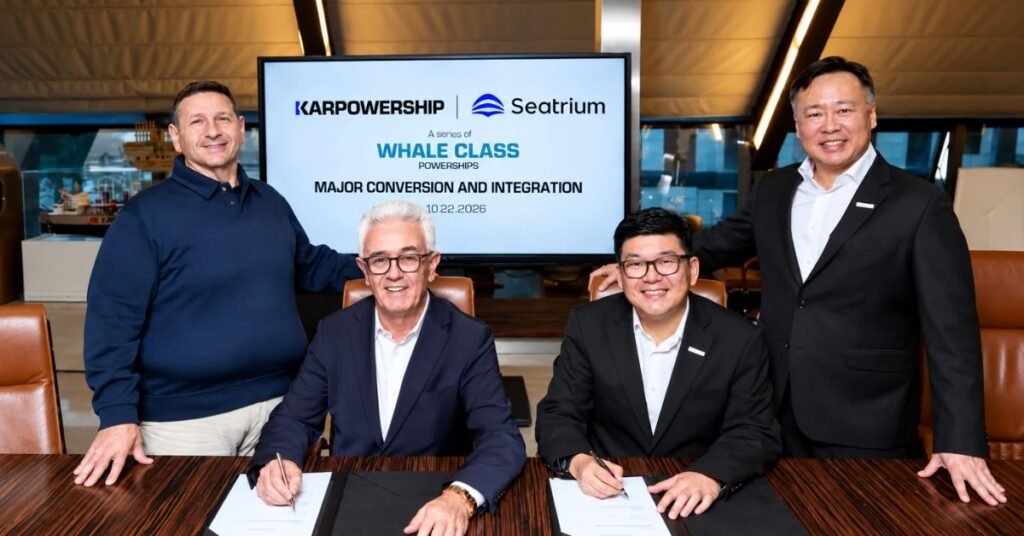
Seatrium has secured a contract to convert and integrate five of Karpowership’s third-generation Whale Class Powerships. Engineering is under way, with the first vessel expected at Singapore’s Tuas Boulevard Yard in December 2027. The agreement extends a partnership previously centred on floating LNG storage and regasification conversions.
Article
Five vessels enter the contracted programme
The Whale Class Powership contract, announced on 23 October 2026, covers major conversion and systems integration work on five floating power plants for Karpowership.
Seatrium’s responsibilities include equipment integration, mechanical completion and pre-commissioning. Engineering activities have begun, while execution will progress towards the first vessel’s targeted arrival at Tuas Boulevard Yard in December 2027.
That date is a yard-arrival milestone, rather than a delivery or electricity-generation deadline. The announcement does not disclose the contract value or deployment destinations.
The hydrogen-ready, multi-fuel Whale Class is designed to supply up to 600 MW per vessel, with onboard substations connecting generation equipment to national grids.
Earlier agreement established the development framework
The latest award follows an August 2025 letter of intent that outlined a broader programme of floating energy projects.
That framework envisaged electrical and mechanical integration of four new-generation Powerships, with options for two additional units, alongside the conversion of three LNG carriers into floating storage and regasification units.
The proposed FSRU work included regasification modules, mooring systems and upgrades to cargo-handling, electrical and automation equipment.
The five-vessel contract now establishes a defined Powership work package within that wider relationship. The earlier potential scope should therefore be distinguished from the number of vessels covered by the latest signed award.
The progression illustrates how the partnership has moved from an initial framework towards individual project commitments.
Seven FSRU conversions completed since 2018
The companies’ collaboration began in 2018 and has already produced a substantial LNG conversion programme.
In September 2026, they marked the naming and sailaway of LNGT Türkiye, the seventh and final vessel delivered under their initial seven-unit FSRU programme.
The series converted LNG carriers into facilities capable of storing LNG and supplying regasified fuel. It involved integration of cryogenic, marine and gas-handling systems.
The completed vessels support Karpowership’s LNG-to-power model, supplying gas for floating electricity generation.
LNGT Türkiye was also the final Karpowership project completed at Seatrium’s Admiralty Yard before that facility’s scheduled return to Singapore’s authorities by 2028. The companies identified Tuas Boulevard Yard as the location for their continuing collaboration.
Additional LNG infrastructure remains in development
Further contracts have extended the FSRU programme beyond those seven deliveries.
In March 2026, Seatrium secured the eighth conversion, LNGT Karadeniz, designed for regasification capacity of up to 600 million standard cubic feet per day.
On 5 October, the companies announced a ninth project, LNGT Akdeniz, with work scheduled to begin in the first quarter of 2027.
For Akdeniz, Seatrium’s scope covers engineering, conversion, integration, installation and commissioning of regasification equipment and associated systems.
These projects provide context for the Whale Class award but perform a different function: FSRUs prepare LNG for use as gas, while Powerships generate electricity. Their respective capacity measures should not be confused.
Hydrogen readiness is a design characteristic
The Whale Class announcement identifies hydrogen-ready generation systems, but does not specify a hydrogen blending percentage, dedicated hydrogen supply agreement or date for hydrogen operation.
Readiness therefore describes an intended technical capability. It does not establish that the vessels will begin service using renewable hydrogen or operate without greenhouse-gas emissions.
For customers assessing floating generation, the available fuel and actual operating configuration will remain central to project performance.
Similarly, a short connection period after deployment should be distinguished from the time required to convert, equip and prepare a vessel for delivery.
Contract broadens Seatrium’s conversion workload
Commercially, the award adds power-generation integration to a relationship built around LNG infrastructure.
The work requires coordination between marine engineering, generation equipment and electrical systems. Completing those interfaces is essential before a converted vessel can supply power.
For Karpowership, the programme supports development of higher-capacity floating plants. For Seatrium, it establishes a five-vessel workload extending into the period following the first planned yard arrival.
The next measurable milestones will be engineering progress, vessel arrivals and completion of the integration stages needed ahead of deployment.
FAQs
How many vessels does the contract cover?
Five Whale Class Powerships.
What work will Seatrium undertake?
Major conversion, equipment integration, mechanical completion and pre-commissioning.
When is the first vessel expected at the yard?
December 2027 at Tuas Boulevard Yard in Singapore.
What generating capacity is specified?
The Whale Class design can supply up to 600 MW per vessel.
Does hydrogen-ready mean hydrogen will be used immediately?
No. The announcement does not establish a hydrogen operating schedule or supply arrangement.
Recent Posts
Power & Propulsion
ABS Verifies Breakerless MVDC Power System Concept for Large Commercial Ships
LNG
WinGD Signs Long-Term Service Contracts for 14 LNG Carriers Across Three Shipowners
Marine
Whale Class Powership Contract Gives Seatrium Five-Vessel Conversion Programme