
Summary
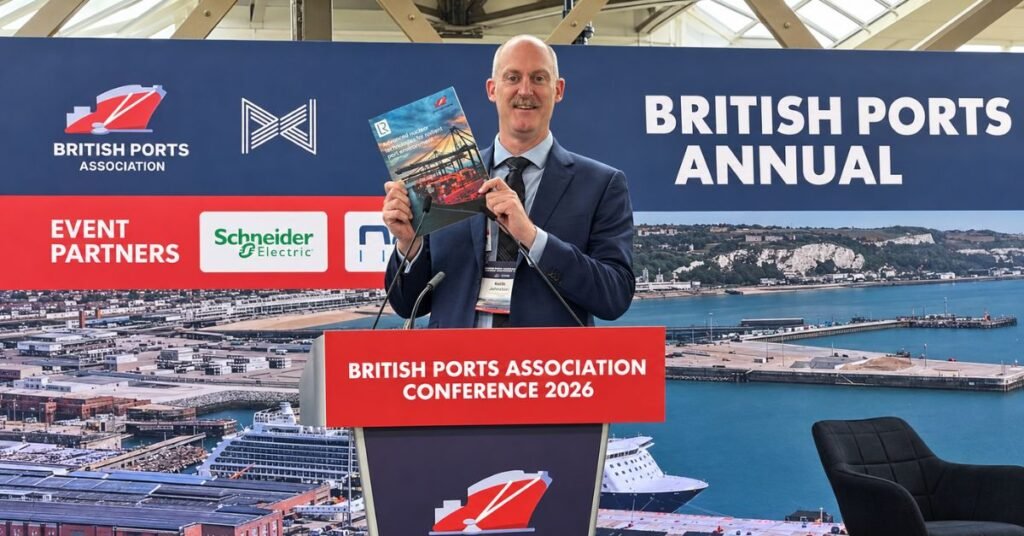
Lloyd’s Register and the British Ports Association have urged ports to prepare for potential advanced nuclear applications, including ship calls, floating power units and land-based reactors. Their joint paper recommends proportionate planning around energy needs, safety, regulation and commercial responsibilities before ports commit substantial capital to nuclear infrastructure.
Article
Ports urged to assess future requirements
Advanced nuclear port readiness should become part of long-term infrastructure planning as maritime and industrial businesses explore new sources of reliable, low-carbon energy, Lloyd’s Register and the British Ports Association have said.
Their joint paper, Advanced Nuclear Technology Use Within Port Environments, considers applications ranging from nuclear-powered vessel visits to floating power installations and small modular reactors.
Announcing the findings on 22 October 2026, the organisations called for preparation before procurement. They recommend that ports assess future electricity demand, identify grid constraints, map stakeholders and begin discussions with relevant authorities.
The paper proposes graduated levels of readiness, allowing individual ports to decide whether they need basic awareness, operational preparedness or a more extensive role as a nuclear energy hub.
Energy opportunities extend beyond ship propulsion
The potential market extends beyond receiving nuclear-powered ships.
The paper examines how advanced reactors could supply electricity to port estates, shore-power connections and neighbouring industrial users. Other prospective applications include industrial heat, resilient microgrids and energy for hydrogen or synthetic-fuel production.
Ports could also participate in specialist activities such as equipment integration, maintenance and associated logistics.
These possibilities would create different infrastructure and operating requirements. A port accommodating occasional vessel calls would face a different proposition from one hosting a power installation or supporting reactor-related industrial services.
The paper consequently presents nuclear as a strategic planning question involving several possible business models. It does not identify a single solution suitable for every port or recommend immediate investment across the sector.
Governance and public confidence are central
The organisations identify regulatory coordination, liability, insurance, emergency planning and workforce capability as important conditions for development.
They recommend incorporating nuclear scenarios into established port safety-management arrangements, supported by additional nuclear-specific expertise and evidence.
Ports already manage hazardous cargoes, restricted areas and complex vessel movements. Those disciplines offer a starting point, but nuclear applications would introduce further responsibilities and interfaces with specialist authorities.
Early engagement with employees and local communities is another recommended step. Commercial proposals would need to explain the intended application, the parties responsible and the evidence supporting safe operation.
This preparatory work would help ports determine whether a project merits more detailed examination before committing to infrastructure development.
Rotterdam study provides earlier context
A separate study published in June 2026 examined the feasibility and regulatory requirements of nuclear-powered commercial ship calls using Rotterdam as a case study.
The joint development project involved Lloyd’s Register, the Port of Rotterdam Authority, CORE POWER and A.P. Moller–Maersk.
It considered a defined feeder-vessel concept, operating scenario and port-call profile. The assessment found that existing risk-based port safety frameworks could provide a credible basis for further analysis if nuclear-specific requirements were systematically incorporated.
However, the desktop study was not a licensing assessment, deployment endorsement or completed safety case.
Further work remained necessary on security, emergency preparedness, insurance, governance and regulatory alignment. Its contribution was to organise the questions requiring resolution, rather than establish that routine nuclear-powered commercial calls could begin.
Transatlantic project examines port access
In September 2026, Lloyd’s Register, Maersk and the ports of Charleston and Felixstowe announced another research initiative, the Pink Corridor project.
This examines requirements for the theoretical operation of a nuclear-powered container ship between the United States and the United Kingdom.
Its scope includes ship security, safeguards, cyber resilience, emergency response, insurance and coordination between maritime and nuclear regulatory expectations.
The initial phase is intended to identify practical requirements and gaps, informing any subsequent work across engineering, legislation and regulatory frameworks. It remains a conceptual assessment rather than an announced shipping service.
Preparation can clarify commercial choices
For port authorities, the immediate task is to understand which potential applications are relevant to their location, customers and energy requirements.
Structured assessments can distinguish opportunities from unsuitable proposals and identify responsibilities before negotiations become investment commitments.
The commercial value of early preparation lies in better decisions: ports can establish what evidence they need, which authorities must participate and how prospective nuclear activities would interact with existing operations. That process will be essential as individual projects move from concepts towards formal assessment.
FAQs
What does the paper recommend?
It recommends proportionate planning, stakeholder engagement and regulatory preparation before major investment.
Which nuclear applications could involve ports?
Potential applications include nuclear-powered ship calls, floating power units, small modular reactors and microreactors.
Does the paper announce an approved nuclear project?
No. It provides a framework for assessing potential applications and readiness requirements.
What did the Rotterdam study establish?
It identified existing port safety frameworks as a starting point for further assessment, with significant work still required.
What is the Pink Corridor project?
It is an early-stage study of requirements for a theoretical nuclear-powered container service between Charleston and Felixstowe.
Recent Posts
Power & Propulsion
ABS Verifies Breakerless MVDC Power System Concept for Large Commercial Ships
LNG
WinGD Signs Long-Term Service Contracts for 14 LNG Carriers Across Three Shipowners
Marine
Whale Class Powership Contract Gives Seatrium Five-Vessel Conversion Programme