
Summary
Zhoushan is expanding its alternative marine fuel business through domestic biofuel blending, LNG and methanol infrastructure, and commercial green ammonia bunkering. An update presented at IPEC 2026 highlighted growing supply capabilities, while recent operations demonstrate how production, storage and transport networks are being connected with international shipping demand.
Article
Multi-fuel strategy takes shape
Zhoushan alternative fuel bunkering is developing across biofuels, LNG, methanol and ammonia as the Chinese port city broadens its role beyond conventional marine fuel supply.
Local authorities outlined the progress on 22 October at the ninth Interregional Petroleum and Natural Gas Enterprises Conference, or IPEC 2026.
They reported approximately 45,000 tonnes of marine biofuel blended under a pilot programme combining domestic biodiesel with imported fuel oil. Officials also said Zhoushan accounted for around 90% of China’s marine biofuel bunkering volume.
Supporting infrastructure includes 380,000 cubic metres of bonded LNG storage and 195,000 cubic metres of bonded methanol storage. These figures describe storage capacity, rather than annual fuel sales or confirmed renewable-fuel throughput.
Biofuel blending adds domestic supply capability
The biofuel programme follows approval announced in February 2026 for Zhoushan to undertake China’s first national pilot for blending and exporting marine biofuel oil.
A dedicated regulatory framework accompanied the approval. The initiative was intended to reduce reliance on imported blended marine biofuels by enabling blending within the Zhejiang Pilot Free Trade Zone.
Its commercial significance lies in connecting domestic biodiesel production with an established marine fuel market. Local blending can give suppliers another procurement option while creating demand for associated storage, handling and distribution services.
An earlier shipment demonstrated that distribution role. On 23 March, the fuel supply vessel Da Yuan You 8 departed Zhoushan carrying 2,600 tonnes of biofuel blend for delivery at Qingdao.
The shipment extended the pilot’s reach beyond local blending to supplying international vessels through another Chinese port. Customs facilitation formed part of the arrangements supporting that movement.
For suppliers, this development offers a model in which fuel preparation and final bunkering need not occur at the same location. It also illustrates why transport permissions and customs procedures matter alongside blending facilities.
Green ammonia reaches an ocean-going customer
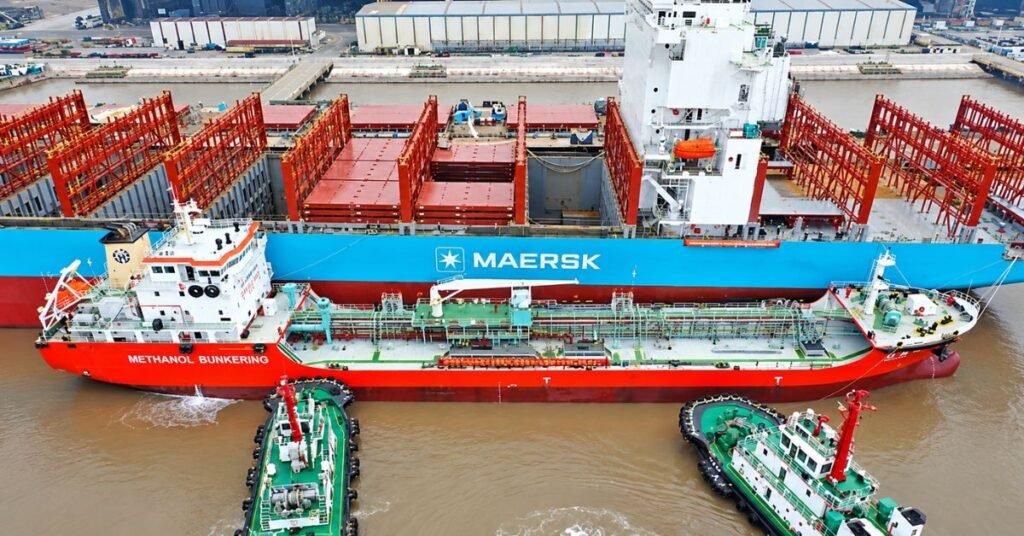
A separate milestone occurred on 13 October, when Shenghang Yongle supplied 1,000 tonnes of green ammonia to CMB.TECH’s Mineral Europa at a Zhoushan anchorage.
The project participants described it as the world’s first commercial ship-to-ship green ammonia bunkering at anchorage.
The fuel originated at China Energy Engineering Group’s Songyuan project in Jilin province. It moved by road to storage at Nanjing Port before being transported by the bunkering vessel to Zhoushan.
This sequence connected inland production with port storage, waterborne distribution and delivery to an ocean-going ship. It provides a completed operational example behind the broader hub-development strategy, rather than simply an infrastructure proposal.
Licensing and certification underpin delivery
Preparations for the ammonia operation included regulatory and vessel-conversion work.
Jiangsu Andefu Energy Technology obtained a liquid ammonia bunkering licence from Zhoushan’s municipal government in May 2026. Shenghang Yongle completed its bunkering conversion in August and received an “Ammonia Bunkering” class notation from China Classification Society.
The supplying Songyuan project’s first phase entered formal operation in December 2025. Its production pathway combines wind and solar electricity, hydrogen production through water electrolysis, and ammonia synthesis.
Project materials also identify ISCC EU RFNBO certification and carbon-emissions tracking across the supply chain. These elements are commercially relevant because buyers increasingly need evidence about fuel origin and lifecycle emissions alongside physical delivery.
Customs cooperation remains an expansion priority
The IPEC update also highlighted ship-to-ship methanol operations and direct LNG supply arrangements linking Ningbo and Zhoushan across customs jurisdictions.
Authorities plan to extend comparable supply arrangements to additional fuels, including methanol and ammonia. Further alternative-fuel price indices are also being explored. These remain development intentions, distinct from completed operations.
For shipowners, the practical value of a multi-fuel hub depends on dependable availability, suitable delivery infrastructure and clear documentation. For producers, an established bunkering location can provide access to maritime customers.
Zhoushan’s progress shows several parts of that system coming together. Sustained commercial growth will depend on converting individual deliveries and available infrastructure into repeat purchases across different vessel types and trading patterns.
FAQs
Which alternative fuels is Zhoushan developing?
Its programme covers marine biofuel blends, LNG, methanol and ammonia.
How much biofuel has been blended under the pilot?
Authorities reported approximately 45,000 tonnes at IPEC 2026.
What ammonia operation took place in October?
Shenghang Yongle supplied 1,000 tonnes of green ammonia to Mineral Europa at anchorage on 13 October.
Where was that ammonia produced?
It came from the Songyuan project in Jilin province.
Do the storage figures represent bunker sales?
No. Storage capacity and actual fuel sales are separate measures.
Recent Posts
Power & Propulsion
ABS Verifies Breakerless MVDC Power System Concept for Large Commercial Ships
LNG
WinGD Signs Long-Term Service Contracts for 14 LNG Carriers Across Three Shipowners
Marine
Whale Class Powership Contract Gives Seatrium Five-Vessel Conversion Programme