
Summary
Amogy plans to deploy an ammonia cracking module on Singapore’s Jurong Island in 2027, targeting hydrogen production of up to one ton daily. Developed with A\*STAR and supported by the Economic Development Board, the pilot will test industrial performance and inform potential expansion into hydrogen supply and power generation.
Article
Industrial testing planned for 2027
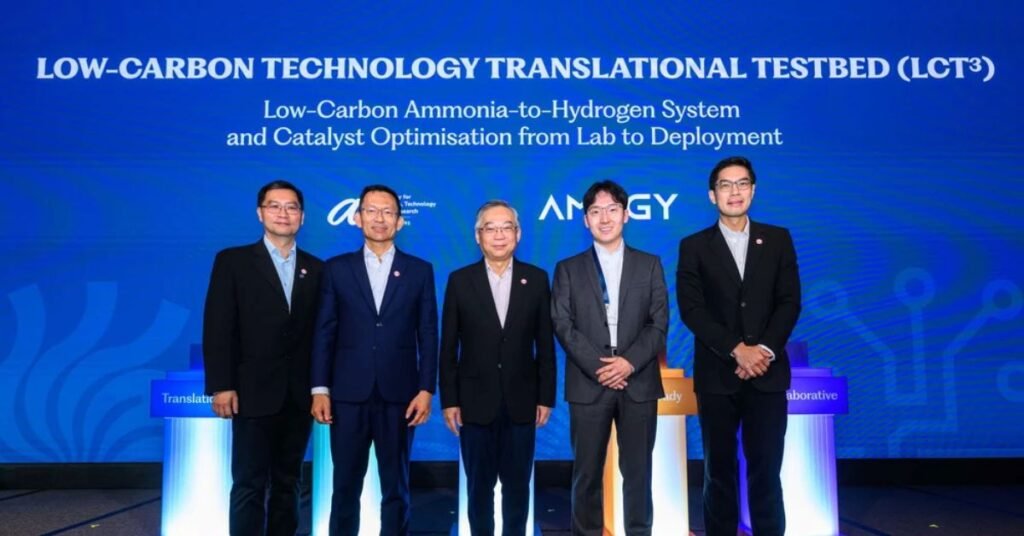
The Amogy ammonia cracking pilot will be installed at Singapore’s Low-Carbon Technology Translational Testbed, known as LCT³, as the company advances its partnership with the Agency for Science, Technology and Research.
Announced on 23 October 2026, the project will evaluate the technology under industrial operating conditions. The facility is hosted by A\*STAR’s Institute of Sustainability for Chemicals, Energy and Environment on Jurong Island.
Amogy will supply its reformer and catalyst technologies and oversee project execution. The partners will also develop lower-cost, next-generation catalysts to improve the economics of producing hydrogen from ammonia.
The module’s stated production capacity is a design target. Deployment is scheduled for 2027; the announcement does not establish that hydrogen production has begun.
Shared testbed supports commercial development
The project was announced alongside the groundbreaking of LCT³ at the Singapore Industry Decarbonisation Forum.
Singapore’s government identified Amogy, IHI Corporation and Metha8 as the testbed’s first three industry users. Their projects cover separate pathways: ammonia-to-hydrogen, carbon dioxide conversion into sustainable aviation fuel, and an integrated methanol-to-power system.
The shared facility is intended to help companies test technologies under conditions relevant to industry without each having to develop a standalone pilot installation.
This approach addresses a practical challenge in commercialisation. Promising laboratory results must be translated into dependable performance at a scale and cost that prospective customers can evaluate.
The government has positioned LCT³ as infrastructure supporting that transition, with construction underway and research collaborations providing its initial programme of work.
Partnership builds on September 2025 agreement
The latest development follows a memorandum of understanding signed by Amogy and A\*STAR on 23 September 2025.
That earlier agreement explored ammonia-based technologies for Singapore, including potential demonstrations on Jurong Island. Its proposed activities included catalyst research, digital tools and workforce training for system integration and expansion.
A\*STAR’s anticipated contribution covered safety and standards, cost assessment and sustainability evaluation.
The collaboration also identified data centres as a potential application because of their continuous electricity requirements. Heavy industry was another area of interest.
The 2026 announcement takes that broader research relationship into a defined pilot phase. It provides a specific deployment location, target production level and schedule around which further technical work can proceed.
Ammonia serves as a hydrogen carrier
Amogy’s technology splits ammonia into hydrogen and nitrogen. The resulting hydrogen can subsequently supply fuel cells or hydrogen engines.
The Jurong Island project centres on demonstrating the cracking module. Potential downstream power applications should therefore be distinguished from the pilot’s announced hydrogen-production scope.
Commercially, operating data can help prospective customers assess reliability, maintenance requirements and integration with their own processes. Catalyst development is also relevant because conversion costs influence the competitiveness of the resulting hydrogen.
The wider emissions outcome depends on how the ammonia is produced and the energy used throughout the supply chain. Ammonia-to-hydrogen conversion alone does not establish the lifecycle carbon intensity of the final energy product.
Earlier maritime demonstration provides background
Amogy previously demonstrated its ammonia-to-electrical power technology aboard NH3 Kraken, a tug originally built in 1957.
Following conversion, the vessel sailed on the Hudson River in September 2024. That project also involved developing ammonia bunkering procedures, providing experience in fuel handling and system integration.
The tug demonstration and the Singapore pilot address different applications. The former demonstrated onboard power generation; the latter will examine hydrogen production under industrial conditions. Together, they illustrate the company’s efforts to adapt its technology across maritime and stationary energy markets.
Singapore’s hydrogen strategy provides policy context
Singapore’s National Hydrogen Strategy, launched in 2022, identified low-carbon hydrogen and derivatives such as ammonia as potential contributors to energy security and decarbonisation.
It envisaged technology trials, research, supply-chain development and international cooperation, including applications in maritime transport.
The Jurong Island pilot fits within that development approach. Its next milestone will be installation and testing, followed by evidence showing whether the technology can support larger commercial applications. ema.gov.sg
FAQs
Where will the pilot be installed?
At the LCT³ facility hosted by A\*STAR on Jurong Island, Singapore.
When is deployment planned?
Amogy has scheduled deployment for 2027.
What is the proposed hydrogen output?
The module is designed to produce up to one ton of hydrogen daily.
Who is involved?
Amogy and A\*STAR are collaborating, with support from Singapore’s Economic Development Board.
Will the pilot immediately supply data centres?
No such supply arrangement was announced. Data-centre power is a potential future application being assessed.
Recent Posts
Power & Propulsion
ABS Verifies Breakerless MVDC Power System Concept for Large Commercial Ships
LNG
WinGD Signs Long-Term Service Contracts for 14 LNG Carriers Across Three Shipowners
Marine
Whale Class Powership Contract Gives Seatrium Five-Vessel Conversion Programme