
Summary
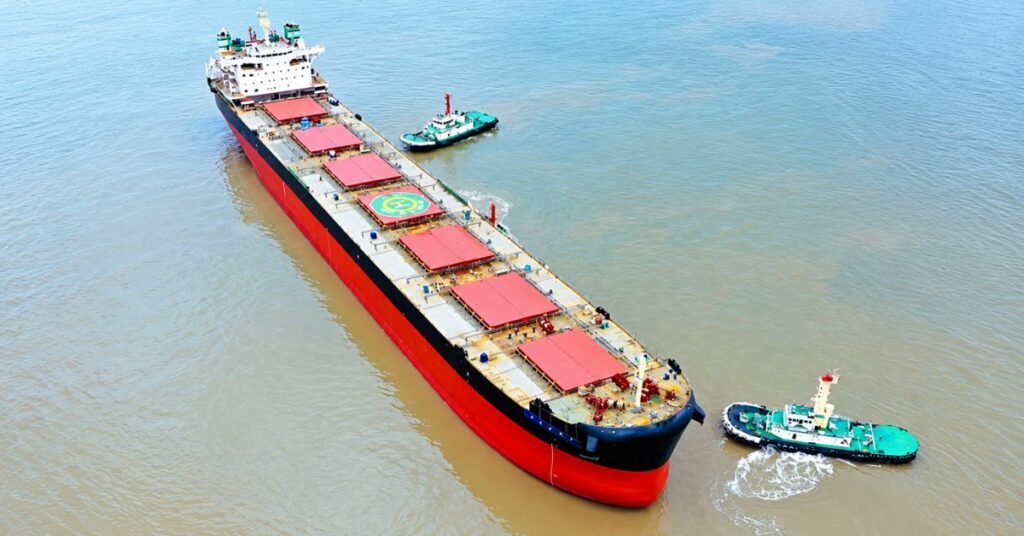
Safe Bulkers has taken delivery of Kypros Island, its first methanol dual-fuel Kamsarmax bulk carrier. Built at Tsuneishi’s Zhoushan yard in China, the 81,200-dwt vessel also becomes the first dual-fuel bulker on the Cyprus register. A second methanol-capable vessel is expected to follow in 2027.
Article
Delivery advances alternative-fuel investment
The first Safe Bulkers methanol dual-fuel Kamsarmax has joined the company’s fleet, bringing an alternative-fuel investment into operation three years after the vessels were ordered.
Named Kypros Island, the newbuilding was constructed by Tsuneishi Shipbuilding at its Zhoushan facility. Safe Bulkers announced the delivery through a company update on 22 October.
The vessel’s addition marks a milestone for both the owner and its flag state. Safe Bulkers identified it as the first dual-fuel bulk carrier to enter the Cyprus register.
Its propulsion arrangement provides the ability to use methanol alongside conventional marine fuel, giving the owner flexibility as alternative-fuel availability develops.
Construction followed a three-year programme
The delivery follows the vessel’s launch on 25 June 2026 at Tsuneishi’s shipyard on Xiushan Island, in the Zhoushan region.
At that stage, Safe Bulkers identified the newbuilding as Hull SS386 and scheduled delivery for late October. The company also indicated that a second methanol-capable Kamsarmax was expected in January 2027.
The project forms part of a fleet-renewal programme centred on newer vessels and energy-efficiency improvements. The June announcement linked that programme to EEDI Phase 3 designs and preparations for future greenhouse-gas requirements.
Delivery is distinct from the earlier launch: the June event placed the ship in the water, while the latest milestone transfers the completed newbuilding into the owner’s fleet.
Design combines fuel flexibility with efficiency
Tsuneishi announced the two-vessel order involving Safe Bulkers and Itochu Corporation in October 2023. The contracts were signed in Limassol, Cyprus.
The shipbuilder’s methanol Kamsarmax design combines dual-fuel machinery with an independent, large-capacity methanol tank positioned towards the stern. That arrangement was developed to preserve cargo-hold capacity while maintaining access for cargo operations and crew maintenance.
Tsuneishi also incorporated hull-form improvements and an upgraded version of its AEROLINE wind-resistance reduction technology.
These features show that the project extends beyond changing the fuel supply system. Its design addresses propulsion choice, hydrodynamic performance, aerodynamic resistance and the space required for alternative-fuel storage.
The shipbuilder retained many principal characteristics of its established Kamsarmax platform to maintain operational versatility. That is commercially relevant for bulk carriers expected to work across different cargoes, ports and charter requirements.
Wider renewal programme remains substantial
The methanol investment sits within a broader programme of newbuilding acquisitions and upgrades to existing ships.
In its July 2026 fleet update, Safe Bulkers reported 46 vessels with approximately 4.5 million dwt of carrying capacity. Two were held for sale at that reporting date.
Its orderbook then comprised ten vessels: nine Kamsarmaxes, including the two methanol dual-fuel ships, and one Capesize. Scheduled deliveries extended through 2029.
The company had also completed environmental upgrades on 25 existing vessels. Measures included low-friction paint applications and energy-saving devices intended to reduce fuel consumption.
Those figures describe the July position, before the latest delivery, and should not be treated as an updated post-delivery fleet count. They nevertheless demonstrate that methanol capability is one component of a wider efficiency strategy.
Fuel availability will determine practical benefits
Safe Bulkers has previously acknowledged that alternative-fuel capability does not guarantee access to commercially viable lower-carbon fuel.
Its 2024 annual report identified production scale, worldwide availability, infrastructure and price as potential constraints. The company warned that its dual-fuel vessels could operate on fossil fuels if suitable alternatives were unavailable or uneconomic, limiting their intended environmental and financial advantages.
For charterers, the delivery creates an opportunity to assess methanol-capable bulk transport in commercial service. Realising that opportunity will require suitable fuel procurement, coordinated voyage planning and agreement on the associated costs.
The immediate achievement is the delivery of a vessel equipped to accommodate another fuel pathway. Its longer-term contribution will depend on how that capability is used across actual voyages and fuel purchases.
FAQs
What is the vessel’s name and capacity?
Kypros Island is an 81,200-dwt Kamsarmax bulk carrier.
Who built the ship?
Tsuneishi Shipbuilding constructed it at its Zhoushan yard in China.
Why is its registration significant?
Safe Bulkers identified it as the first dual-fuel bulk carrier on the Cyprus register.
When is the second vessel expected?
The company’s earlier schedule indicated January 2027.
Does methanol capability guarantee lower emissions?
No. The outcome depends on the fuel actually used, including its production pathway and lifecycle emissions.
Recent Posts
Power & Propulsion
ABS Verifies Breakerless MVDC Power System Concept for Large Commercial Ships
LNG
WinGD Signs Long-Term Service Contracts for 14 LNG Carriers Across Three Shipowners
Marine
Whale Class Powership Contract Gives Seatrium Five-Vessel Conversion Programme