
Summary
Seven Japanese companies are planning an integrated marine ammonia fuel supply chain centred on Japan’s Chubu region, combining green ammonia production, fuel sales, bunkering infrastructure and ammonia-fuelled car carriers. NYK and Kawasaki Kisen Kaisha (K Line) will each introduce two dual-fuel ammonia-powered car carriers by 2030, while a dedicated bunkering vessel and new terminal facilities will support fuel distribution. The companies describe the initiative as the first commercial supply chain of its kind, although project costs, vessel specifications and planned ammonia volumes have not been disclosed.
Article
Seven Companies Coordinate Ammonia Fuel Infrastructure and Vessel Operations
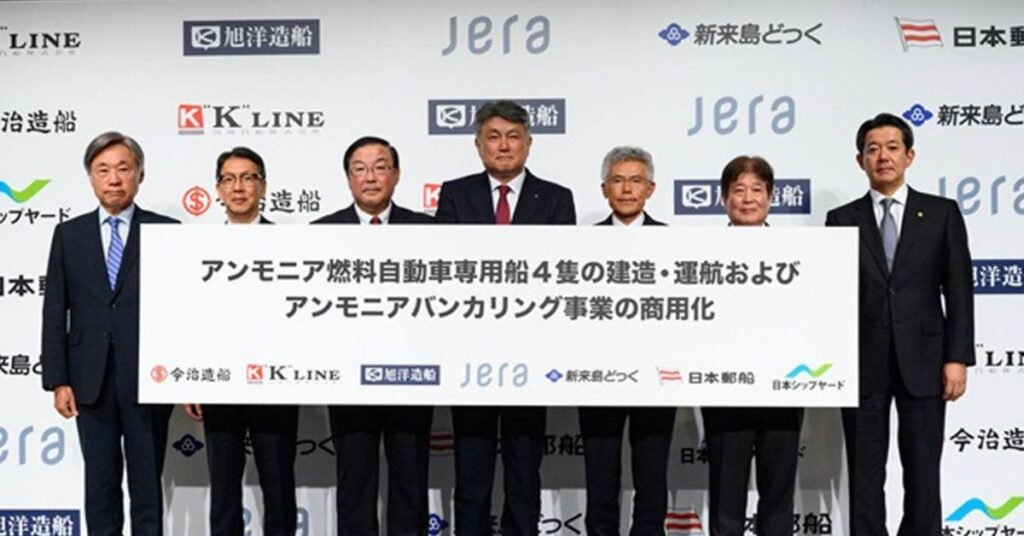
Seven Japanese companies are developing an integrated system to support the commercial use of ammonia as a marine fuel, connecting fuel production and supply with bunkering operations and vessel deployment. The project will be centred on Japan’s Chubu region and is intended to establish a coordinated supply chain for ammonia-fuelled shipping.
The participating companies are NYK, Kawasaki Kisen Kaisha (K Line), JERA, Imabari Shipbuilding, Shin Kurushima Dockyard, Nihon Shipyard and Kyokuyo Shipyard. Their respective roles cover vessel ownership and operation, fuel production, shipbuilding, bunkering infrastructure and fuel sales.
The companies describe the initiative as the first commercial supply chain integrating these elements around ammonia as a marine fuel. However, the project’s total investment, expected fuel volumes and detailed vessel specifications have not been announced.
Four Ammonia-Fuelled Car Carriers Planned for 2030
NYK and K Line will each introduce two car carriers equipped with dual-fuel ammonia engines, bringing the planned fleet to four vessels. The ships are scheduled for completion in 2030, with Imabari Shipbuilding, Shin Kurushima Dockyard and Nihon Shipyard responsible for their design and construction.
The vessels are intended to undertake trans-Pacific voyages using ammonia as their sole fuel. They are also expected to transport finished vehicles for customers including Toyota Motor Corporation.
The deployment of the four ships is a central component of the initiative, linking demand for ammonia fuel to the development of production, distribution and bunkering infrastructure.
JERA to Develop Green Ammonia Supply and Terminal Facilities
JERA will lead the green ammonia production and supply component of the project. Renewable energy from regions including India is expected to contribute to green ammonia production, although the companies have not disclosed specific sourcing arrangements, suppliers or planned volumes.
JERA already operates a low-carbon ammonia value chain that includes activities at the Hekinan Thermal Power Station. Its existing infrastructure also includes a system for loading and unloading ammonia tank trucks.
As part of the new initiative, JERA will construct additional ship-loading facilities at the ammonia receiving terminal adjacent to the Hekinan station. The facilities are intended to support a stable ammonia supply for the dedicated bunkering vessel.
The development will connect ammonia handling infrastructure at the terminal with the fuel requirements of the planned car carriers.
Dedicated Ammonia Bunkering Vessel to Support Ship-to-Ship Transfers
Kyokuyo Shipyard will design and build a dedicated ammonia bunkering vessel, which is also scheduled for completion in 2030. NYK will own and operate the vessel.
The bunkering ship will be designed to transfer ammonia directly between vessels, providing a dedicated means of supplying fuel to ammonia-powered ships.
Given ammonia’s toxicity and corrosiveness, the vessel will incorporate leak-prevention systems and equipment intended to address the hazards associated with handling the fuel. The project’s operational arrangements will therefore need to account for the specific safety requirements of ammonia bunkering.
NYK and K Line to Establish Fuel Sales Joint Venture
NYK and K Line will establish a joint venture to sell ammonia fuel, completing the planned integration of production, distribution, bunkering and vessel operations.
The fuel sales venture is intended to connect the supply side of the project with shipping customers. NYK, which has experience with LNG-fuelled carriers, will also operate the dedicated ammonia bunkering vessel.
The companies have not yet disclosed the joint venture’s ownership structure, commercial terms or planned fuel sales volumes.
Implications for the Maritime Fuel Transition
The initiative brings together several elements required for the wider adoption of ammonia as a marine fuel: suitable vessels, a dependable fuel supply, dedicated bunkering capacity and a commercial sales structure.
Coordinating these elements within a single project could help address the challenge of developing fuel infrastructure alongside demand from ship operators. However, commercial deployment will depend on the availability and cost of ammonia, infrastructure readiness, vessel performance and the implementation of appropriate safety and regulatory arrangements.
The planned use of renewable energy from regions including India also identifies a potential connection with future green ammonia exports. No Indian production partners, supply agreements or export volumes have been announced, so the extent of India’s participation remains unclear.
What Happens Next?
Key details to watch include the specifications and capacities of the four car carriers, the bunkering vessel’s design, green ammonia production volumes and sourcing arrangements, and the investment required for terminal and bunkering infrastructure.
Further information on the fuel sales joint venture, commercial supply agreements and applicable regulatory approvals will also be important in assessing the project’s readiness for operation by 2030.
FAQs
What is the Japanese ammonia marine fuel project?
Seven Japanese companies are planning an integrated supply chain connecting green ammonia production, fuel sales, bunkering infrastructure and ammonia-fuelled car carriers, with Japan’s Chubu region serving as the hub.
Which companies are involved in the project?
The participants are NYK, Kawasaki Kisen Kaisha (K Line), JERA, Imabari Shipbuilding, Shin Kurushima Dockyard, Nihon Shipyard and Kyokuyo Shipyard.
How many ammonia-fuelled car carriers are planned?
NYK and K Line will each introduce two dual-fuel ammonia-powered car carriers, bringing the planned total to four vessels.
When are the ammonia-fuelled ships expected to be completed?
The four car carriers are scheduled for completion in 2030. The dedicated ammonia bunkering vessel is also planned for completion in the same year.
Where will the ammonia fuel be supplied from?
JERA will lead green ammonia production and supply, with renewable energy from regions including India identified as a potential source. Specific suppliers, production volumes and sourcing agreements have not been disclosed.
What role will the ammonia bunkering vessel play?
The vessel, to be built by Kyokuyo Shipyard and owned and operated by NYK, will facilitate ship-to-ship ammonia fuel transfers. It will incorporate safety systems designed to address ammonia’s toxicity and corrosiveness.
What is the significance of the project for India?
The reference to renewable energy from regions including India points to a potential role for Indian green ammonia production in the supply chain. However, no Indian partners, supply commitments or export volumes have been confirmed.
What project details remain undisclosed?
The companies have not announced the vessels’ sizes and capacities, project costs, planned ammonia volumes, detailed sourcing arrangements or the commercial terms of the fuel sales joint venture.
Recent Posts
Power & Propulsion
Wärtsilä and WinGD Renew Global Service Agreement for Two-Stroke Marine Engines
Ammonia
JERA–AM Green Ammonia Agreement Links Kakinada Supply with Japanese Marine Fuel Plans
Marine
MSC ESG Recognition Highlights Six Certified Management Systems