
Summary
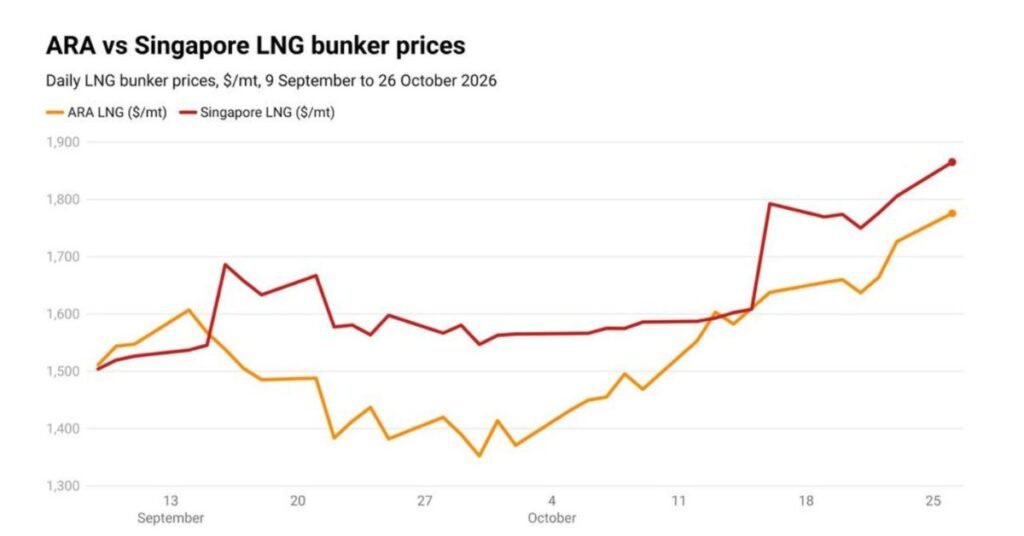
Rotterdam’s LNG bunker price rose for a fourth consecutive week, increasing US$121 per tonne to US$1,776 in the assessment published on 26 October. Norwegian gas supply disruptions, colder European weather forecasts and Middle Eastern uncertainty supported the rise, while increases in Singapore and the Baltic region highlighted broader pressure on marine gas costs.
Article
Fourth weekly rise increases bunker costs
The Rotterdam LNG bunker price increased approximately 7.3% week on week, reinforcing a sustained upward movement in the cost of gas-fuelled shipping.
The US$121-per-tonne increase brought the assessment to US$1,776 per tonne. Singapore rose US$96 to US$1,865, while the Baltic assessment increased US$120 to US$1,879.
Rotterdam’s larger weekly increase narrowed Singapore’s premium over the Amsterdam–Rotterdam–Antwerp region to US$89 per tonne, compared with US$114 a week earlier.
For operators purchasing LNG across different ports, the changing spread affects procurement comparisons. However, headline assessments do not establish the price available for every delivery, which also depends on parcel size, timing, contractual arrangements and supplier availability.
Norwegian outages coincide with colder forecasts
The European gas market strengthened as supply disruptions affected Norway’s Troll and Åsgard fields.
JOGMEC’s review of the week ending 23 October identified those disruptions, forecasts of lower European temperatures and renewed Middle Eastern tensions as drivers of higher gas prices.
Prices had initially softened following reports of mediation efforts concerning the Middle East conflict. That movement subsequently reversed as supply and winter-demand concerns regained prominence.
The sequence demonstrates the market’s sensitivity to both physical supply developments and geopolitical expectations. A change in diplomatic sentiment can influence prices quickly, while unplanned production interruptions reduce the flexibility available to meet demand.
For LNG bunker buyers, this creates exposure to developments extending well beyond maritime fuel demand. Heating, power generation and industrial consumption compete for the same underlying gas resources.
Storage provides a smaller seasonal buffer
European inventories remain an important source of concern ahead of winter.
EU underground gas storage was 74.6% full on 23 October, compared with 74.3% the previous weekend. Despite that modest increase, stocks remained substantially below the corresponding level a year earlier.
JOGMEC also reported the first net withdrawal of the winter season on 20 October.
Earlier monitoring by European energy regulator ACER showed how the position developed. Storage ended winter 2025–26 at 28% of capacity, below both the previous year and the historical average.
Slower summer replenishment reflected higher LNG import prices and weak commercial incentives to inject gas. Middle Eastern supply disruption further tightened the market. ACER expects continued competition between Europe and Asia for flexible LNG cargoes during the heating season.
Lower inventories do not establish that shortages will occur. They do, however, leave less stored gas available to absorb prolonged cold weather or additional supply interruptions.
Asian demand reinforces competition for cargoes
The pressure is not confined to Europe.
JOGMEC identified stronger prompt buying requirements in China, South Korea and India during the latter part of the reporting week, alongside concerns over securing winter supplies.
Colder European forecasts also influenced Asian market sentiment because additional European purchasing can intensify competition for internationally traded cargoes.
This connection helps explain why marine LNG prices can rise simultaneously across geographically distant bunkering centres. Regional delivery conditions remain important, but the underlying fuel market is increasingly influenced by competing international demand.
Infrastructure expands, but fuel exposure remains
Rotterdam is adding LNG infrastructure despite the immediate price pressure.
On 1 October, Gasunie announced commissioning of Gate terminal’s fourth storage tank, adding 180,000 cubic metres of LNG storage. The expansion also adds four billion cubic metres of annual regasification capacity, bringing the terminal’s total to 20 billion.
Separately, Jetty 4 is under construction and is expected to support small-scale ship loading and bunkering by the end of 2028.
These investments strengthen handling capacity and supply flexibility. They cannot independently offset higher international commodity prices.
For ship operators, the immediate commercial issue is how the LNG increase changes voyage costs and fuel choices. Comparisons with conventional bunkers require an energy-equivalent assessment, together with engine performance and applicable emissions costs. The next price direction will depend heavily on Norwegian supply recovery, winter temperatures and Middle Eastern shipping conditions.
FAQs
How much did Rotterdam’s LNG bunker price increase?
It rose US$121 per tonne week on week to US$1,776, marking its fourth consecutive weekly increase.
What supported the rise?
Norwegian supply disruptions, colder European forecasts and Middle Eastern geopolitical uncertainty contributed to stronger gas prices.
How did Singapore compare?
Singapore’s assessment reached US$1,865 per tonne, leaving an US$89 premium over the ARA region.
Why do European storage levels matter?
Stored gas helps meet winter demand and cushion supply interruptions. Lower inventories reduce that buffer.
Will Rotterdam’s new infrastructure necessarily lower prices?
No. Additional storage and handling capacity improve flexibility, while fuel prices remain exposed to international supply and demand.
Recent Posts
Power & Propulsion
Wärtsilä and WinGD Renew Global Service Agreement for Two-Stroke Marine Engines
Ammonia
JERA–AM Green Ammonia Agreement Links Kakinada Supply with Japanese Marine Fuel Plans
Marine
MSC ESG Recognition Highlights Six Certified Management Systems