
Summary
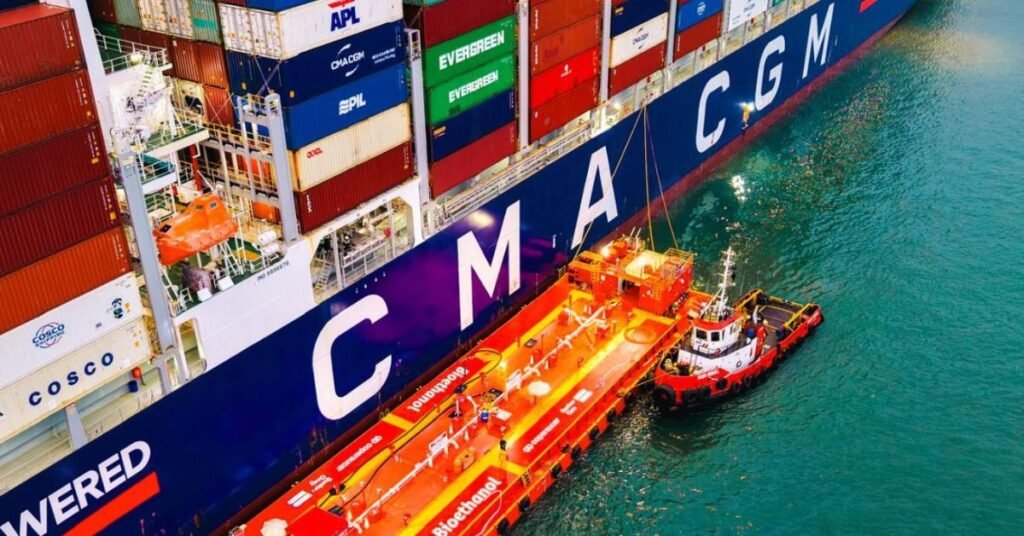
Regular bioethanol bunkering has begun at Brazil’s Port of Santos, following a July demonstration involving CMA CGM and Brazilian fuel and logistics partners. The first delivery under the new arrangement took place on 19 October, connecting sugarcane ethanol production with recurring marine-fuel demand. Further CMA CGM deliveries are planned before year-end.
Article
Regular supply follows July demonstration
Santos bioethanol bunkering has entered a new commercial phase, with CMA CGM, Copersucar, Bunker One and the Santos Port Authority announcing a recurring supply arrangement at the Brazilian gateway.
The first operation under the programme took place on 19 October 2026, when the 13,000-TEU containership CMA CGM Iron received ethanol. Additional bunkering operations involving CMA CGM vessels are planned before the end of 2026.
The development builds on a demonstration completed in July and shifts the initiative towards repeated deliveries. However, the partners have not disclosed a fixed supply frequency, annual contracted volume or fuel pricing.
For shipowners, that distinction matters: recurring availability can support voyage planning, while a single demonstration establishes only that a particular operation can be completed.
Production, storage and delivery linked
The supply chain brings together several specialist businesses. Ethanol from mills associated with Copersucar is supplied and transported to Santos by Evolua Etanol, then stored at AGEO Terminais.
Bunker One manages the bunkering stage at the Santos Brasil terminal. Its operating protocol followed months of studies and dedicated personnel training, taking account of ethanol’s low flash point.
The arrangement illustrates the coordination required to turn an available biofuel into a marine-fuel service. Production must connect with suitable storage, delivery equipment, trained personnel and a vessel equipped to use the product.
For suppliers and terminals, repeat deliveries also provide opportunities to refine scheduling and handling procedures. The commercial test will be whether those arrangements remain dependable as more vessels seek fuel.
CMA CGM Iron provides the operating platform
CMA CGM Iron is equipped with an Everllence-B&W G95ME-C10.5-LGIM engine certified to operate on bioethanol. Delivered in 2025, the vessel is the first in a series of twelve 13,000-TEU containerships.
The earlier bunkering operation took place at Santos on 12 July 2026. It involved transporting ethanol to the port, holding it in dedicated storage and transferring it to the containership through a specialised barge.
The project brought together CMA CGM, Copersucar, AGEO Terminais, Santos Brasil, Bunker One and engine manufacturer Everllence. Regulatory and port authorities also supported the operation.
The July delivery established an operational reference for the subsequent supply programme. The October development adds continuity, although neither announcement establishes that ethanol will become the vessel’s exclusive fuel.
Brazilian supply offers a new market opportunity
The initiative connects an established Brazilian bioethanol production and logistics network with international shipping demand.
Copersucar describes its ethanol supply chain as certified and points to Brazil’s RenovaBio sustainability framework. The company also states that sugarcane cultivation expansion occurs predominantly on degraded pastureland.
These credentials form part of the partners’ case for the fuel. The announcements do not provide a shipment-specific lifecycle emissions calculation or a quantified reduction for the October operation.
For prospective buyers, documented sustainability performance will remain relevant alongside price, availability and technical compatibility. The bunkering development demonstrates a delivery pathway; its wider environmental and economic value must be assessed against the fuel actually supplied and consumed.
Engine development broadens the context
Separate developments show ethanol attracting attention beyond container shipping.
In September 2026, Everllence announced successful research-and-development testing of an ethanol-capable G80 engine at HD Hyundai Heavy Industries’ engine division in South Korea.
That engine is intended for the third vessel in a ten-ship very large ore carrier series ordered by Shandong Shipping for charter to Vale. Delivery of the vessel is scheduled for early 2027. The engine platform can operate on fuel oil, methanol, ethanol or blends of the latter two.
This separate project illustrates expanding technical interest, while Santos provides an operating example of the shore-side supply chain. Together, they highlight the importance of developing compatible vessels and dependable bunkering services in parallel.
FAQs
When did regular bioethanol bunkering begin at Santos?
The first operation under the new arrangement took place on 19 October 2026.
Which vessel received the fuel?
The 13,000-TEU containership CMA CGM Iron.
Who supplies and handles the ethanol?
Copersucar’s associated mills produce it, Evolua Etanol supplies and transports it, AGEO provides storage, and Bunker One handles bunkering at Santos Brasil’s terminal.
How does this differ from the July operation?
July established a demonstration operation. The October announcement introduced a regular supply arrangement with further deliveries planned.
Have annual volumes or prices been announced?
No fixed annual supply volume, delivery frequency or fuel price was disclosed.
Recent Posts
Power & Propulsion
Wärtsilä and WinGD Renew Global Service Agreement for Two-Stroke Marine Engines
Ammonia
JERA–AM Green Ammonia Agreement Links Kakinada Supply with Japanese Marine Fuel Plans
Marine
MSC ESG Recognition Highlights Six Certified Management Systems