
Summary
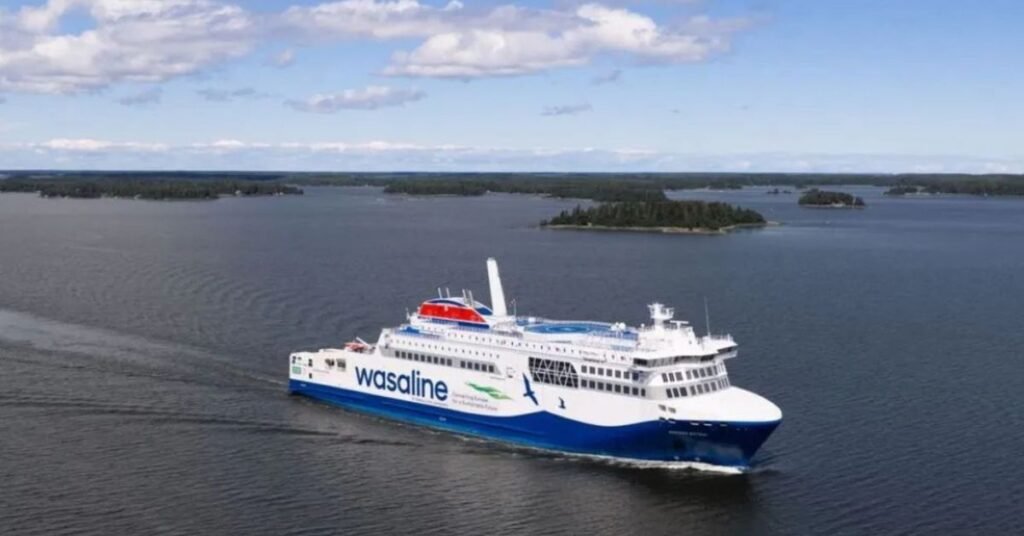
Wasaline has signed a two-year agreement with St1 Biokraft for 42 GWh of liquefied biogas annually, with deliveries starting in January 2028. The fuel will be bunkered at Vaasa for Aurora Botnia, strengthening the ferry operator’s renewable-fuel supply and creating a maritime outlet for regional biogas production.
Article
Agreement supports the Vaasa–Umeå service
The Wasaline biogas supply deal will provide liquefied biogas for Aurora Botnia, the hybrid ferry operating between Vaasa in Finland and Umeå in Sweden.
Announced on 22 October, the agreement runs for two years from January 2028. The contracted annual quantity is expressed as 42 gigawatt-hours of energy, rather than a fuel volume or tonnage.
Deliveries will move by tanker truck from St1 Biokraft’s production facilities and terminals to the Port of Vaasa for bunkering. Wasaline intends to source mainly locally produced fuel from Suomen Lantakaasu’s Nurmo plant, approximately 80 kilometres from Vaasa.
St1 Biokraft described the contract as its first major marine biogas agreement. Wasaline technical director Jonas Teir said regional sourcing would strengthen energy security and support the use of manure and other organic residual materials.
Regional production connects with maritime demand
The proposed local supply links the ferry service with a developing agricultural and food-industry energy network.
Suomen Lantakaasu, a joint venture between St1 Biokraft and Valio, inaugurated the Nurmo plant in August 2026. The facility processes manure and agricultural and food-industry by-products into renewable fuel and biofertilisers.
Its stated annual production capacity is approximately 100 GWh of liquefied biogas. At inauguration, the plant was producing raw biogas, with liquefaction scheduled to begin later in the autumn. That distinction separates the facility’s opening from confirmation of full liquefied-fuel production.
For the regional supply chain, a marine customer adds another potential market alongside road transport and industrial users. For Wasaline, nearby production offers an additional sourcing option within an established operating area.
Plant development has received public backing
The Nurmo project was developed by Nurmon Bioenergia, majority-owned by Suomen Lantakaasu, with Atria Finland holding a minority interest.
Finland’s Ministry of Economic Affairs and Employment granted €9.4 million in energy investment aid to the project. Separate environmental ministry support covered a biofertiliser loading-tank investment.
The facility’s model combines fuel production with nutrient recovery, allowing agricultural residual materials to serve both energy and fertiliser markets. Its approximately 100 GWh capacity is a design figure, rather than evidence that annual output has already reached that level.
Fuel procurement complements battery investment
The contract builds on Aurora Botnia’s existing use of biogas, batteries and shore power.
Earlier this year, Wasaline completed a substantial battery upgrade. In February 2026, the operator announced successful sea trials following an increase in onboard battery capacity from 2.2 MWh to 12.6 MWh.
AYK Energy supplied the additional batteries, while Wärtsilä carried out system integration. The work was completed at BLRT Repair Yards in Finland, and DNV approved the upgraded system for operation.
Danfoss drives were configured for the expanded installation, with Foreship responsible for evaluation and basic design.
The sequence illustrates how vessel upgrades and fuel procurement can progress together. Battery investment changes the ship’s energy-storage capability, while the new agreement addresses access to renewable gaseous fuel.
Contract provides certainty without disclosing economics
The announcement identifies a buyer, annual energy quantity, delivery location and commencement date. Those details provide a clearer commercial commitment than a general expression of interest in alternative fuels.
However, the companies have not disclosed pricing, contract value or the proportion of Aurora Botnia’s total energy requirements covered by the agreement. It therefore cannot be assumed that the contract supplies all the ferry’s fuel needs or guarantees lower operating costs.
For the wider maritime market, the agreement offers an example of regional production being connected to a regular ferry customer through defined delivery arrangements.
Its practical performance will depend on production availability, transport reliability and consistent fuel quality. The immediate milestone is the signed future supply commitment, with deliveries scheduled to begin in 2028.
FAQs
When do deliveries begin?
Deliveries start in January 2028 under a two-year agreement.
How much fuel is covered?
The contract specifies 42 GWh of liquefied biogas annually, measured by energy content.
Where will bunkering take place?
At the Port of Vaasa, following tanker-truck deliveries from production facilities and terminals.
Will all the fuel come from Nurmo?
Wasaline’s stated ambition is to use mainly locally produced biogas from Nurmo; exclusive sourcing has not been announced.
Has Aurora Botnia’s battery upgrade been completed?
Yes. Wasaline announced successful sea trials and operational approval for the expanded 12.6 MWh system in February 2026.
Recent Posts
Power & Propulsion
Wärtsilä and WinGD Renew Global Service Agreement for Two-Stroke Marine Engines
Ammonia
JERA–AM Green Ammonia Agreement Links Kakinada Supply with Japanese Marine Fuel Plans
Marine
MSC ESG Recognition Highlights Six Certified Management Systems