
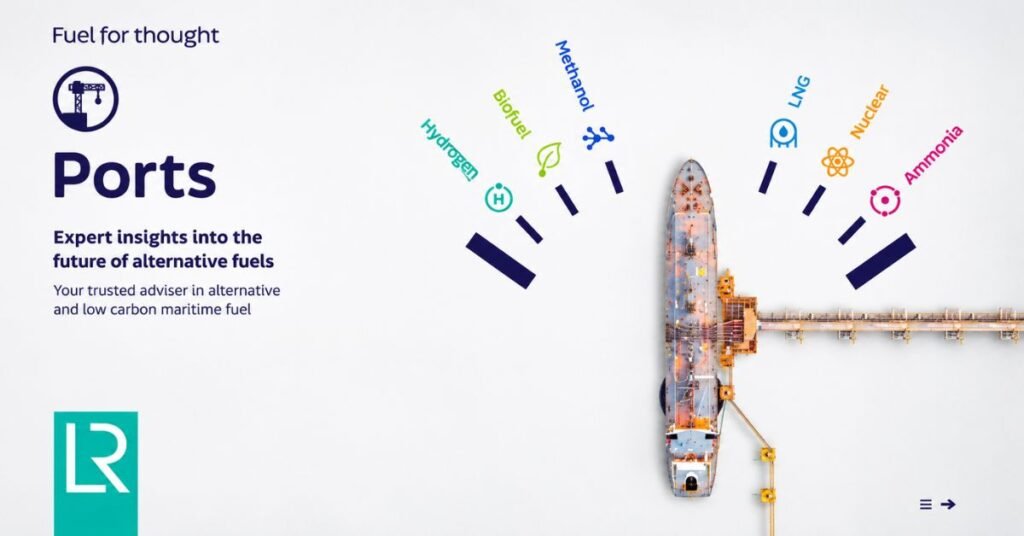
Ports worldwide are assessing infrastructure, safety requirements and investment priorities as the maritime industry moves towards the adoption of alternative fuels, according to a new report from Lloyd’s Register (LR).
The latest edition of LR’s Fuel for Thought series examines how ports are preparing to support multiple fuel pathways, including liquefied natural gas (LNG), methanol, ammonia, hydrogen and biofuels. The report draws on findings from more than 25 ports across Europe, Asia, the Middle East and the Americas to assess the developments influencing port readiness.
As shipowners expand investments in alternative-fuel-capable vessels, the availability of shoreside infrastructure is becoming an important factor in the pace of maritime decarbonisation. Ports will need to develop the capacity to store, handle and supply new fuels while addressing the associated safety, regulatory and operational requirements.
The report examines how demand for alternative fuels is developing across different vessel segments and geographical regions. It also considers the infrastructure requirements for fuel storage and bunkering, alongside the workforce training and emergency-response capabilities needed to handle fuels with different safety characteristics.
Regulatory developments and compliance requirements are another focus, particularly as port authorities and terminal operators evaluate investment decisions amid uncertainty over which fuel pathways will gain wider adoption. The report also examines the role of digitalisation, data management and operational preparedness in supporting the development of alternative-fuel infrastructure.
With several fuel options developing simultaneously, ports face decisions over which technologies and infrastructure to prioritise. Investments made too early or without sufficient demand visibility could result in underutilised or stranded assets, while delayed investment could affect a port’s ability to serve vessels adopting alternative fuels.
To address these considerations, the report introduces a port readiness framework intended to help stakeholders assess existing capabilities, identify infrastructure gaps and establish investment priorities. It provides a structured approach to evaluating the requirements for supporting different fuel pathways and developing longer-term port strategies.
Beyond biofuels, LNG, methanol, ammonia and hydrogen, the report also considers the evolving role of ports in relation to nuclear-powered shipping. Its findings highlight the importance of coordination between port authorities, terminal operators, shipowners, fuel suppliers, investors and policymakers as the industry develops the infrastructure required for a multi-fuel future.
The report identifies port readiness as a key consideration for maritime’s energy transition, with infrastructure availability, safety arrangements, regulatory compliance and investment planning likely to influence port competitiveness over the coming decade.
The report is available for download through Lloyd’s Register.
Ports are preparing for the maritime fuel transition by investing in alternative-fuel storage and bunkering infrastructure, strengthening safety and emergency-response frameworks, addressing regulatory requirements and developing investment strategies for fuels such as LNG, methanol, ammonia, hydrogen and biofuels.
SOURCE : Lloyd’s Register
Recent Posts
Technology
ClassNK Updates Ship Cyber Security Guidelines to Align with Major Vetting Schemes
Marine
Lloyd’s Register Report Examines How Ports Worldwide Are Preparing for Maritime Fuel Transition
Methanol
OOCL Grace takes on 983 tonnes of green methanol at Yantian