
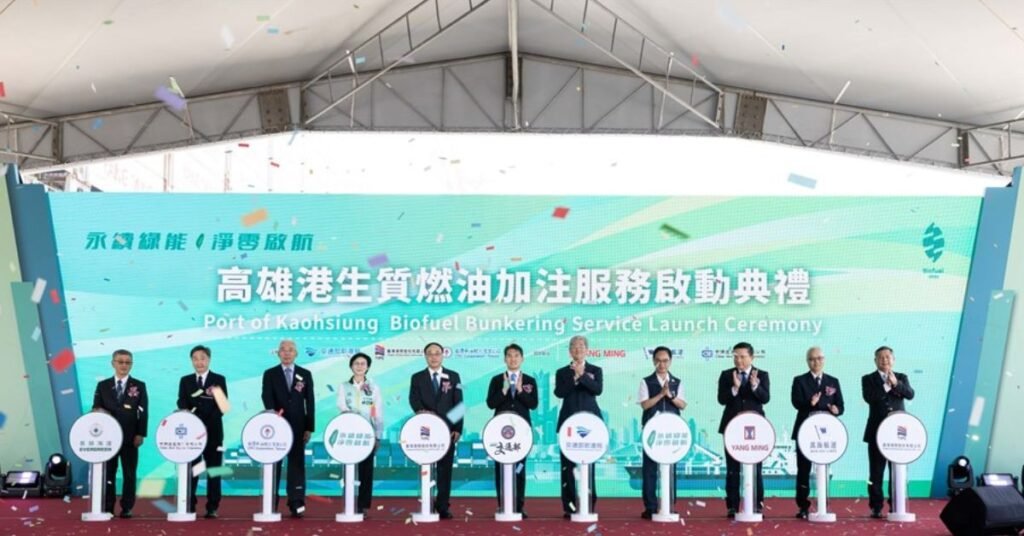
Taiwan International Ports Corporation (TIPC) has launched biofuel bunkering at the Port of Kaohsiung, establishing the first stage of a broader programme to develop alternative marine fuel services across its commercial ports. Vessels operated by Yang Ming Marine Transport, Wan Hai Lines and China Steel Express had collectively received 1,200 tonnes of biofuel by the service’s formal launch on 5 October 2026.
In a November update, TIPC outlined plans to extend biofuel supply to other ports while developing capabilities for liquefied natural gas (LNG), methanol and, over the longer term, ammonia and hydrogen. The programme responds to shipping companies’ changing fuel requirements and Taiwan’s maritime decarbonisation objectives.
How has Kaohsiung’s biofuel service been established?
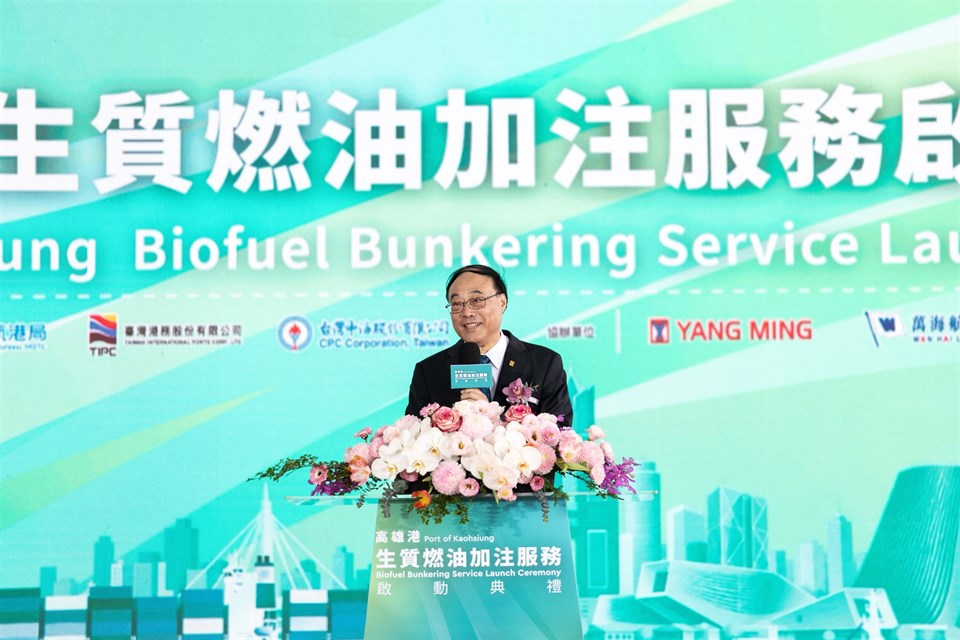
The launch ceremony took place at Kao Ming Container Terminal in Kaohsiung’s Sixth Container Terminal, with representatives from the Ministry of Transportation and Communications, the Maritime and Port Bureau, TIPC, CPC Corporation and shipping companies.
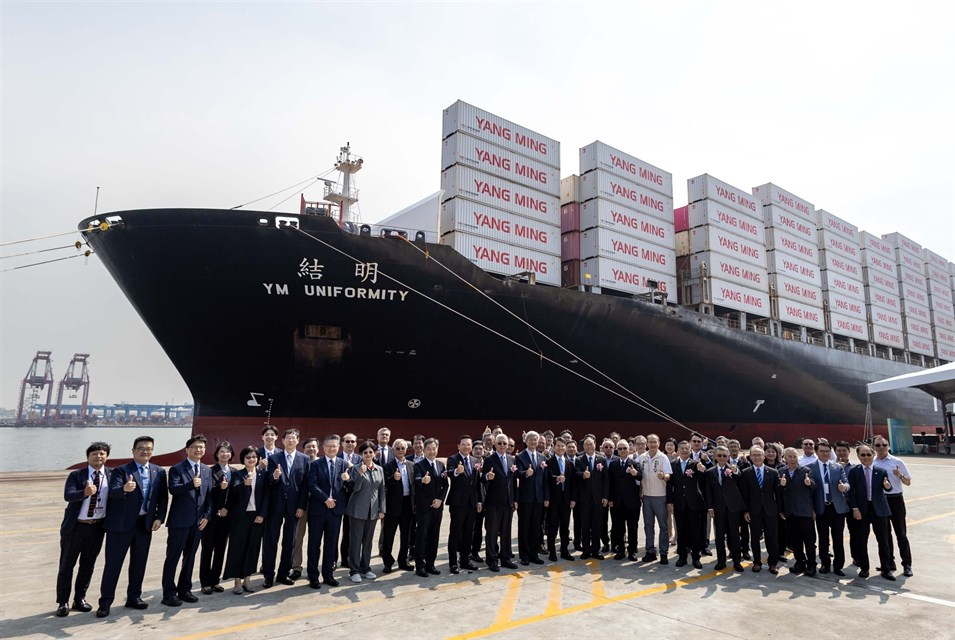
During the event, Yang Ming’s YM Uniformity received marine biofuel and connected to shore power while berthed. The combination addressed fuel-related emissions during vessel operations and reduced reliance on onboard generators during the port stay.
TIPC awarded the initial biofuel bunkering bids to CPC Corporation and Chant Oil Company following a September 2026 tender. The port operator had announced its alternative-fuel bunkering strategy in 2023, selecting Kaohsiung for the initial rollout.
What fuel is available to ship operators?
Ahead of the launch, CPC specified a B24 product containing 24% biofuel and 76% low-sulphur marine fuel, designated LSMF-180, with a maximum sulphur content of 0.5%.
The September announcement scheduled deliveries to begin in October, giving ship operators a defined product and supply timetable before the service’s inauguration. Kaohsiung, on Taiwan’s south-western coast, provides the initial location for this supply offering.
CPC supplies the biofuel used in the initiative and holds International Sustainability and Carbon Certification for the European Union, known as ISCC EU. The government’s launch announcement said CPC could provide carbon-footprint traceability and sustainability documentation to support shipping companies’ emissions reporting.
How does the service support shipping companies’ fuel strategies?
Yang Ming’s participation builds on an existing biofuel programme. The carrier began using sustainable biofuels in 2024 and reported introducing them across 45 operating vessels in 2025.
Its sustainability disclosures identify ISCC-certified B24–B30 blends as part of its lower-carbon transport offering. Yang Ming reports approximately 20% lower carbon emissions for these fuels compared with conventional marine fuels on a well-to-wake lifecycle basis.
That distinction is important: the reported benefit considers the fuel’s production and use, rather than treating a biofuel blend as having no emissions during combustion. The carrier also combines fuel changes with vessel efficiency improvements and shore-power installations.
What is planned for LNG and other marine fuels?
TIPC is planning connections to support LNG bunkering using CPC’s seventh LNG terminal at Kaohsiung, which it expects to enter regular operation in 2029. Discussions with CPC also cover potential supplies before that date.
Methanol forms another development priority, while ammonia and hydrogen services remain dependent on demand and technological readiness. TIPC says the stages are flexible rather than a fixed sequence.
The port’s longer-term plans include a New Energy Industrial Zone on reclaimed land for alternative marine fuel activities. Expansion beyond Kaohsiung will reflect each port’s requirements and the development of supporting fuel supply chains.
Recent Posts
Ammonia
Waaree proposes ₹15,000-crore green ammonia plant with 1.2 million-tonne capacity near Kakinada Port
Marine
Kongsberg Maritime introduces independent brand identity after Oslo listing
Technology
Lloyd’s Register adds AI readiness and LNG benchmarks to Digital Maturity Index