
Hong Kong and Greece’s Port of Piraeus have signed a memorandum of understanding (MoU) to establish Hong Kong’s first green shipping corridor, creating a framework for cooperation on maritime decarbonisation between Asia and Europe.
Announced on 16 November 2026 during Hong Kong Maritime Week, the agreement also establishes a partner-port relationship. Chief Executive John Lee presented the initiative at the opening ceremony and World Maritime Merchants Forum, alongside measures to develop Hong Kong’s green maritime fuel supply and trading capabilities.
What does the Hong Kong–Piraeus agreement establish?
The agreement formalises cooperation between the two ports to develop a green shipping corridor. Lee described it as a step towards reducing emissions along major shipping routes connecting Asia and Europe.
The government’s announcement confirms the corridor agreement and partner-port status. It does not specify participating vessels, committed fuel volumes, quantified emissions targets or a date for the first corridor voyage. The signing therefore establishes the cooperation framework, rather than demonstrating that a dedicated low-emission shipping service is already operating.
How will mainland partnerships support fuel supply?
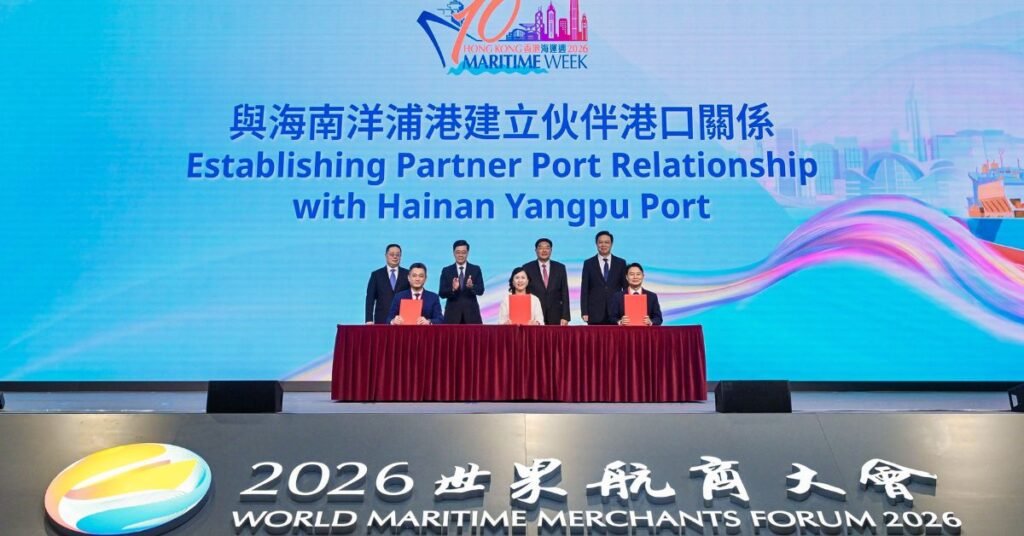
Hong Kong announced two additional port agreements at the same event. An MoU with Yangpu Port in Hainan establishes a partner-port relationship, while an agreement with Zhanjiang in Guangdong provides for Hong Kong’s first green energy corridor.
The Zhanjiang initiative is intended to connect green fuel production in mainland China with Hong Kong and international maritime markets. It complements the Piraeus agreement by addressing the supply-chain side of the transition, alongside cooperation on shipping routes.
Secretary for Transport and Logistics Mable Chan said the agreements supported international green shipping cooperation, regional port development and higher-value maritime services.
What is planned for green fuel trading?
Hong Kong has formed a Task Group on the Development of the Green Fuel Trading Platform. Industry experts will advise on its strategic direction, infrastructure and operating arrangements.
Lee said the objective was to expand beyond physical bunkering into a market-driven, internationally oriented fuel-trading platform. The Transport and Logistics Bureau also signed five MoUs with industry partners at a maritime and logistics luncheon on 16 November to support this work.
The initiative builds on a Green Maritime Fuel Development Communication Platform established in November 2025. That earlier platform was designed to bring stakeholders together, gather industry views and facilitate business connections across the bunkering supply chain.
How does the corridor fit Hong Kong’s longer-term strategy?
Hong Kong’s First Five-Year Plan for 2026–2030 targets the establishment of five green energy corridors by 2030. The strategy envisages linking mainland production, storage and transport capabilities with bunkering and trading services in Hong Kong.
These energy corridors are intended to strengthen fuel availability and commercial connections. They form a related but distinct part of the strategy from the green shipping corridor agreed with Piraeus.
Physical infrastructure is also being planned. The 2026 Policy Address states that planning applications and other statutory procedures for green maritime fuel storage facilities at Tsing Yi South are to begin in 2027, with tenders expected in early 2028. The government also intends to facilitate new storage capacity and the conversion of existing oil tanks.
The Piraeus pact adds an international port partnership to this programme. Its operational significance will become clearer as the partners define fuel arrangements, vessel participation and implementation milestones.
Recent Posts
Marine
Clean Shipping Alliance seeks risk evidence behind Greenland’s scrubber discharge restrictions
EV
Lloyd’s Register adds FIRE (EV) notation to strengthen vehicle-carrier fire protection
Policy
Hong Kong and Piraeus sign green shipping corridor pact to support Asia–Europe decarbonisation