
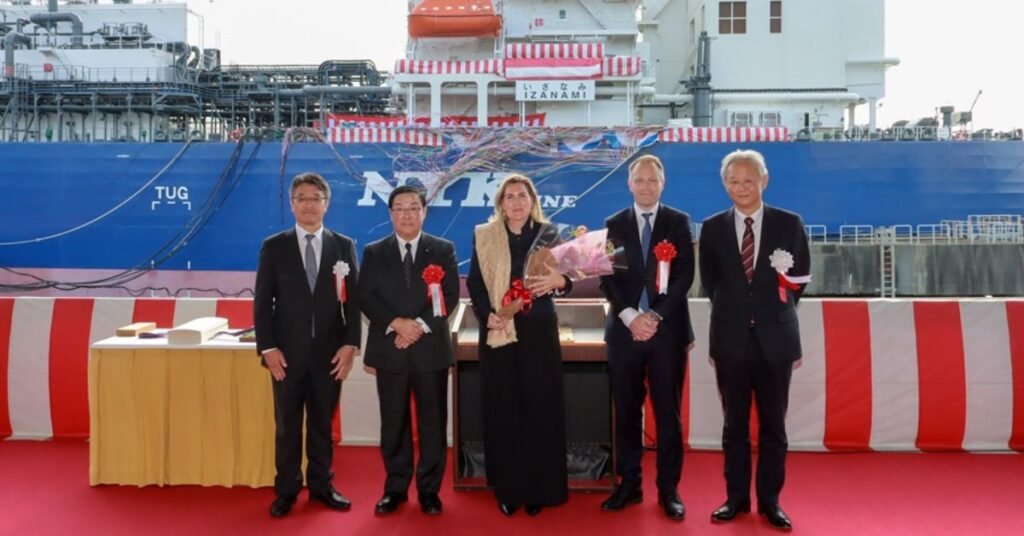
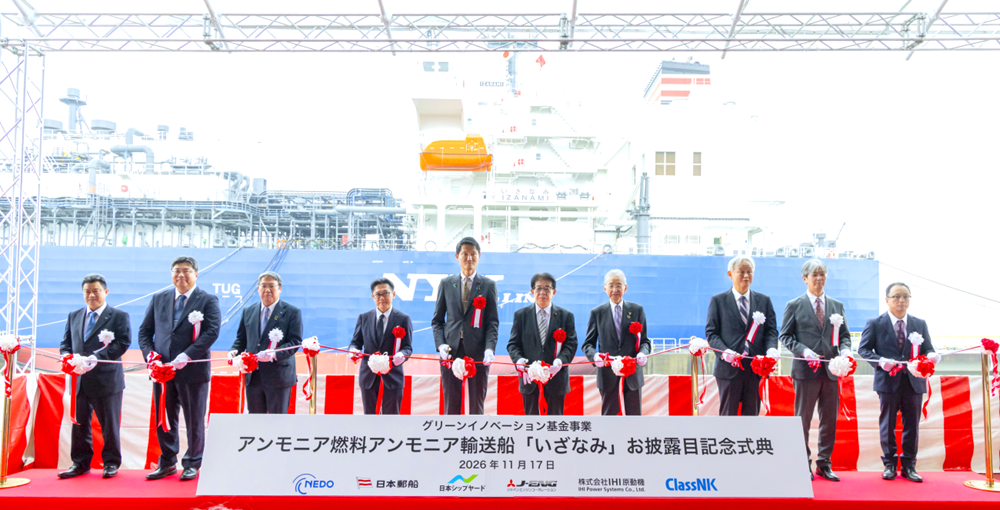
NYK has unveiled Izanami, a newly built ammonia-fuelled medium gas carrier that will undertake demonstration voyages under a time charter to Yara Clean Ammonia Switzerland SA. Presented on 17 November 2026 at Japan Marine United Corporation’s Ariake Shipyard in Kumamoto Prefecture, the vessel is described by NYK as the world’s first equipped with ammonia-fuelled main and auxiliary engines.
The unveiling marks the transition of a Japanese public-private development project towards operational demonstration. Following delivery, the vessel will be used to assess performance, safety and greenhouse gas emissions reductions under actual trading conditions.
What distinguishes Izanami’s propulsion system?
Izanami combines an ammonia-fuelled dual-fuel two-stroke main engine manufactured by Japan Engine Corporation with ammonia-fuelled dual-fuel four-stroke auxiliary engines supplied by IHI Power Systems.
The main engine provides propulsion by driving the propeller, while the auxiliary engines power generators supplying electricity to the ship. The installation therefore extends ammonia use beyond propulsion to onboard power generation.
Ammonia produces no carbon dioxide when burned and can be stored and transported as a liquid. However, the vessel’s overall greenhouse gas reduction performance remains a subject for verification during its demonstration voyages. NYK has not announced a quantified reduction result for Izanami in the latest release.
What are the vessel’s specifications?
The Japanese-flagged carrier has approximately 40,000 cubic metres of cargo capacity. It measures 180 metres in overall length, 32 metres in breadth and 18.45 metres in moulded depth.
NYK President Takaya Soga named the ship at a ceremony on 6 November at the Ariake yard. Approximately 40 people attended, including representatives of Yara Clean Ammonia Switzerland SA.
The name derives from Izanami-no-Mikoto, a deity associated with the formation of Japan’s islands. NYK selected it to reflect the project’s ambition to introduce a new generation of marine energy technology from Japan.
How will the Yara charter support operational testing?
After delivery, Izanami will be time-chartered to Yara Clean Ammonia Switzerland SA, part of Yara International ASA.
Demonstration voyages during the charter will examine the vessel’s operating performance, safety and greenhouse gas reduction effects. Findings will inform the development and operation of subsequent ammonia-fuelled ships.
The announcement does not specify the delivery date, charter duration or trading routes. It confirms that operational verification will take place during the charter, following the development and construction stages.
Which organisations developed the vessel?
NYK, Japan Engine Corporation, IHI Power Systems and Nihon Shipyard were selected in October 2021 for a next-generation vessel project supported by the New Energy and Industrial Technology Development Organization (NEDO).
Working with classification society ClassNK, the partners developed vessels using ammonia-fuelled engines manufactured in Japan.
The work falls under NEDO’s Green Innovation Fund, established by Japan’s Ministry of Economy, Trade and Industry with an initial ¥2 trillion allocation. The programme provides support for up to ten years, covering research, development, demonstrations and commercial implementation of technologies contributing to carbon neutrality.
Approximately 100 project participants attended the 17 November unveiling. Guests included Kentaro Asahi, vice-minister of Land, Infrastructure, Transport and Tourism, and House of Representatives member Yasushi Kaneko.
How does Izanami build on NYK’s ammonia experience?
The same development programme also supported Sakigake, which NYK describes as the world’s first commercially operated ammonia-fuelled vessel. The tugboat was completed in August 2024 and has continued commercial operations.
Izanami takes the programme into gas-carrier operations, with ammonia-fuelled machinery serving both propulsion and electricity generation. Its demonstration results will provide practical evidence for future vessel designs and operating procedures as the partners work towards wider deployment of ammonia as a marine fuel.
Recent Posts
Methanol
Zhejiang Ocean University plans 1,000-cubic-metre methanol bunker vessel design tender
Fuels
Green fuel contracts set to widen liner shipping cost differences, says Hapag-Lloyd
Marine
Shipping groups urge IMO to align net-zero rules with fuel costs and availability