
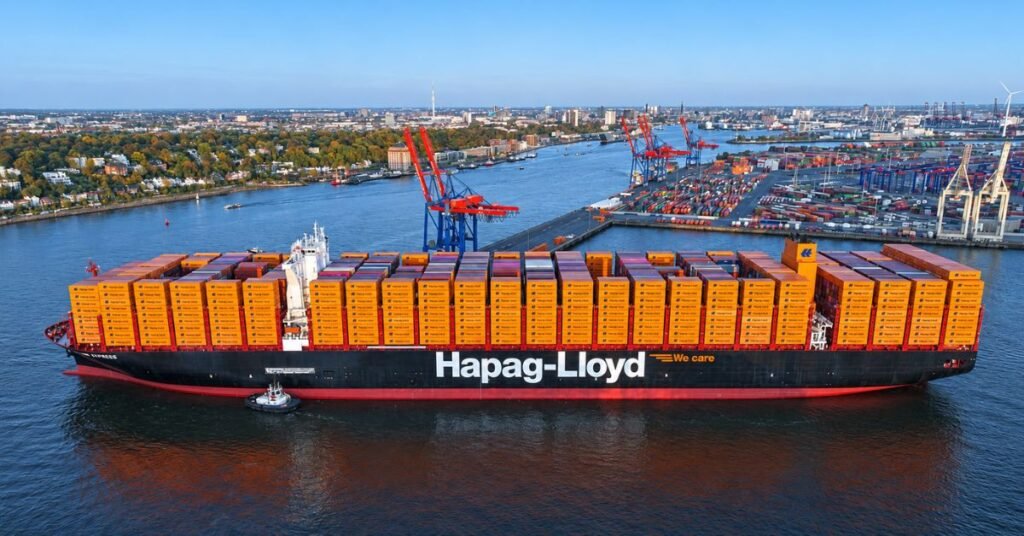
Container shipping lines could face increasingly different bunker costs as their fuel choices and long-term supply commitments diverge, according to Jan Christensen, Senior Director, Global Fuel Sourcing at Hapag-Lloyd.
Speaking at the International Bunker Industry Association (IBIA) Annual Convention in New York, Christensen said average bunker prices among competing carriers had historically differed by only $5–10 per tonne. He expects larger differences as companies adopt different fuel mixes and levels of contractual risk.
“It becomes not just a tactical thing now, but also very strategic,” he said.
Why do long-term fuel contracts create risk?
Christensen said Hapag-Lloyd had signed a 15-year green methanol offtake agreement before it had demand for the fuel. Customer contracts typically last one or two years, leaving the carrier exposed over a much longer purchasing period.
He also highlighted the absence of a liquid green methanol market through which that exposure could be hedged.
The challenge is compounded by geopolitical disruption, which can change vessel routes and refuelling requirements at short notice. Carriers must therefore balance long-term supply commitments with operational flexibility and uncertain customer demand for lower-emission transport.
What methanol supply has Hapag-Lloyd secured?
Hapag-Lloyd announced an agreement with China’s Goldwind in November 2024 for annual deliveries of 250,000 tonnes of green methanol.
The contracted fuel comprises bio-methanol and e-methanol. At the announcement, the carrier said it would meet applicable sustainability certification requirements and deliver greenhouse gas emissions reductions of at least 70%.
Hapag-Lloyd estimated that the contracted volume could avoid up to 400,000 tonnes of carbon dioxide equivalent annually compared with conventional fuels. These were projected benefits, rather than reported operating results.
The supply agreement was linked to its strategy of using several alternative fuels. Intended consumers included five chartered vessels of 10,100 twenty-foot equivalent units each, which Hapag-Lloyd and Seaspan planned to convert to methanol dual-fuel propulsion.
Goldwind’s supply plans included a new production facility alongside its existing project in Hinggan League, China, with early deliveries scheduled for 2026. The announcement connected fuel procurement with both production investment and vessel conversion, illustrating the multiple commitments involved in establishing a new marine fuel supply chain.
How does biomethane fit the carrier’s fuel strategy?
Hapag-Lloyd has also secured renewable fuel for vessels equipped to use liquefied natural gas (LNG).
In September 2025, it signed a multi-year liquefied biomethane supply agreement with Shell Western LNG, with deliveries beginning immediately. The arrangement built on a collaboration established in 2023.
At the time, Shell said liquefied biomethane was available at 22 locations within its global LNG bunkering network. Hapag-Lloyd identified supply reliability and access to waste-based renewable fuels as principal reasons for the agreement.
The fuel can be used by LNG dual-fuel vessels without equipment modifications. Its production pathway uses organic waste, with biogas upgraded by removing carbon dioxide and impurities.
The agreement provides for certified supply on a mass-balance basis. Certification addresses feedstock sustainability, traceability and verified lifecycle emissions reductions. This offers a different deployment route from methanol, where compatible propulsion and fuel-handling systems are required.
What does this mean for liner competition?
Christensen’s comments suggest that fuel procurement decisions will increasingly influence carriers’ relative operating costs over several years. Access to supply, contract duration and customer commitments will matter alongside the price paid for an individual bunker delivery.
Hapag-Lloyd’s methanol and biomethane agreements demonstrate how those decisions are already being made across different technologies. They support its stated ambition of net-zero fleet operations by 2045, while creating commercial obligations that extend beyond normal customer contracting cycles.
Recent Posts
Methanol
Zhejiang Ocean University plans 1,000-cubic-metre methanol bunker vessel design tender
Fuels
Green fuel contracts set to widen liner shipping cost differences, says Hapag-Lloyd
Marine
Shipping groups urge IMO to align net-zero rules with fuel costs and availability