
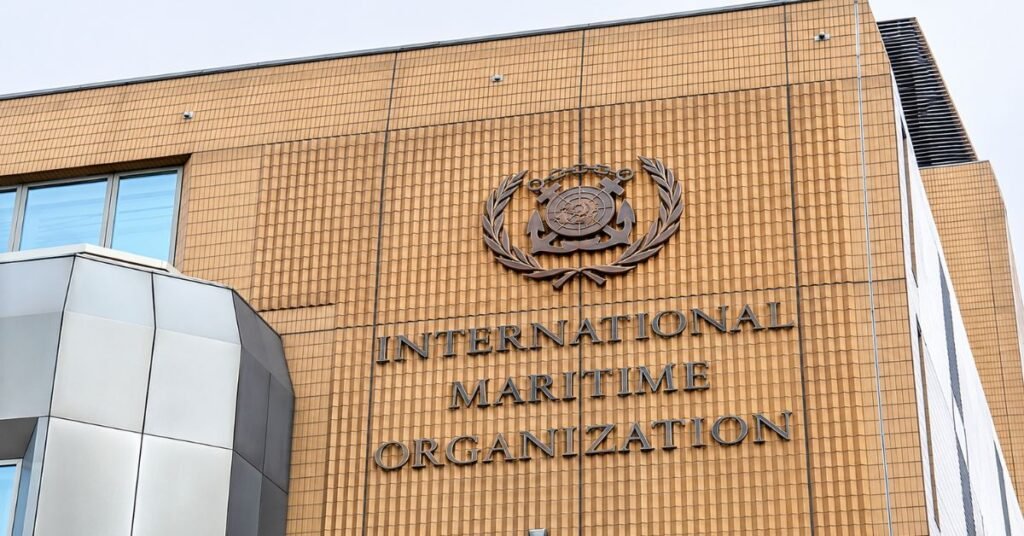
Nine international shipping associations have urged governments to agree global emissions rules that reflect alternative fuel costs and availability, ahead of negotiations at the International Maritime Organization (IMO) in London. Their joint statement, issued on 18 November 2026, calls for regulatory certainty to support investment in shipping’s energy transition.
The signatories include the Baltic and International Maritime Council, Cruise Lines International Association, International Bunker Industry Association, International Chamber of Shipping, International Association of Dry Cargo Shipowners, Interferry, International Association of Independent Tanker Owners, International Parcel Tankers Association and World Shipping Council.
What changes does the shipping industry want?
The associations want enforceable, technology-neutral regulations that reward verified emissions reductions and offer flexible compliance options. They argue that commercially viable zero or near-zero greenhouse gas (GHG) fuels and technologies remain unavailable to much of the existing fleet.
They also seek equal treatment across flags, ownership structures and trades, without overlapping national or regional requirements imposing multiple charges on the same emissions.
Their statement acknowledges that competing government proposals remain under consideration. It calls for agreement that supports investment decisions by shipowners, fuel producers, charterers, ports and financiers.
When will IMO negotiations resume?
The IMO’s Marine Environment Protection Committee will hold its 85th session, known as MEPC 85, from 30 November to 3 December 2026. An intersessional working group on shipping emissions will meet beforehand, from 23 to 27 November.
A resumption of the committee’s second extraordinary session is provisionally scheduled for 4 December, subject to confirmation by MEPC 85.
The committee will examine the outcomes of the September and November working group meetings and consider ways to resolve outstanding concerns over the proposed regulations. Its agenda also includes further development of the framework for assessing marine fuels’ lifecycle emissions.
What would the Net-Zero Framework regulate?
The draft IMO Net-Zero Framework combines a global marine fuel standard with an emissions-pricing mechanism. The fuel standard would progressively reduce permitted GHG emissions per unit of energy, while the pricing component would support compliance and encourage cleaner fuel use.
Assessment would cover emissions throughout a fuel’s lifecycle, including production, transportation and onboard consumption. This approach accounts for carbon dioxide, methane and nitrous oxide, rather than measuring exhaust emissions alone.
The draft targets oceangoing ships above 5,000 gross tonnage, which the IMO says account for more than 85% of global shipping emissions.
Although the draft was approved in April 2025, formal adoption remains outstanding. The extraordinary session convened in October 2025 adjourned for a year. Approval of draft text therefore does not mean the requirements are already legally binding.
Why do fuel certification and traceability matter?
Preparatory work has extended beyond the proposed emissions limits and charges. IMO working groups have developed draft provisions for calculating, verifying and reporting fuel emissions, alongside requirements for recognising sustainable fuel certification schemes.
Discussions have also covered how to trace fuels through supply chains and determine rewards for zero or near-zero emission technologies. These technical provisions are intended to support consistent measurement and implementation of any eventual agreement.
Which emissions targets guide the negotiations?
The IMO’s 2023 strategy seeks net-zero GHG emissions from international shipping by or around 2050. Its interim checkpoints call for reductions of at least 20%, striving for 30%, by 2030, and at least 70%, striving for 80%, by 2040, against 2008 levels.
It also aims for zero or near-zero emission technologies, fuels and energy sources to supply at least 5%, striving for 10%, of international shipping’s energy by 2030. The forthcoming negotiations concern the regulatory measures needed to advance those ambitions.
Recent Posts
Methanol
Zhejiang Ocean University plans 1,000-cubic-metre methanol bunker vessel design tender
Fuels
Green fuel contracts set to widen liner shipping cost differences, says Hapag-Lloyd
Marine
Shipping groups urge IMO to align net-zero rules with fuel costs and availability