
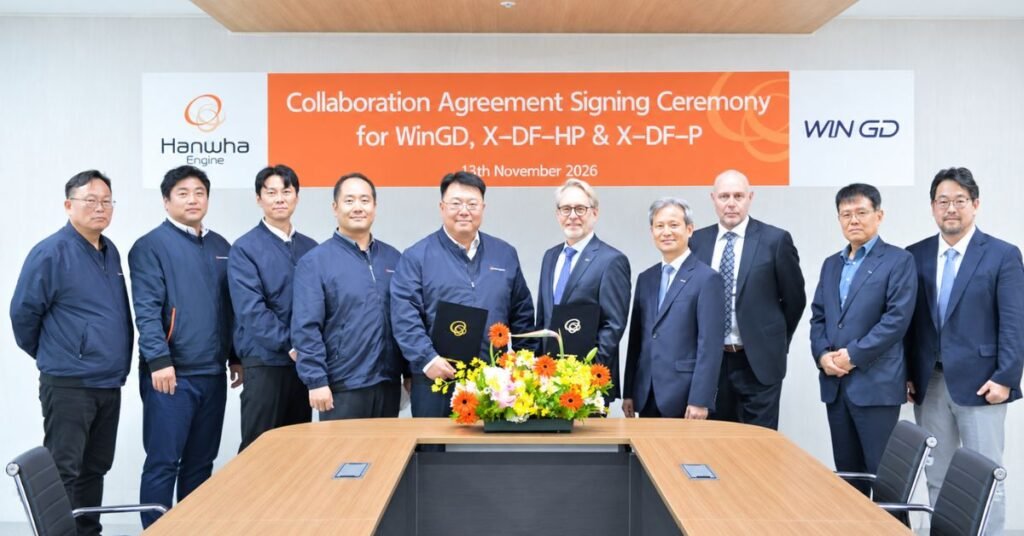
WinGD has signed a collaboration agreement with South Korea’s Hanwha Engine to prepare new dual-fuel marine engines for production and commercial deployment. The partnership focuses on propulsion systems for large container ships and gas carriers, supporting shipowners considering different fuel options for new vessels.
Signed at Hanwha’s manufacturing facility in Changwon on 13 November and announced on 19 November 2026, the agreement covers WinGD’s X-DF-HP high-pressure liquefied natural gas (LNG) engine and X-DF-P liquefied petroleum gas (LPG) engine concept.
What does the collaboration cover?
The companies will cooperate on individual engine projects and associated technical requirements. They will also discuss requirements for LNG carrier newbuildings using WinGD’s X72DF-2.2 engine.
The X-DF-HP is aimed at large container ship newbuildings, while the X-DF-P is suited to very large gas carriers. Both designs use established vessel interfaces intended to simplify installation and commissioning.
Hanwha Engine’s Head of Engine Business, Changho Hong, said the cooperation would broaden the propulsion choices available to shipyards and owners and help match engines to customer requirements.
The announcement establishes a framework for technical cooperation. It does not disclose a specific engine order, contract value or vessel delivery programme.
When will the new engine platforms become available?
WinGD’s published product information identifies 2028 as the expected start of deliveries for its X-DF-HP engines. The platform extends the company’s LNG offering into high-pressure technology for ultra-large container ships.
It forms part of a wider dual-fuel portfolio that has developed from WinGD’s low-pressure LNG engines, which entered operation in 2016. The portfolio now includes designs for ammonia, methanol, ethanol and LPG, alongside high-pressure LNG.
These dates describe the engine designer’s product programme rather than a delivery commitment announced under the Hanwha agreement.
For the LPG platform, WinGD currently lists first engine deliveries from the end of 2027. The engines are intended to give LPG and ammonia carrier operators flexibility to align their propulsion fuel with the cargo trades they serve.
How does the LPG engine support a later fuel change?
The X-DF-P shares its platform and fuel-injection concept with WinGD’s X-DF-A ammonia engine. According to the designer, it can initially operate on LPG and subsequently be adapted for ammonia through a minor modification.
WinGD lists both X52DF-P-1.0 and X62DF-P-1.0 models using this approach. The shared architecture is intended to preserve a future fuel-conversion option for owners ordering vessels before their longer-term trading requirements are settled.
The design therefore gives operators a route between LPG and ammonia propulsion, although any vessel conversion would still need to address the ship’s wider fuel-storage, supply and safety arrangements.
What development work supports the ammonia platform?
WinGD reported a further ammonia-engine testing milestone in April 2026, when an X52DF-A-1.0 built by Yuchai Marine Power underwent testing in the presence of China Classification Society.
That engine was intended for the first of four LPG/ammonia carriers being built for Tianjin Southwest Maritime at CSSC Huangpu Wenchong Shipbuilding in China.
In its subsequent announcement, WinGD reported an orderbook exceeding 30 X-DF-A engines across gas carriers, bulk carriers, tankers and container vessels. This development programme provides the technical foundation for the related LPG engine concept now included in the Hanwha collaboration.
Recent Posts
Marine
Lloyd’s Register approves nuclear classification framework for ships and offshore units
Marine
IGFA forms three committees to support Hong Kong’s green marine fuel market
Methanol
Fratelli Cosulich lays keel for final tanker in four-vessel methanol-ready programme